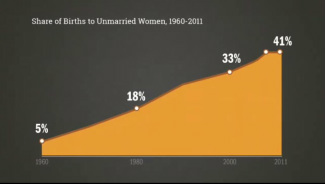
 In 2011, 41% of children were born to unwed mothers. In 2011, 41% of children were born to unwed mothers.
Tags: abortion/reproduction, aging/life course, demography/population, marriage/family, cohabitation, divorce, millennials, 00 to 05 mins
Year: 2014 Length: 2:16 Access: YouTube Summary: A report from Pew Research Center confirms a familiar trend known to sociologists of the family: marriage is in decline. While in 1960 about 7 in 10 Americans over the age of 18 were married, by 2010 that rate had slipped to about 5 in 10. To those who see this trend as evidence that families are disappearing, the evidence appears even more grim once one examines the rate of decline among different age groups. In 1960, about 6 out of every 10 Americans between the ages of 18 and 29 tied the knot. Today, people in that age bracket have been dubbed millennials and far fewer of them are married—only about 2 in 10 in 2010. Not surprisingly, the difference in cohort marriage rates seems to be echoed in the difference between what those cohorts say about marriage. For instance, 44% of millenials agree with the sentiment that marriage is becoming obsolete, while only 32% of people over the age of 65 agree with that view. • While the proportion of people aged 18 to 29 who are reluctant to ever get married appears to be growing, it's important to note that many millennials are just waiting longer than ever to to do it. That is, the median age at first marriage in 1960 was 20 for women and 23 for men, but by 2013, the respective ages had increased to 23 for women and 29 for men. Accompanying this delay is the fact that people appear to be much more inclined to have children out of wedlock. • Nevertheless, it is true that the institution of marriage, as Americans once understood it, appears to be changing, and by nearly every measure it is fair to say it is in decline. But to those who see the foregoing discussion as further evidence that the American family is also in decline, or in the grips of a crisis, take a breath and consider the following. Familes existed long before the advent of marriage, so there is no logical reason to assume that they will cease to exist if marriage disappears. To peer into the future of marriage and family, one must analytically uncouple the two concepts: family can exist without marriage, and marriage can exist without family. What seems clear is that families are simply continuing to change, just as they have always changed. Unlike the nuclear family of the 1950s, there is no dominant family type which casts a long shadow on all the others. In a sense, families are persisting in spite of marriage. For even more information about demographic trends related to the family, check out our Pinterest page devoted to the topic. Submitted By: Lester Andrist
11 Comments
 When it comes to infidelity, does gender and biology matter? When it comes to infidelity, does gender and biology matter?
Tags: abortion/reproduction, biology, bodies, culture, emotion/desire, gender, sex/sexuality, biological determinism, infidelity, sociobiology, 06 to 10 mins
Year: 2008 Length: 6:21 Access: today.com Summary: This segment from the Today Show explores whether humans are “wired”—or, biologically predisposed—to cheat on their mates. The clip can be used to teach biological determinist perspectives of gender, and specifically those rooted in sociobiology. In short, biological determinism argues that the social world is predetermined by biological factors. Sociobiology stems from this tradition of thought, but focuses more specifically on genetic reproduction and evolutionary processes. Often relying on observations of animal behaviors to make claims about human behaviors, sociobiology argues that a fundamental human drive is to ensure genetic reproduction, and many human activities can be reduced to this drive. Using the case of infidelity, this video clip is helpful for shedding light on sociobiological explanations of gender difference. The segment opens with a sociobiological perspective, using Barash and Lipton's (2001) book The Myth of Monogamy as a point of reference. Here, the authors argue that monogamy is not natural; from an evolutionary standpoint, humans have a stake in having multiple sexual partners. Sexual promiscuity is prevalent throughout the animal kingdom, they argue, and humans are not exempt from the same biological urges that drive other animals to be promiscuous. After the opening segment (minute mark 2:17), host Meredith Vieira speaks with Jeffrey Kluger, TIME magazine’s science editor, and psychologist David Buss; the conversation quickly turns to a discussion of gender difference. Kluger represents a fairly classical sociobiological argument when he states: “Nature wants one thing, and what it wants are babies. It also wants lots of them. And it wants variety, because the greater the genetic variety, the greater the likelihood that the babies are going to survive into adulthood and do well.” Kruger goes on to assert that men will look for women who are young and fertile, and women look for men who are good providers, such as those who are rich and powerful. Buss introduces more socio-cultural elements into the discussion, such as strong social norms against cheating, and argues that both men and women feel attraction to others outside of their relationships. He also points to psychological pathologies, namely narcissism, as an explanation for infidelity, and draws attention to infidelity in a cross-cultural context where polygamy is common (that is, cultures where men are legally entitled to have multiple wives). Although Buss mostly draws upon socio-cultural explanations, he also suggests that biological impulses to be non-monogamous are a part of our “human nature.” Asked why men cheat more, Kruger draws upon biological and sociological arguments, arguing that: (1) biologically, men have the ability to breed more, and could conceivably breed offspring everyday; from this he argues that men are “tripwired" for infidelity; and (2) in a patriarchal society such as ours, men are more likely to be in positions of power and feeling entitled to be unfaithful. After screening the video, viewers can be encouraged to identify messages in the clip that cohere with, and deviate from, the sociobiological perspective. Viewers can also be encouraged to explore feminist and/or sociological critiques of biological determinism, such as those outlined in Carmen Schifellite’s (1987) essay, "Beyond Tarzan and Jane Genes: Towards a Critique of Biological Determinism.” Submitted By: Valerie Chepp  This video explains ebbs and flows in global population. This video explains ebbs and flows in global population. Tags: abortion/reproduction, demography/population, world population, 00 to 05 mins
Year: 2010 Length: 2:58 Access: YouTube Summary: Population growth is a difficult subject to explain to students. This is a great short video that explains some of the subtleties of global population increases simply and with some fun visuals (and even better sound effects). The video explains how the global population increased in size incredibly rapidly in recent history and offers some suggestions for why that increase is likely to slow in the coming years. The video discusses advances in medicine and agriculture as part of what's at work here: accounting for fewer deaths and longer lives. But, the video does not suggest any ways to stave off the number of births. While they do provide the UN project of 10 billion, they don't quite explain how and why population growth will slow. It's a great video to begin a conversation about demographic change and global population. But, it requires a discussion of dual forces at work: (1) social and technological advances that help keep more of us alive longer and (2) social and cultural factors that cause us to have fewer babies, in part—though not entirely—due to various social and technological advances. If births didn't slow down, it's likely we'd already have overfilled the beakers. Discussing the social and cultural forces that work to help people decide to have fewer babies is also part of this conversation and well worth exploring after the video. For other clips on The Sociological Cinema that explore the challenges associated with a world population of 7 billion, click here and here. Submitted By: Tristan Bridges  Scene from LA Times video, "The Challenge Ahead" Scene from LA Times video, "The Challenge Ahead"
Tags: abortion/reproduction, consumption/consumerism, demography/population, environment, food/agriculture, globalization, inequality, rural/urban, 06 to 10 mins
Year: 2012 Length: 5:12 Access: Los Angeles Times Summary: This short video, "The Challenge Ahead: Rising Numbers, Shrinking Resources," accompanies a five-part series from the Los Angeles Times and highlights the causes and consequences of the global population explosion. Demographers anticipate continued population growth driven by the reality that there are now 3 billion people on the planet under the age of 25, and about 1.2 billion of them are adolescents who are entering their reproductive years. Projections suggest that by 2050 there will be well over 9 billion people on the earth, and the video highlights many of the resource demands of this many people. For instance, Jonathon Foley of the Institute on the Environment asks, "how are we going to feed 9 billion people without trashing the planet?" and Joel E. Cohen notes that humans are currently consuming resources on planet earth as if the earth were about 50% more productive. The connection between consumption (and production) and population is also explored in Foley's 2011 Ted Talk, where he reports that the total area humans are currently using for agriculture is about the size of South America (16 million square kilometers), while the total area used as pasture and range land is about the size of Africa (30 million square kilometers). Humans are also currently using about 50% of Earth's fresh water, and of this share, about 70% is used for agriculture. But after connecting population growth to agricultural demands, it is only a short distance to discussions exploring the connections between population and environmental degradation, or even climate change. After all, as Foley also points out in his Ted Talk, agricultural activity is by far the largest contributor of greenhouse gases. Thus "The Challenge Ahead" is an excellent teaser for any introduction to the field of demography, and it can be used to spur discussion about the importance of the field for tackling some of the most formidable challenges of the twenty-first century. Note that The Sociological Cinema has previously recommended clips that explore problems associated with population (here, here, and here). Submitted By: Lester Andrist  Bollywood actor and filmmaker Aamir Khan Tags: abortion/reproduction, demography/population, gender, marriage/family, violence, domestic violence, gendercide, india, infanticide, patriarchy, sex ratio, subtitles/CC, 61+ mins
Year: 2012 Length: 64:29 Access: YouTube Summary: The cultural preference for sons in India and China is well known and widely discussed, and demographers observe that both countries have distorted sex ratios, due in part to a rise in sex selective abortions since the 1980s. According to estimates based on census and sample registration data, in mainland China the sex ratio stood at 120.6 boys per 100 girls in 2008, while it stood at 110.6 boys per 100 girls in India for 2006-2008. In some Chinese provinces and Indian states, the ratios are even higher than these national-level estimates. For instance, in Jiangxi, Anhui and Shaanxi provinces in China the sex ratios are 137.1, 132.2 and 132.1, respectively, and in India's northern states of Punjab, Haryana and Rajasthan, the sex ratios are 119.6, 118 and 114.9, respectively. This video is from the Indian television talk show Satyamev Jayate and takes on the issue of sex selective abortions in India. The video can be used to supplement discussions on distorted sex ratios. In particular, it can be used to highlight the domestic violence that often accompanies the preference for sons but tends to be neglected in the demographic literature, given its tendency to focus exclusively on numbers and trends. From about the 6:10 mark to about 19:30 minutes, the audience hears the testimony of two women who were coerced into having sex selective abortions and have faced considerable harassment from their husbands and in-laws for their failure to have sons. Instructors can further use the video to begin a discussion about how the problem of imbalanced sex ratios can be addressed. Since patriarchal notions that men are more valuable than women underlie the trend toward coerced sex selective abortion, a truly systemic approach will likely include an attempt to dismantle patriarchy itself. Submitted By: Manjistha Banerji  Tags: abortion/reproduction, aging/life course, biology, bodies, gender, health/medicine, lgbtq, marriage/family, science/technology, sex/sexuality, social construction, fatherhood, motherhood, parenting, pregnancy, stigma, transgender, subtitles/CC, 06 to 10 mins
Year: 2012 Length: 10:33 Access: Vimeo Summary: This video portrays the experiences and voices of various transgender parents and their families, which includes their decisions to become parents, reflections on what it means to be a parent, experiences of being a child of a transgender parent, the social stigma attached to being a transgender parent (and transgenderism in general), and experiences with various reproductive technology options. The video is excellent for illustrating the diversity of family structures and alternative gender arrangements, and would be useful in a class on sociology of the family, reproduction, gender, or sex and sexuality. People in the video highlight the hyper-gendered experience of pregnancy and parenting, thereby illustrating the social construction of these core features of the life course; this social constructivist perspective stands in contrast to common biological understandings of pregnancy and parenting. This video would pair well with Laura Mamo's Queering Reproduction: Achieving Pregnancy in the Age of Technoscience, as well as with GLAD's recently released book, Transgender Family Law: A Guide to Effective Advocacy, which can offer a nice framework for discussing some of the legal issues and advocacy strategies that transgender people encounter in a family law context. The video is also available with Spanish subtitles. Submitted By: Valerie Chepp Image by Kristian Dowling/Getty Images for Beatie  Tags: abortion/reproduction, discourse/language, gender, government/the state, inequality, contraception, feminism, fertility, slut-shaming, 00 to 05 mins
Year: 2012 Length: 2:44 Access: Hulu Summary: In this clip of Seth Meyers and Amy Poehler's classic sketch called "Really!?! with Seth & Amy," the comedic duo rails against the rash of recent politicos, who seek to restrict the ability of women to control their own fertility. Seth and Amy refer to the hearings held by a House Oversight Committee on religious liberty and insurance coverage for contraception on February 16th. In the hearings, representatives Carolyn Maloney (D-N.Y.) and Eleanor Holmes Norton (D-D.C.) accused Chairman Darrell Issa (R-Calif.) of manipulating committee rules to block women from testifying as witnesses. Seth and Amy also mention Foster Friess (a major donor to the super PAC backing Rick Santorum's presidential campaign), who recently joked in an interview on MSNBC about contraception. "Back in my days," Friess remarked, "The gals put [Bayer aspirin] between their knees, and it wasn't that costly." Not mentioned by Seth and Amy is Georgetown law student, Sandra Fluke's recent testimony before Congress in favor of contraceptive coverage. Political commentator, Rush Limbaugh, responded by calling Fluke a "slut" and a "prostitute," and he made her the following proposition: "So Miss Fluke, and the rest of you Feminazis, here’s the deal. If we are going to pay for your contraceptives, and thus pay for you to have sex, we want something for it. We want you to post the videos online so we can all watch." These recent news stories, many of which are touched on in Seth and Amy's comedy, illustrate the ambitions of men to continue to exercise power over the reproductive lives of women. In the first congressional hearing, the experiences of women were formally excluded from the congressional record. The remarks from Friess and Limbaugh, in contrast, amount to slut-shaming, which is a discourse that similarly attempts to control women's sexual lives. While the above comedy sketch may not be intellectually rich on its own, it works well as a means of broaching a discussion about why contraception is a feminist issue, and how formally controlling women's sexual behavior through law works in concert with informal controls, such as slut-shaming. Submitted By: Lester Andrist  Melissa Harris-Perry Melissa Harris-Perry Tags: abortion/reproduction, historical sociology, government/the state, politics/election/voting, theory, violence, weber, civil liberties, democracy, melissa harris-perry, social contract theory, states rights, thomas hobbes, 11 to 20 mins
Year: 2012 Length: 20:55 Access: msnbc Summary: The social contract refers to the individual's acceptance of some social rules and limitations in exchange for the protections and benefits from the state. The concept was initially developed in the philosophies of Thomas Hobbes and Jean-Jacques Rousseau; however, sociologist Max Weber further specified the social contract as it relates to violence by highlighting how all forms of political organization including democracy, entrust "the state" (e.g. government at all levels) as the only social institution that can legitimately use physical force. In this video, political scientist and pundit Melissa Harris-Perry applies this Weberian approach by arguing that the State of Virginia failed to force women to undergo an invasive procedure, known as a transvaginal sonogram, prior to having an abortion because social consensus concluded it was not a legitimate use of force (or even violence) by the government. In other words, the state was in breach of the social contract. For a similar discussion on the same political issue, Rachel Maddow explores the fringe pro-life movement’s use of illegitimate violence against abortion doctors in her full-length documentary, The Assassination of Dr. Tiller. Submitted By: Jason Eastman 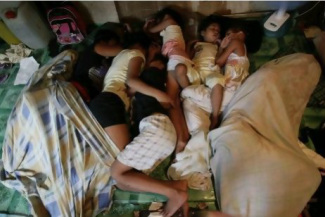 Children sleeping in a cramped shanty in a Manila slum / Reuters Children sleeping in a cramped shanty in a Manila slum / Reuters Tags: abortion/reproduction, class, demography/population, government/the state, inequality, political economy, philippines, poverty, fertility, contraception, 11 to 20 mins Year: 2008 Length: 12:26 Access: YouTube Summary: This news report from Al Jazeera English focuses on the growing population in the Philippines. "It's a population explosion," the reporter begins, "Every year two million babies are born in the Philippines." The report suggests that one important reason for the growth is the government's pronatal policies, and specifically, its failure to promote contraception. The clip highlights the role governments play in demographic realities and fertility in particular. The clip suggests connections between population growth and economic development and would work well in a class on demography or development. Submitted By: Lester Andrist  |
Tags
All
.
Got any videos?
Are you finding useful videos for your classes? Do you have good videos you use in your own classes? Please consider submitting your videos here and helping us build our database!
 |
 RSS Feed