 The latent vs. manifest functions of education. The latent vs. manifest functions of education.
Tags: art/music, children/youth, education, inequality, knowledge, adolescence, hidden curriculum, latent functions, manifest functions, pedagogy, performance poetry, spoken word, structural functionalism, youth studies, 00 to 05 mins
Year: 2014 Length: 3:46 Access: YouTube Summary: In this spoken word performance entitled “Somewhere in America,” three high school students share their experiences as youth in America’s educational system. The video can be used to illustrate features of the structural-functionalist perspective, and specifically how sociologists working within this framework—e.g., Emile Durkheim, Robert Merton, and Talcott Parsons—distinguished between the manifest and latent functions (and dysfunctions) of various social phenomena. Here, the teenagers discuss the functions and implications of the manifest versus latent curriculum, and how these two curriculums play out in the lives of children. The poets argue that the manifest curriculum, which is the content teachers are required to teach, is not what students remember most; rather, the girls suggest that the latent or hidden curriculum is the knowledge that becomes more deeply embedded in students’ memories and daily interactions. The hidden curriculum refers to the values, beliefs, and attitudes that are transmitted to students through the education system; a latent function of these hidden lessons is that these help to socialize young individuals to form a more “cohesive” society. In doing so, the views and values of the dominant culture are coached into the minds of young school-goers. Arguing that the biggest lessons in school “won’t come from a syllabus,” the words of these poets reinforce decades of social scientific research stating that schools go farther than simply advancing the academic success of children; schools also instill social and cultural ideas within students (for one prominent example, see Ann Arnett Ferguson’s research on the role of public schools in constructing Black masculinity). The group closes by saying, “The greatest lessons [in school] are the ones you don’t remember learning.” While we’ve chosen to highlight the structural-functionalist contours of the poem, viewers are encouraged to think about how the teens’ poem can be read through other foundational sociological lenses, namely, social conflict theory and symbolic interactionism. For example, the students’ attention to power inequalities that emerge from the education system resemble a social conflict approach. This supplementary video explaining the three foundational sociological perspectives and how they relate to education can help viewers with this analysis. Submitted By: Jordan Grier and Valerie Chepp
6 Comments
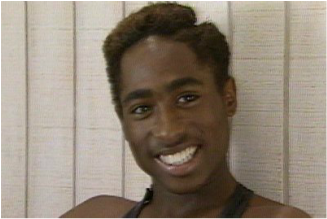 17-year-old Tupac Shakur reflects on society in this 1988 interview. 17-year-old Tupac Shakur reflects on society in this 1988 interview.
Tags: children/youth, class, education, inequality, intersectionality, race/ethnicity, social mvmts/social change/resistance, adolescence, sociology of youth, standpoint theory, youth studies, 21 to 60 mins
Year: 1988 Length: 35:39 Access: YouTube Summary: Scholars working within the interdisciplinary field of Youth Studies often highlight the limited ways in which youth and their unique lived experiences are portrayed in popular discourse and academic literature. For example, discourses around adolescent sex and sexuality—and specifically adolescent female sexuality—frequently rely on ideologies of fear, shame, and restraint (Fields 2008; Fine and McClelland 2006; Fine 1988). Andreana Clay (2012) points to the ways sociologists tend to focus on "deviant" behavior within youth culture: "By focusing on gangs or the consumption of fashion, music, and the media, scholars have pointed to a crisis among youth, particularly youth of color and working class youth. Recent attacks on affirmative action, increases in police brutality and racial profiling, and new anti-youth legislation have exacerbated this sense of crisis, urgency, and hopelessness among critics, community activists, scholars, and the youth themselves" (Clay 2012:3). Often missing from popular portrayals of youth and youth culture is a perspective that comes directly from youth themselves. • Filmed prior to his experience with stardom, in this 1988 interview, rapper Tupac Shakur (1971-1996) articulates his perspective on society, told from the standpoint of being a teenager, Black, and poor. Only 17-years-old at the time, the interview is full of wisdom and insight, as Tupac talks about various aspects of society from this unique intersectional vantage point. Prominent themes include his reflections on what it feels like to be a teenager growing up in the late 1980s, youth stereotypes, and the deep desire youth have for being respected. He provides context and nuance for why his generation seems angry, rebellious, and scared, pointing in part to the ways in which prior generations of adults have left behind a world in crisis that the younger generation must fix. He also critiques America's antiquated education institution, and how school curriculums fail to prepare his generation for today's world. Advocating for a more socially and intellectually relevant adolescent education, Tupac suggests classes on drugs, “real” sex education, scams, religious cults, police brutality, apartheid, American racism, poverty, and food insecurity. Using the example of foreign language education, Tupac underscores the irrelevancy of learning something like German (“When am I going to Germany?! I can hardly pay my rent in America!”) and the need for young people to learn the basics of English, as well as “politicians’ double talk.” Citing rising homicide, suicide, and drug abuse rates, Tupac provides a glimpse of his gift for poetry and incisive social commentary when he argues, “More kids are being handed crack than being handed diplomas.” He further advocates for his own unique perspective of society and its significance when he proposes that adults and youth, and rich and poor, temporarily switch roles, so that each group can understand and experience the others' realities. • Tupac concludes the interview talking about social change, and the role of youth within movements for change. Throughout the interview, Tupac reflects frequently on his mother, Afeni Shakur, who was an active member of the Black Panther Party in the late 1960s and early 70s. The influence of this political legacy is evident in Tupac's own political consciousness. Asked what he can do when he grows up, Tupac talks about the challenges of social change, and how the structures of society make change difficult. Using the metaphor of a maze of blocks in which mice roam, Tupac says, “Society is like that. They’ll let you go as far as you want, but as soon as you start asking too many questions and you’re ready to change, boom, that block will come." Tupac expresses his disillusionment with our political leaders and democratic process, but he also alludes to his own sense of hope, as he is actively engaged in political organizing around issues of safe sex and teen violence. At the time of the interview, he and his high school friends are trying to reinvigorate the Black Panthers' political efforts, particularly their vision around education and Black pride. Submitted By: Valerie Chepp 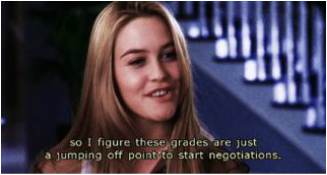 In the movie Clueless, self-mastery is a skill taught to rich kids. In the movie Clueless, self-mastery is a skill taught to rich kids.
Tags: children/youth, class, education, inequality, marriage/family, bourdieu, cultural capital, parenting, self-efficacy, self-mastery, socialization, status, 00 to 05 mins
Year: 1995 Length: 4:50 Access: YouTube Summary: Several generations of sociological researchers discovered parenting styles vary by social class. Post World War II, Melvin Kohn ([1969] 1977) found middle-class parents stress self-mastery and creativity in their children; working-class parents focus on instilling conformity and making their children obedient to authority. At the turn of the century, Annette Lareau’s ([2001] 2011) research found working-class parents focus on providing basic necessities for their children while largely leaving their kids alone to socialize themselves; middle- and upper-class parents focus on instilling self-mastery in their children, often through activities, constructive interactions with others, and the learning of making choices and actions to bring about desirable outcomes. More recently, Jessica McCrory Calarco (2014) found classed parenting styles influence education, as there is a positive relationship between class status and a student’s likelihood of taking a proactive role in their learning. These cross-class parenting styles and their influence on education is depicted in this edited clip from the movie Clueless (1995), where a wealthy and powerful father encourages his daughter to achieve high academic marks not through hard work and study, but through creative negotiation and maybe even the outright manipulation of teachers. According to generations of research on cross-class parenting styles, it would be unlikely working-class parents would emphasize negotiation as a life skill, perhaps because these fathers and mothers often feel powerless themselves. Thus, alongside the economic resources that are especially important to intergenerational mobility, middle- and upper-class parents also pass along a form of social capital to their child that offers advantages in modern workplaces that do not reward subordination to authority, but rather incentivize the ability to bend and manipulate authorities towards one’s own interests and desires. Submitted By: Jason T. Eastman  White savior films: who needs to be saved and why? White savior films: who needs to be saved and why?
Tags: children/youth, education, media, race/ethnicity, stereotypes, white savior complex, 06 to 10 mins
Year: 2015 Length: 9:54 Access: YouTube Summary: This short film flips the typical white savior teacher narrative and offers a counterpoint to the cliché of a white teacher who endures the perilous journey each day into the inner city in order to teach "at-risk," students of color. The Sociological Cinema has previously taken up the topic of the white savior complex in a pair of satirical videos poking fun at the Kony 2012 campaign (here and here) and in an essay about the film McFarland, USA. Along with a few guiding questions, this video would be useful as a writing prompt. Instructors could ask students to consider how one might successfully combat the stereotypes typically found in white savior films. What would a counter to those movies look like? White savior films like Dangerous Minds, which the above film references, are fueled by the idea that a group of people need to be saved. Who needs to be saved in Dangerous Minds, and why do they need to be saved? The above film can prompt broader discussions about the role played by media in perpetuating or challenging stereotypes. Finally, are white savior films racist? Why or why not? Check out this Pinterest board for even more examples of white savior films and white-centered media. Submitted By: Esteban Gast 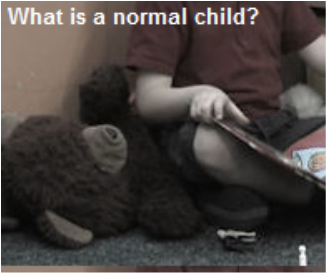 A combination of visual images, sound, and text provokes discussion. A combination of visual images, sound, and text provokes discussion.
Tags: children/youth, education, emotion/desire, psychology/social psychology, theory, philosophy, postmodernism, 11 to 20 mins
Year: 2010 Length: 16:20 Access: ESRC Summary: This unconventional and provocative film challenges viewers to reflect upon what constitutes problematic behavior in children. As described on the film's website, "it presents a thought-provoking collection of visual, sound, and text images drawn from a range of sources, including art, education, psychology, special education, policy documents, popular media, and philosophy. These materials are organized around 5 key themes: What counts as problem behavior?; What is a normal child?; Difficult Bodies; Parents; and Observing and Monitoring." The film "depart[s] from the usual didactic conventions of the educational film or the in-service training video and invit[es] a more open and critical engagement from audiences." Its organization and style reflect some of its postmodern influences (e.g. Gilles Deleuze), and have provoked interesting responses from viewers (which have been shared by the film's creators). For example, viewers have noted its highly "emotional" and "somber" tone that suggests how education "controls children"; but its open-ended nature encourages a very diverse range of responses. The film also has accompanying educational support materials, "which can be used for training and professional development purposes, [and] provides some questions to guide discussion and further activity." Submitted By: Rachel Holmes 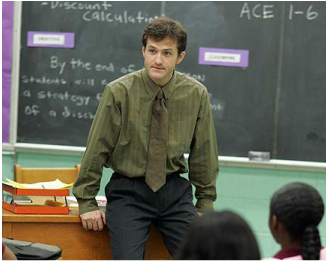 Unqualified teachers are much more likely in poorer schools. Unqualified teachers are much more likely in poorer schools.
Tags: children/youth, class, education, inequality, race/ethnicity, the wire, 00 to 05 mins
Year: 2006 Length: 1:31; 1:48 Access: YouTube clip 1; clip 2 Summary: Public education is meant to be the "great equalizer" and the cornerstone of the American Dream. But the reality is that the US has the greatest educational inequalities in the developed world, and in many ways, our educational system reproduces inequality rather than lessening it. These inequalities are largely rooted in how public schools are funded in the US. Most countries fund schools centrally and equally, but in the US, schools are largely funded through local property taxes and the wealthier your neighborhood, the wealthier the school (on average, wealthy schools spend 2-3 times more per pupil than poor schools). The impacts of these inequalities have been well documented in Kozol's (1991) classic study, Savage Inequalities, in more recent work (e.g. see "Structured for Failure: Race, Resources, and Student Achievement" by Linda Darling-Hammond, 2010); and they are illustrated throughout season 4 of The Wire. For example, schools in poorer districts cannot pay as high for teacher salaries and have a harder time attracting good teachers. In the first Wire clip above, the Principal and Assistant Principal discuss the teacher shortages that they have in science and math, and how the teachers took jobs in suburban schools. Roland Pryzbylewski (Prez) enters their office (after dealing with the schools' deteriorating infrastructure) in search of a job, and while he still lacks his teaching credentials, he is hired to teach math. Poor, low-achieving schools are five times as likely to have unqualified teachers, and this impacts teacher quality in the classroom (Darling-Hammond 2010). Schools in wealthier neighborhoods offer much higher salaries, more educational resources, and have fewer disruptive students, thus attracting better teachers to teach children from wealthier families. But the principals are happy to hear his past job was a police officer, given the severe behavioral issues Prez will face in the classroom. In the second clip, Bubbles helps his friend Sherrod return to school. Sherrod stopped attending school in the 5th grade, and is now 13 years old, which is a typical age for an 8th grader. But due to a lack of resources for students to repeat grade levels and a view that if they place the older children in the younger classes, "it us unfair to teachers, who are responsible for maintaining order." Accordingly, Sherrod will start off attending the 8th grade. This policy of "social promotion" effectively guarantees that Sherrod will not be prepared for the academic material taught in class. These types of inequality are also much more likely to impact students of color. Viewers would also be interested in this experiment on Oprah, where students from poor inner-city school traded places with a wealthy suburban school, which reinforces the examples above. You can also view other clips from The Wire that are useful for teaching sociological concepts. Submitted By: Paul Dean 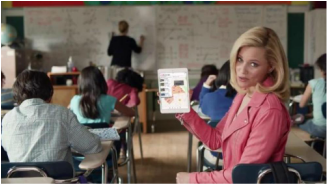 This real estate ad relates housing and education to inequality. This real estate ad relates housing and education to inequality.
Tags: class, education, inequality, housing, intergenerational inequality, school funding, 00 to 05 mins
Year: 2015 Length: 0:29 Access: iSpot.tv Summary: In this commercial for Realtor.com, Elizabeth Banks explains how privilege is passed on from parents to children. In the ad she explains a feature on the Realtor.com website that shows where school boundaries are located. This gives parents looking for a house the ability to know which schools their children will attend, or as she states, it lets you “know where to live to get your kid into the best school.” She then explains how sending kids to better schools means attending better colleges, which means better jobs. In just 12 seconds, she explains how economic inequality is reproduced from generation to generation. The importance of housing in maintaining and reinforcing inequality has been explored extensively in sociology. Property taxes are a major source of funding for public schools. Those schools located in districts with higher housing values will generally have more funding for public schools. Students in higher income areas have better facilities and supplies, more access to technology, and more opportunities for extra-curricular activities. This then increases their chances of attending better colleges, and therefore increases their chances for higher occupational attainment. Rather than education leveling the playing field between poor, middle-class, and rich students, we see that education is a way that inequality gets reinforced. The commercial is appealing to parents to buy houses in the “good neighborhoods” and avoid the “bad neighborhoods.” But what does this mean for families who don’t have the financial wherewithal to move into neighborhoods with the best school districts? Their kids are more likely to attend underfunded schools, which decreases their chances of attending better colleges. So we see the children of middle-class and upper-class parents will have opportunities and privileges passed on to them that are denied those from lower socio-economic statuses. This video would pair well with this New York Times article. Submitted By: Wes Shirley 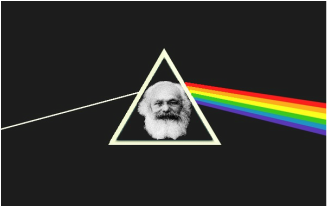 Pink Floyd is useful for teaching sociological theory Pink Floyd is useful for teaching sociological theory
Tags: class, education, foucault, government/the state, inequality, knowledge, marx/marxism, theory, alienation, althusser, gramsci, hegemony, state apparatuses, subtitles/CC, 00 to 05 mins
Year: 1982 Length: 5:13 Access: YouTube Summary: In my Classic Sociological Theory class, I ask students to write a reflective essay on Marxist concepts of alienation (see also here, here, here, here, and here) and class conflict, and then I ask them to relate the concepts to Pink Floyd's "Another Brick in the Wall." It is a common misunderstanding that Marx was solely a materialist who ignored the sphere of ideas. On the contrary, Marx explicitly argued that "the ideas of the rulling class were in every epoch the ruling ideas." To stretch students’ analytical skills I ask and encourage them to also incorporate Althusser’s idea of state apparatuses (repressive and ideological). That is, drawing from the video, what does it mean to say that the state is repressive in order to further the interests of the ruling classes? I then ask students to push their argument even further and incorporate a discussion of Gramsci’s notion of hegemony (see also here, here, and here). Here the question is, how does the bourgeoisie develop a hegemonic culture, wherein its own values and norms become common sense for all? Instructors should feel free to press for a more radical departure from Marx. For instance, it might be fruitful to draw on Foucault to analyze resistance, punishment, and the complex notion of power-knowledge. I remind students that the objective is not to merely summarize the theories and create links between concepts and the video, but to use the video as a springboard for a deeper discussion about resistance and oppression. Submitted by: Hadi Khoshneviss, University of South Florida  What does this imagery evoke in the American context? What does this imagery evoke in the American context?
Tags: culture, education, immigration/citizenship, multiculturalism, nationalism, race/ethnicity, american, cultural assimilation, melting pot, 00 to 05 mins
Year: 1976 Length: 3:20 Access: YouTube Summary: This episode of "The American Melting Pot" is from Schoolhouse Rock!, the popular animated and musical education series for children. While it sought to promote awareness of immigration and diversity, it also illustrates the concept of cultural assimilation and the ideology of the US as a melting pot. The song's chorus communicates "Lovely Lady Liberty / With her book of recipes / And the finest one she's got / Is the great American melting pot." The animation reveals her book of recipes (e.g. Irish Stew) from various immigrant groups, but also a recipe for "The Great American Melting Pot," with these ingredients: "Armenians, Africans, English, Dutch, Italians, Chinese, Poles ..." The concept of the melting pot is that these cultures have peacefully intermixed throughout American history, thus building and then becoming a part of a dominant culture of American values and customs—which continues to welcome immigrants that "melt" or assimilate into a unified mainstream American culture (Native American culture and its destruction are never mentioned). It's clear intention is to promote equality: "You simply melt right in / It doesn't matter what your skin / It doesn't matter where you're from / Or your religion, you jump right in / To the great American melting pot." But in an educational context, its ideological effect can be to obscure that race and religion both mattered at the time the series was aired in the 1970s, and that they continue to matter today. Proponents of multiculturalism have critiqued this concept and suggested new metaphors (e.g. salad bowl, cultural mosaic, or kaleidoscope) where different ethnic groups maintain their own cultural identities within a shared space. The video does, however, suggest a more nuanced notion of the melting pot when it states "How great to be an American / And something else as well" while it reveals a flag-waving grandmother's button that reads "Kiss me, I'm Polish." Thank you to Nicole Spitzer for recommending this clip! Submitted By: Paul Dean 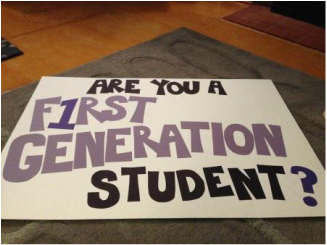 The first-gen experience can be an important part of one's identity. The first-gen experience can be an important part of one's identity.
Tags: children/youth, class, education, inequality, cultural capital, first-gen, social mobility, 00 to 05 mins
Year: 2015 Length: 5:57 Access: New York Times Summary: This video and the accompanying NYT article analyze the experiences of students who are the first in their family to attend college (i.e. first-gen students). It addresses the challenges that students face, including not knowing how to network, discomfort in talking with professors, not having parents to help them navigate higher education, not having money to buy appropriate clothes for professional interviews, and needing to work while attending college. In sociological terms, these reflect inequalities in both economic capital (e.g. needing to work) and cultural capital (e.g. not having the knowledge and disposition necessary for navigating professional institutions). The video also mentions positive parts of the first-gen experience, such as knowing how to do their own laundry and other basic skills for independently taking care of oneself, and having empathy for others who struggle. It addresses issues of identity, including how some students actively conceal a first-gen identity, difficulties communicating the experience to family, but also having pride in (and "coming out" as) first-gen. These issues of identity and experience in both college and professional life are insightfully explored in Alfred Lubrano's book, Limbo: Blue Collar Roots, White Collar Dreams. Other resources on first-gen students include this Chronicle of Higher Education report and Social Class on Campus: Theories and Manifestations (Barratt 2011). The video also documents Brown's first conference for inter-ivy first-gen students, organized by the student group 1vyG at Brown, where students shared their first-gen experiences. While the video focuses on first-gen students from ivy-league Brown University, the experiences translate to other institutional contexts as well (I can attest to this as a first-gen student myself!). Submitted By: Paul Dean |
Tags
All
.
Got any videos?
Are you finding useful videos for your classes? Do you have good videos you use in your own classes? Please consider submitting your videos here and helping us build our database!
 |
 RSS Feed