 Jessica Alba Jessica Alba
Tags: biology, knowledge, race/ethnicity, social construction, subtitles/CC, 00 to 05 mins
Year: 2011 Length: 3:33 Access: YouTube Summary: In this short video from 2011, Jessica Alba appears on the talk show Lopez Tonight and endures George Lopez's comedic preamble before hearing the results of her ancestry DNA test. According to Lopez and the language used by the testing company, Alba is 87 percent European and 13 percent Native American. But to the astute observer, the show is actually claiming to reveal more than the details of Alba's genetic composition. It is also claiming to reveal information about her "true" race, and therein lies the problem. • As I have noted elsewhere on The Sociological Cinema, racial categories do not consistently correspond to biological observations (see here and here). To put it another way, race is not based on biology; it merely claims to be. This point often confuses people, for they reason that in some sense race must be biological. After all, skin color is largely a genetically determined characteristic, and so the thinking goes, race must be too. But while genetic instructions largely determine the amount of melanin a body produces, it is through socialization that people become predisposed to notice skin color as one of the most salient features a body can have. The thickness of one's eyebrows, the shape of their ears, or the color of their of eyes—these are also genetically determined characteristcs, but people mostly discount these features as the bearers of useful information. To socially construct race, then, is to teach people which physical characteristics are the salient markers of a racial group, and racism becomes possible once people begin assigning meanings to those salient racial markers. • At about the 45-second mark, Lopez explains that the DNA analysis distinguishes between four ancestral groups, and perhaps sensing that it would resonate with his audience, he incorrectly equates each ancestral group with a race. The Europeans, according to Lopez, are white, Sub-Saharan Africans are black, East Asians are Asian, and the Indigenous American group refers to Native Americans. The results confuse Alba, who racially identifies as Latina and knows her last name comes from Spain. But it is instructive to dwell a bit on the basis of her confusion, for it highlights the incompatibility between ancestral DNA and race. In the United States people with Spanish heritage tend to be racially categorized as Hispanic or Latino, which is a category believed to be distinct from white. However, DNA analyses show that the original inhabitants of the Iberian Peninsula (i.e. Spain, Portugal, the small UK overseas territory of Gibraltar, and the Principality of Andorra) are a part of the same general migratory group of homo sapiens that settled the rest of Europe. As with all racial categories, contemporary distinctions between whites and Hispanics in the United States are socially created and not based on some deeper biological truth. Submitted By: Lester Andrist  The latent vs. manifest functions of education. The latent vs. manifest functions of education.
Tags: art/music, children/youth, education, inequality, knowledge, adolescence, hidden curriculum, latent functions, manifest functions, pedagogy, performance poetry, spoken word, structural functionalism, youth studies, 00 to 05 mins
Year: 2014 Length: 3:46 Access: YouTube Summary: In this spoken word performance entitled “Somewhere in America,” three high school students share their experiences as youth in America’s educational system. The video can be used to illustrate features of the structural-functionalist perspective, and specifically how sociologists working within this framework—e.g., Emile Durkheim, Robert Merton, and Talcott Parsons—distinguished between the manifest and latent functions (and dysfunctions) of various social phenomena. Here, the teenagers discuss the functions and implications of the manifest versus latent curriculum, and how these two curriculums play out in the lives of children. The poets argue that the manifest curriculum, which is the content teachers are required to teach, is not what students remember most; rather, the girls suggest that the latent or hidden curriculum is the knowledge that becomes more deeply embedded in students’ memories and daily interactions. The hidden curriculum refers to the values, beliefs, and attitudes that are transmitted to students through the education system; a latent function of these hidden lessons is that these help to socialize young individuals to form a more “cohesive” society. In doing so, the views and values of the dominant culture are coached into the minds of young school-goers. Arguing that the biggest lessons in school “won’t come from a syllabus,” the words of these poets reinforce decades of social scientific research stating that schools go farther than simply advancing the academic success of children; schools also instill social and cultural ideas within students (for one prominent example, see Ann Arnett Ferguson’s research on the role of public schools in constructing Black masculinity). The group closes by saying, “The greatest lessons [in school] are the ones you don’t remember learning.” While we’ve chosen to highlight the structural-functionalist contours of the poem, viewers are encouraged to think about how the teens’ poem can be read through other foundational sociological lenses, namely, social conflict theory and symbolic interactionism. For example, the students’ attention to power inequalities that emerge from the education system resemble a social conflict approach. This supplementary video explaining the three foundational sociological perspectives and how they relate to education can help viewers with this analysis. Submitted By: Jordan Grier and Valerie Chepp 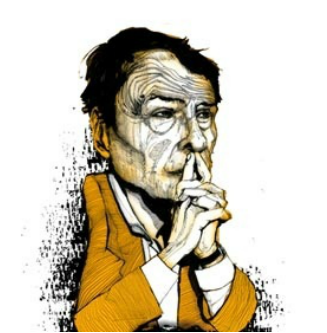 Sociologist Pierre Bourdieu (1930-2002) Sociologist Pierre Bourdieu (1930-2002)
Tags: class, inequality, knowledge, cultural capital, embodied state, institutionalized state, objectified state, pierre bourdieu, 00 to 05 mins
Year: 2015 Length: 5:29 Access: YouTube Summary: This short tutorial video summaries Pierre Bourdieu's (1930-2002) theory of cultural capital, a concept that is defined in this video as “the cultural knowledge that serves as currency that helps us navigate culture and alters our experiences and the opportunities available to us.” The video goes on to elaborate by discussing three different forms of cultural capital—embodied state, objectified state and institutionalized state—and provides examples of each type that students can apply to their own lives. At the end of the video, discussion questions are included that can assist students in applying the concept of cultural capital to what is happening in the world today. This is one of several videos on The Sociological Cinema that illustrate Bourdieu’s ideas, including his theory of taste (here, here, and here), different forms of capital, habitus, and social distance. In addition to this tutorial video, The Sociological Cinema's has several videos that use examples from popular culture to teach Bourdieu’s concept of cultural capital, which includes clips from the popular reality TV show Wife Swap, scenes from The Wire (here and here), the movie Clueless, and this excerpt from the PBS documentary film People Like Us: Social Class in America. Submitted By: Sociology Live!, Cindy Hager  Pink Floyd is useful for teaching sociological theory Pink Floyd is useful for teaching sociological theory
Tags: class, education, foucault, government/the state, inequality, knowledge, marx/marxism, theory, alienation, althusser, gramsci, hegemony, state apparatuses, subtitles/CC, 00 to 05 mins
Year: 1982 Length: 5:13 Access: YouTube Summary: In my Classic Sociological Theory class, I ask students to write a reflective essay on Marxist concepts of alienation (see also here, here, here, here, and here) and class conflict, and then I ask them to relate the concepts to Pink Floyd's "Another Brick in the Wall." It is a common misunderstanding that Marx was solely a materialist who ignored the sphere of ideas. On the contrary, Marx explicitly argued that "the ideas of the rulling class were in every epoch the ruling ideas." To stretch students’ analytical skills I ask and encourage them to also incorporate Althusser’s idea of state apparatuses (repressive and ideological). That is, drawing from the video, what does it mean to say that the state is repressive in order to further the interests of the ruling classes? I then ask students to push their argument even further and incorporate a discussion of Gramsci’s notion of hegemony (see also here, here, and here). Here the question is, how does the bourgeoisie develop a hegemonic culture, wherein its own values and norms become common sense for all? Instructors should feel free to press for a more radical departure from Marx. For instance, it might be fruitful to draw on Foucault to analyze resistance, punishment, and the complex notion of power-knowledge. I remind students that the objective is not to merely summarize the theories and create links between concepts and the video, but to use the video as a springboard for a deeper discussion about resistance and oppression. Submitted by: Hadi Khoshneviss, University of South Florida  Gillian Anderson explains cultural transmission Gillian Anderson explains cultural transmission
Tags: culture, discourse/language, knowledge, theory, cultural transmission, ferdinand de saussure, primatology, signifier, signs, symbols, subtitles/CC, 00 to 05 mins
Year: 2015 Length: 1:39 Access: YouTube Summary: There is a widely held myth that humans are distinct from all other animals because we have culture. As sociologists understand the term, culture is the system of beliefs, skills, and knowledge shared by a group of people or society, and stated in those terms, it is not something unique to homo sapiens. In fact, as Gillian Anderson (i.e., Dana Scully from The X-Files) explains in this short video, chimpanzees have a kind of culture too. What makes humans unique is that we are capable of passing on our culture, knowledge, and skills across generations to strangers we’ve never met, a phenomenon known as cultural transmission. Unlike chimpanzees, who have been observed teaching other chimpanzees how to use tools from their environment, humans are not limited to face-to-face interactions. Through our use of symbols, or signifiers in the terminology introduced by the Swiss semiotician Ferdinand de Saussure, we have proven to be very capable of transmitting our culture in various forms, such as writing, paintings, photographs, videos, and even in the artifacts we've designed, like tombstones and telephones. Submitted By: Lester Andrist 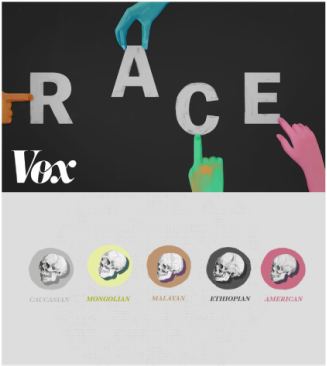 Vox debunks the race myth in a new video Vox debunks the race myth in a new video
Tags: biology, immigration/citizenship, inequality, knowledge, prejudice/discrimination, race/ethnicity, science/technology, social construction, caucasian, mexican, racial formations, scientific racism, subtitles/CC, 00 to 05 mins
Year: 2015 Length: 3:08 Access: YouTube; Vox Summary: It often surprises students to learn that sociologists and other social scientists regard race as little more than a creation of the collective imagination, or as the above video from Vox argues, race isn't real. Contrary to popular belief, racial categories do not consistently correspond to biological observations; nor are the racial categories used today a particularly ancient means of categorizing human societies. They are, in fact, both flimsy and recent. • The social theorist David Theo Goldberg argues that starting in the sixteenth century racial thinking and racist articulation became increasingly common in European societites. As Vox explains in the above video, one crucial moment of racist articulation appears to have occurred nearly two centuries later when in 1779 German scientist Johan Friedrich Blumenbach is credited with attempting to establish a scientific, race-based system of classification. Although his work has long been discredited, it is worth noting that he arrived at five hierarchically organized racial categories: "Caucasian, the white race; Mongolian, the yellow race; Malayan, the brown race, Ethiopian, the black race, and American, the red race." Not surprisingly, he ranked Caucasians highest on his racial hierarchy. • For those who remain unimpressed by the fact that racial thinking is a relatively recent phenomenon in human history, consider the fact that racial categories and their hierarchical arrangement have been shown to change with political priorities. In academic parlance, racial formations have continued to be created, transformed, and destroyed. For instance, the video explains that the U.S. Census categorized people with Mexican ancestry as white until 1930, at which point the Census began categorizing these whites as an emergent racial category known simply as "Mexican." The change in Census categories reflected a developing racial discourse in the American Southwest but it also played a role in temporarily limiting immigration from Mexico, and fewer immigrants from Mexico meant higher wages for whites. • Properly contextualized, the reason for the emergence of racial thinking in Western Europe seems fairly clear. Although it is assumed race is based on natural, biological differences, the truth is that racial thinking has had very little to do with accurately describing natural variation in human populations and far more to do with whites maintaining power, privilege, and resources at the expense of nonwhites. Although race isn't real in a biological sense, as the video explains, it has become hugely important in a social sense. The racial categories to which we're assigned can determine real life experiences. Submitted By: Lester Andrist 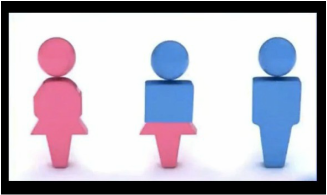 ISU adds gender-neutral labels to its restrooms ISU adds gender-neutral labels to its restrooms Tags: crime/law/deviance, gender, inequality, knowledge, lgbtq, media, prejudice/discrimination, sex/sexuality, social construction, agender, androgyne, bigender, gender fluid, genderqueer, neutrois, non-binary, trans*, transgender, 00 to 05 mins Year: 2014 Length: 0:50 Access: Mediaite Summary: In this clip from Fox & Friends Heather Nauert reports that Illinois State University recently relabeled its "family” restrooms as "gender-neutral." She kicks off the segment by saying,"Someone call the P.C. police!" and warns that viewers are "not going to believe this one.” The giddy laughter of her off-camera colleagues is audible while she delivers her exasperated explanation of the new restroom symbols. The video is useful in any class wrestling with the social construction of gender, the gender binary, and consequences of rigidly enforced gender categories. People who identify as transgender, two spirit, demiguy, demigirl, bigender, non-binary, trigender, third gender, genderqueer, gender fluid, androgyne, neutrois, and agender (and others) have often reported instances of ridicule and danger faced when using public restrooms. For this group, the labeling change means the difference between being able to safely use public restrooms at their university. What is interesting is not the change toward more inclusive signage at Illinois State University, but how Fox & Friends uses their platform as a major news network to actively police the gender binary. Nauert begins by framing the change as an instance of political correctness, a term that suggests the new signs are of trivial importance. The demeanor of both newscaster and her off-camera colleagues is another cue that viewers should not regard the change as an important or positive development at Illinois State University. Although times are changing, news programs still give lip service to the idea that their job is simply to give the public impartial (i.e., fair and balanced) information about important events. What is discussed less is the role the media plays in shaping the public's understanding of those events and reconstituting the state of affairs where excluding people who do not conform to the gender binary is acceptable. For more information about bathrooms as a site of gender politics, check out our Pinterest board on the topic. Submitted By: Lester Andrist 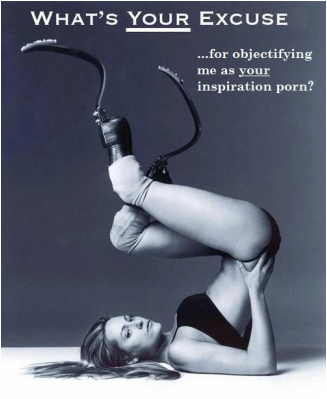 "What's your excuse...for objectifying me as your inspiration porn?" Amy Purdy poses while wearing her running blades "What's your excuse...for objectifying me as your inspiration porn?" Amy Purdy poses while wearing her running blades Tags: bodies, culture, disability, emotion/desire, inequality, knowledge, marketing/brands, media, sports, inspiration porn, super bowl, 00 to 05 mins Year: 2015 Length: 1:15 Access: YouTube Summary: Every year the Super Bowl proves to be a rich site for sociological investigation, and we have analyzed many different aspects of this American spectacle, including the commercials. All media, but the commercials of the Super Bowl in particular, can be seen as cultural artifacts. Ads are saturated with resonant images and meanings, and with a little work, one can deduce information about the society that created the ads, how they see themselves and what they believe about the world. The commercials of Super Bowl XLIX featured a surprising number of people with disabilities. Among them, Reebok and Toyota showcased athletes with prosthetic legs engaged in rather punishing exercise regiments. Our video of the week is the Toyota ad, which tracks world-class snowboarder and double amputee, Amy Purdy, on the slopes, in a dance hall, and as the subject of a photo shoot. Microsoft's ad, by contrast, centered on Braylon O'Neil, a toddler learning how to walk and play T-Ball with his prosthetic legs. All of the ads were accompanied by narration that attempted to inspire and somehow leave audiences with the impression that Microsoft, Toyota, or Reebok are central players in helping humanity realize its full potential. • The problem is that the ads reek of what is sometimes referred to as inspiration porn. That is, to the extent that people with disabilities feature in media at all, they are typically portrayed in a very one-dimensional way; as a narrative device that has been fashioned with the sole intent of inspiring the able-bodied majority. For those who think inspiration porn isn't a big deal, consider the awkward similarities it shares with the old practice of featuring people with disabilities as freaks in circus sideshows. Toyota is using Amy Purdy to inspire the able-bodied majority, whereas P. T. Barnum used double amputees to amuse. In both cases, people with disabilities are being objectified to give the majority a big emotional experience. Find more information and resources about disability and media representation on our Pinterest board. Submitted By: Lester Andrist  "The Big Questions" tackles the question of reparations "The Big Questions" tackles the question of reparations Tags: discourse/language, globalization, inequality, knowledge, prejudice/discrimination, race/ethnicity, colonialism, color-blindness, color-blind racism, laissez-faire racism, neocolonialism, postcolonialism, reparations, slavery, 06 to 10 mins Year: 2014 Length: 9:23 (21:28) Access: Atlanta Blackstar (Full episode: YouTube) Summary: Is it time for the West to begin paying reparations for its role in enslaving African people? The question cannot really be about the timing of reparations, for if blacks are owed any money at all for the chattel slavery their ancestors experienced, then the time for reparations is certainly long overdue. The real question is whether reparations should be paid at all, and as with so many other issues pertaining to race and racism in the United States, one's view of the matter will likely depend on one's race. Writer Ta-Nehisi Coates recently penned a data-driven cover story on the topic for The Atlantic, and in the above video, scholar-activist, Esther Stanford-Xosei comments on the fact that in March of this year, Caricom, the organization Caribbean nations work through to coordinate economic decisions, approved a plan for seeking reparations from colonizing countries including Great Britain. I want to use this video to help explain why discussions about reparations—and so many other issues pertaining to racial inequality—frequently result in a deadlock between whites and people of color, colonizers and the colonized. At about the 35-second mark, the white conservative politician, Daniel Hannan, argues that reparations should not be paid to the descendants of slaves because, as he puts it, "Slavery was universal...if you're looking at paying reparations, anyone whom you choose to pay is statistically certain to be descended both from the owners and the owned." By this logic, whites are just as entitled to reparations as blacks. Hannan's position is common among whites in the West and cannot be easily dismissed as simply evil or consciously racist; rather it is important to see that he and others hold this conclusion because they subscribe to a set of ideas, which together form the basis of what sociologist Lawrence Bobo calls laissez-faire racism. Bobo uses this term to refer to the fact that the institutionalized disadvantages people of color continue to face—which are both measurable and observable—are now accepted and even condoned based on the faulty premise that within the framework of a modern free market, people of all races have an equal shot at economic success. Thus, for the laissez-faire racist, if it is true that people of color are more likely to be poor than whites, it can only be because they are not lifting themselves up by their bootstraps. The fact is the experience of colonialism has left an enduring mark on the way modern institutions dole out privileges and resources, but in more tangible terms, the machinery of colonialism has meant that wealth accumulated for the white colonizers, and that wealth continues to be passed down to their descendants. Even if the market and its institutions truly regarded people of all races equally, people of different races are not participating in the market with anything close to the same chest of resources. Submitted By: Lester Andrist  Josh Zepps criticizes Suey Park's protest as "stupid" Josh Zepps criticizes Suey Park's protest as "stupid" Tags: discourse/language, knowledge, prejudice/discrimination, race/ethnicity, social mvmts/social change/resistance, theory, privilege, racism, standpoint theory, 00 to 05 mins Year: 2014 Length: 5:49 Access: YouTube Summary: This short clip from Huffington Post Live features social media activist Suey Park, who is interviewed by the program's host, Josh Zepps. With Park at the helm, the interview plays as a virtual thrill ride, careening through the convoluted caverns of white male privilege and deftly swerving to miss the host's attempts to sabotage and derail. Before elaborating, a little background is in order. Zepps' interview with Park was based on #CancelColbert trending on Twitter, a hashtag Park started. The hashtag was in response to a tweet sent from an account affiliated with The Colbert Report, which reads, "I'm willing to show the Asian community I care by introducing the Ching-Chong Ding-Dong Foundation for Sensitivity to Orientals or Whatever." It's worth mentioning that the tweet was apparently sent with the intention of lampooning Dan Snyder's recent announcement that he'll start a foundation to benefit Native Americans, instead of changing the racist name of his Washington, D.C. football team (more on that topic, here and here). During the interview, Zepps presses Park to concede that "the intent of the Colbert tweet was to criticize," but Park responds that irrespective of the ironic intention, the tweet missed its mark. "I really don't think we're going to end racism by joking about it," Park explains, "I'm glad white liberals feel like they are less racist because they can joke about people who are more explicitly racist, but that actually does nothing to help people of color." Zepps counters by suggesting that Park's energy would be better spent attacking Dan Snyder, and to this, Park recenters the discussion, explaining that the issue is about changing the behavior of white liberals, not what Josh Zepps thinks people of color should protest. Then, refusing to mince words, Park adds that Zepps is in no position as a white man to decide whether people of color are misguided in protesting the Colbert tweet. In response, Zepps resorts to calling his guest's opinion "stupid," and the segment ends shortly thereafter. There is a lot going on in this five-minute exchange between Zepps and Park, but I'll mention one point here. First, I think the conversation is an interesting example of how whites--including white liberals—often attempt to discredit and minimize the grievances of people of color. Zepps is following in the timeworn tracks of minimization and silencing: 1) "It's not a legitimate grievance because you don't understand the intent"; 2) "Okay, you understand the intent, but it's not a legitimate grievance because there are more important problems to protest"; and finally, 3) "Your opinions are stupid." The problem, as I see it, and the reason Zepps and Park will never find common ground, is that Zepps fundamentally rejects the legitimacy of Park's claims about what she and other people of color find offensive. Certainly, as a matter of principle, neither Zepps nor any other white person can be the one who ultimately decides whether a person of color has a right to be offended, but more to the point, white people occupy a structural position of privilege and power, and from that position, it is even predictable that they will not see eye to eye with people of color. Zepps clearly counts himself a logical man, who is capable of arriving at reasoned perspectives, but his logic is infected by the false premises of white privilege. He would do well to consider the many insights of standpoint theory, which argue that people working from the "outsider-within" perspective occupy a unique position, allowing them to recognize patterns of domination. Submitted By: Lester Andrist |
Tags
All
.
Got any videos?
Are you finding useful videos for your classes? Do you have good videos you use in your own classes? Please consider submitting your videos here and helping us build our database!
 |
 RSS Feed