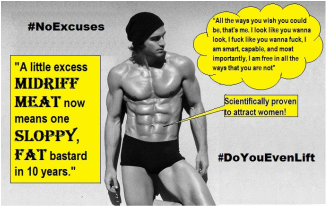
 This ad for six-pack-abs exemplifies the new masculine ideal This ad for six-pack-abs exemplifies the new masculine ideal
Tags: bodies, gender, health/medicine, marketing/brands, body dysmorphia, masculinity, michael kimmel, reflexivity, subtitles/CC, 00 to 05 mins
Year: 2015 Length: 4:21 Access: YouTube Summary: This video advertisement directs viewers to a workout program that promises to give men the washboard abs of their dreams, but for sociologists, the ad simply underscores an emergent masculine ideal, which is neither timeless nor inevitable. Contrary to all appearences, the ideal may not be all that healthy either. • In his article "Masculinity as Homophobia: Fear, Shame, and Silence in the Construction of Gender Identity," sociologist Michael Kimmel traces the origins of masculine ideals in the United States to the eighteenth century, where men aspired to the ideal of a Genteel Patriarch, whose standing was based on landownership. The Genteel figure was refined and elegant, while also being sexual and strong. According to Kimmel, by the 1830s the Genteel Patriarch gave way to a new ideal, or what he calls the Marketplace Man. This figure "derived his identity entirely from his success in the capitalist marketplace, as he accumulated wealth, power, status." • Fast forward to 2015 and take stock of the above video advertisement from Six Pack Shortcuts. Johnny, "the Six-Pack-Abs" pitchman, begins by asking men to guess which muscle is "scientifically proven" to attract women. Johnny assures viewers with a knowing smirk that he isn't talking about the penis (After all, it would be unacceptably shallow and misguided to objectify and fetishize a particular part of a man's body!). No, he's referring to men's abs, and he claims to know because, well, science, and because he's the six-pack-abs-guy. He also quotes from Men's Health, which states that women know "a little excess midriff meat now means one sloppy, fat bastard in 10 years." • In the view of many sociologists who study masculinity, the Marketplace Man has given way to a new Supermale masculinity, which is an aspirational ideal that involves manipulating one's body, purging it of fat stores, and accentuating muscle striation. In a relational context, the Supermale affirms his status by high-fiving the bros, broadcasting short clips of his lifts, posting carefully lit selfies of his abs on social media, and by frequently using the hashtag #DoYouEvenLift. • Masculine ideals change over time, and the generation of men who strive to ascend the ranks of any given ideal simultanously avail themselves to new possibilities and vulnerabilities. To understand the masculinity of an era is to understand the sacrifices men are being enticed to make, as well as the widely-shared conseqences for making those sacrifices. Those who pursued the ideal of the Marketplace Man were vulnerable insofar as they directly pinned their masculinity to the viscissitudes of market capitalism, but what are the distinct vulnerabilities of men pursuing the ideal of the Supermale? The fact is that the Supermale is a largely unattainable ideal that may lead boys and men to develop body image concerns, or even body dysmorphia. Johnny, the six-pack-abs-guy, and the entire industry Johnny represents, excel at branding their products as healthy, but if those products promise to deliver an unattainable ideal, they may be doing more harm than good. Submitted By: Lester Andrist
226 Comments
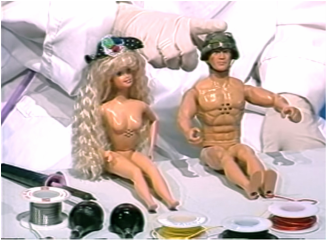 An early example of culture jamming using new media strategies. An early example of culture jamming using new media strategies.
Tags: art/music, consumption/consumerism, gender, marketing/brands, media, science/technology, social mvmts/social change/resistance, activism, culture jamming, new media art, gender socialization, 21 to 60 mins
Year: 1993 Length: 28:29 Access: YouTube Summary: How does social change happen? For more than a century, this question has inspired much sociological research. Within the study of social change, sociologists have often focused their attention on social movement activism and various forms of contentious politics. More recently, some sociologists have sought to move beyond these parameters to ask what other things might “count” as activism. For example, Notre Dame’s Center for the Study of Social Movements Mobilizing Ideas blog recently featured a two-part series entitled “New Ways to Define Activism” (Part I and Part II). Often, sociologists cite new digital media environments and technologies as timely reasons for why we must revisit “old” definitions of activism. While this question might be relevant in the contemporary context, this video illustrates how activists began to strategically draw upon digital media technologies more than twenty years ago. In 1993, a group of artist-activists launched a multi-faceted media campaign call the Barbie Liberation Organization (BLO) in reaction to Mattel’s new talking Barbie, which contained an electronic voice box that played stereotypical phrases such as “Math class is tough” (listen to talking Barbie). The campaign mixed traditional and electronic media, hardware hacking, and “boots on the ground” activism, resulting in this video, which sought to raise awareness of gender stereotypes in a normally difficult-to-reach population of Americans. This video would become one of the earliest and most influential demonstrations of electronic media culture jamming. Instructors can use this video to elicit discussion of successful culture jamming in several ways. First, the video is presented as a legitimate news report, which begs larger questions about the trust we place in news media or the authority of corporations in general. Second, the purported newscast is peppered with clips from actual investigative news reports, such as A Current Affair, to further enhance the legitimacy of BLO’s report. However, many of the clips are taken out of context and edited to subvert the original message, such as when one toy expert’s words are used to accuse Mattel of "terrorism against children” when she was instead accusing BLO of such tactics. Here, we see the artist-activists employing the very medium they challenge to contradict the intended message, which is the crux of culture jamming practice. Finally, the video serves as a DIY tutorial—no different than the myriad of how-to videos populating the web today—which instructs viewers how to perform the voice box swap at home, thus giving consumers and activists alike agency to subvert the toy’s intended message. For a culture jamming video assignment, also posted on The Sociological Cinema, click here. Submitted By: Josh Gumiela and Valerie Chepp  The intersection of teen identity, consumption, and social media. The intersection of teen identity, consumption, and social media.
Tags: children/youth, consumption/consumerism, corporations, marketing/brands, media, science/technology, identity, internet, social media, teenagers, youth culture, subtitles/CC, 21 to 60 mins
Year: 2014 Length: 53:41 Access: PBS Summary: This 2014 PBS Frontline documentary, Generation Like, serves as a nice updated follow-up to the popular 2001 documentary, The Merchants of Cool. As in the 2001 episode, Generation Like explores how large corporations and marketing firms seek to tap into young consumer markets. However, unlike the teens that came of age during the making of The Merchants of Cool, today’s young adults are navigating a radically different media and advertising environment, namely, one dominated by social media. As explained in this plot summary, “Thanks to social media, today's teens are able to directly interact with their culture - artists, celebrities, movies, brands, and even one another - in ways never before possible. But is that real empowerment? Or do marketers still hold the upper hand? In Generation Like, author and FRONTLINE correspondent Douglas Rushkoff (The Merchants of Cool, The Persuaders) explores how the perennial teen quest for identity and connection has migrated to social media - and exposes the game of cat-and-mouse that corporations are playing with these young consumers. Do kids think they're being used? Do they care? Or does the perceived chance to be the next big star make it all worth it? The film is a powerful examination of the evolving and complicated relationship between teens and the companies that are increasingly working to target them.” While this documentary would be useful for teaching ideas related to teen consumption and corporate advertising, it could also serve as a useful way to examine characteristics of the generational cohort following the Millennials, who have been dubbed "Generation Z." Submitted By: Valerie Chepp  Would you choose the beautiful or average door? Would you choose the beautiful or average door?
Tags: bodies, gender, marketing/brands, theory, beauty, looking-glass self, 00 to 05 mins
Year: 2015 Length: 3:40 Access: YouTube Summary: In this ad, Dove’s encouragement of women to "choose beautiful" appears to empower women, but it actually serves to reinforce western standards of beauty and one's sense of self-worth in terms of physical appearance. The ad functions as a social experiment that forces women to choose walking through an “average” or “beautiful” door in a public space. Many women shown are directly influenced by their friends or family when choosing a door, and some are physically steered toward beautiful. Others naturally select the average door, apparently feeling like they did not fit the standards of prescribed beauty. Those who "choose beautiful" report feeling better about themselves, and in this way, Dove is suggesting that being beautiful is about the choices we make as individuals. However, the message of the ad is more complicated. First, in contrast to "average," the idea that beauty is for a minority is reinforced. By positioning “beautiful” in binary opposition to “average” not all women can be beautiful. Second, all of the women interviewed, despite having different cultural backgrounds, fit conventional definitions of beauty. They are all thin, long-haired, have clear skin, and are relatively young. Even the women of color featured have light skin. This sample suggests a specific image of beauty (this skewed sample, which Dove presents as a diverse group, is further explored in our previous post). Third, it reinforces the sense of self-worth on beauty by making women choose between these specific doors, and encouraging women to choose beautiful. Fourth, parts of the video take place in countries like China and India, where the white ideal of beauty (fitting the characteristics described above) has been imposed through colonization. The implications that beauty is for the elite is inescapable. Women in the advertisement are forced to either identify with the majority or to place themselves in positions of prestige. Finally, the video is a great illustration of the looking-glass self, a theoretical concept that explains how perceptions of one’s self are influenced by interactions with others and the imagination of how these others perceive us. Through the lens of the looking-glass self, women approach the door and develop a sense of themselves as beautiful or average, which is largely shaped by their perceptions of how others see them, then experience pride or shame for associating themselves with one or the other door. Submitted By: Miranda Ames  This video examines the phenomenon of "gendered pricing." This video examines the phenomenon of "gendered pricing."
Tags: capitalism, gender, inequality, marketing/brands, prejudice/discrimination, gendered pricing, pink tax, subtitles/CC, 00 to 05 mins
Year: 2015 Length: 3:59 Access: YouTube Summary: In this video, YouTuber Liz Plank looks into how products marketed towards men and women vary in price. Liz starts out with the startling statement that women are losing $100,000 over the course of their lifetime. Not to the wage gap, but to the products they buy--the so called “pink tax.” Liz and her co-blogger Alex (a male identifying individual) take an experimental approach to this issue and head to a pharmacy to see if there really is a price difference or, pink tax, applied to women’s products. Liz and Alex each bought five personal care products that were marketed towards their genders. They made sure that their samples were consistent by checking that the products they bought were the same brand, had the same active ingredients, and were the same size. They each bought one pack of razors, a deodorant bar, shaving cream, wrinkle cream, and body wash. Liz and Alex then compared the prices of the items they bought. In total, Liz spent $42.69 and Alex spent $37.42. For the exact same products, the only difference was that Alex’s products were marketed towards men, and Liz’s towards women. Just to make sure that they actually were the same products, they swapped products for a week. After a week of using the products targeted at the other gender they found no difference in the quality or utility of their products. This led them to conclude that women are in fact getting charged a pink tax for the same products that men can buy for less. This could be because of social norms that dictate that women care more about appearance and are therefore willing to pay more for personal care items. Beauty product companies want to make as much as possible on their products, and they drive up the price of items targeted at women. Because consumers are socialized to shop in the beauty aisle marketed toward their gender and not look at the “other” gender’s products, many people do not even notice this discrepancy. Submitted By: Abigail Adelsheim-Marshall 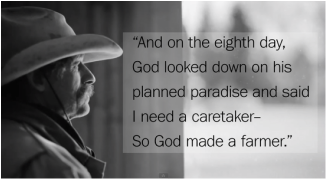 Notions of good, hard-working people are attached to white male farmers in this ad. Notions of good, hard-working people are attached to white male farmers in this ad.
Tags: culture, gender, marketing/brands, media, nationalism, organizations/occupations/work, race/ethnicity, religion, american dream, commercial, farming, hegemony, ideology, 00 to 05 mins
Year: 2013 Length: 2:02 Access: YouTube Summary: This commercial, which aired during the 2013 Superbowl, is a montage of pictures of farmers, their families, and their lifestyle. Throughout the whole ad there is a Paul Harvey speech, known as his “So God Made a Farmer” speech, that was delivered at a 1978 farmer’s convention. The ad connects the speech with the montage of the people in a way that shows how farming is part of American culture, very hard work, and is of great moral and religious value. The ad promotes the new Dodge Ram truck, although the truck only appears a limited number of times. It illustrates the hegemonic ideology of the American Dream in a gendered and racialized manner. In short, the American Dream is the belief that obtaining success and upward social mobility for your family comes through hard work. In the ad, the farmer is working hard because it is their duty to be a hard working American. As a political conservative, Harvey was a big believer in the American Dream and promoted rugged individualism throughout his radio shows, and reflect the meanings that Dodge is attributing to its brand of trucks. This ideology is hegemonic because people take this cultural attitude, and its uniquely American expression, for granted, thereby reinforcing societal power relations. It ilso illustrates gender ideology, which can be referred to as the attitude regarding the roles, rights, and responsibilities of men and women in society. In the traditional sense, the men work blue-collar jobs while the women take care of the household and children. The ad both reflects and reinforces this traditional gender ideology, with 6 females shown in the ad compared to 21 men. None of the women were shown doing the “dirty work” while many of the men showed were actually involved in acting on their farm duties. The second to last picture in the montage is of a young child staring off into the farm with a cowboy hat while Harvey narrates, “When his son says that he wants to spend his life doing what dad does, so God made a farmer,” which reinforces the notion of farming as a masculine activity. Finally, the vast majority of farmers in the clip are white. There is a single image of an African American male farmer, and a Hispanic woman and her son, but for the most part, the video links the notions of good, hard working moral people with white male farmers, and of course, people who drive Dodge trucks. Submitted By: Omar Mendez 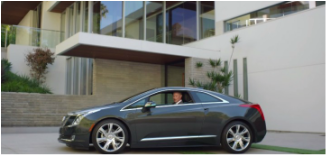 This ad celebrates materialism and the American Dream. This ad celebrates materialism and the American Dream.
Tags: class, consumption/consumerism, culture, marketing/brands, marx/marxism, nationalism, theory, american dream, commercial, ideology, 00 to 05 mins
Year: 2014 Length: 1:02 Access: YouTube Summary: This Cadillac commercial starts with actor Neal McDoungh looking over his private, in-ground pool as he poses the question “Why do we work so hard? For this? For stuff?” He talks about why Americans don’t slack off like other countries, which take a whole month of vacation. He spouts a list of famous innovators, and asks if we think they took an entire month off? Nope, because they were busy being innovators, and living the American dream. The ad is exemplary of the hegemonic ideology of the American Dream. Ideology is a collection of shared beliefs and ideas for understanding the social world that explain and justify power or challenge social relations. In this commercial we see that the actor has achieved economic success. As he walks around his expensive house and material possessions, he discusses why it’s great to be a hard working, no vacation-taking American. McDoungh directly calls out our desire for all the “stuff” which aligns with the value our culture places on material things as a value of success. Then at the end of the commercial he directly ties together the concept that taking only two weeks off means we can have more stuff, enforcing the ideology that hard work will get you the things you want: “It’s pretty simple, you work hard, you create your own luck, and you gotta believe anything is possible.” Similar to a second Cadillac ad, the emphasis on "American" suggests that this idea is a uniquely American characteristic, even though upward mobility is more common in other developed countries. It is like other dominant ideologies that are reproduced throughout institutions (i.e. the media), and this particular ideology is hegemonic because for many Americans, this way of understanding our culture is taken-for-granted. It reproduces existing class relations because it suggests that material success is based upon our degree of effort, passion, and hard work (rather than our class background or other environmental factors), and that if we are not successful, then we accept that we only have ourselves to blame. After watching this ad, it is interesting to see this Ford commercial. It emphasizes local efforts, and parallels the format and style of the Cadillac ad (it really makes fun of the smugness of their competitor, Cadillac). Submitted By: Alexis Blaylock 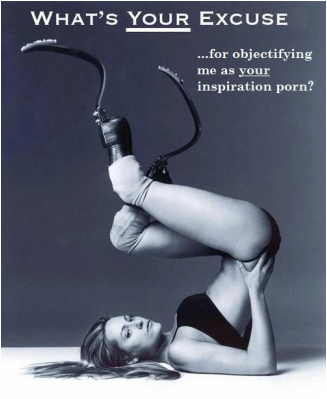 "What's your excuse...for objectifying me as your inspiration porn?" Amy Purdy poses while wearing her running blades "What's your excuse...for objectifying me as your inspiration porn?" Amy Purdy poses while wearing her running blades Tags: bodies, culture, disability, emotion/desire, inequality, knowledge, marketing/brands, media, sports, inspiration porn, super bowl, 00 to 05 mins Year: 2015 Length: 1:15 Access: YouTube Summary: Every year the Super Bowl proves to be a rich site for sociological investigation, and we have analyzed many different aspects of this American spectacle, including the commercials. All media, but the commercials of the Super Bowl in particular, can be seen as cultural artifacts. Ads are saturated with resonant images and meanings, and with a little work, one can deduce information about the society that created the ads, how they see themselves and what they believe about the world. The commercials of Super Bowl XLIX featured a surprising number of people with disabilities. Among them, Reebok and Toyota showcased athletes with prosthetic legs engaged in rather punishing exercise regiments. Our video of the week is the Toyota ad, which tracks world-class snowboarder and double amputee, Amy Purdy, on the slopes, in a dance hall, and as the subject of a photo shoot. Microsoft's ad, by contrast, centered on Braylon O'Neil, a toddler learning how to walk and play T-Ball with his prosthetic legs. All of the ads were accompanied by narration that attempted to inspire and somehow leave audiences with the impression that Microsoft, Toyota, or Reebok are central players in helping humanity realize its full potential. • The problem is that the ads reek of what is sometimes referred to as inspiration porn. That is, to the extent that people with disabilities feature in media at all, they are typically portrayed in a very one-dimensional way; as a narrative device that has been fashioned with the sole intent of inspiring the able-bodied majority. For those who think inspiration porn isn't a big deal, consider the awkward similarities it shares with the old practice of featuring people with disabilities as freaks in circus sideshows. Toyota is using Amy Purdy to inspire the able-bodied majority, whereas P. T. Barnum used double amputees to amuse. In both cases, people with disabilities are being objectified to give the majority a big emotional experience. Find more information and resources about disability and media representation on our Pinterest board. Submitted By: Lester Andrist  Affluenza is a combination of "affluence" and "influenza" to critique the disease of consumerism. Affluenza is a combination of "affluence" and "influenza" to critique the disease of consumerism. Tags: capitalism, class, consumption/consumerism, culture, economic sociology, health/medicine, inequality, marketing/brands, affluenza, american dream, keeping up with the joneses, status treadmill, 06 to 10 mins, 21 to 60 mins Year: 1997 Length: 10:13 (entire documentary is 56:00) Access: YouTube Summary: This clip (start 2:12; end 12:35) from the documentary Affluenza (based on the book), defines the concept and consequences of affluenza. Using the metaphor of disease, affluenza can be defined as a bloated, sluggish and unfulfilled feeling that results from efforts to keep up with the Joneses; an epidemic of stress, overwork, waste and indebtedness caused by dogged pursuit of the American Dream; and an unsustainable addiction to economic growth. This clip notes that "never before has so much meant so little to so many." It can cause headaches and depression amongst other symptoms, and the narrator notes that if it goes untreated, the disease can cause "permanent discontent." In addition to discussions of consumer culture, the clip works particularly well with the book, The Spirit Level. Using a variety of quantitative data, authors Wilkinson and Pickett argue that more unequal societies suffer a variety of social problems. The reason, they propose, is that more unequal societies place more emphasis on material success to prove one's worth in society. This constant drive to display one's material success can never be satisfied and leaves individuals throughout the social hierarchy being unfulfilled. In other words, unequal societies are more likely to suffer from affluenza, and the negative social and health outcomes (e.g. lower life expectancy, higher infant mortality, higher mental illness, higher drug use, etc). The narrators in the video clip further note that while the disease is very contagious (due to extensive marketing and the rise of consumer culture), it is treatable. Viewers might peruse the videos in our social movements category and other web resources for ideas of how to cure affluenza. The documentary website from PBS also offers a teaching guide. Submitted By: Paul Dean 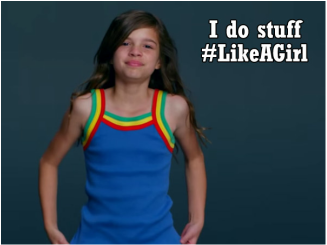 What does it mean to run "like a girl"? What does it mean to run "like a girl"? Tags: children/youth, gender, marketing/brands, sports, femininity, 00 to 05 mins Year: 2014 Length: 3:18 Access: YouTube Summary: In the beginning of this video, teenage girls and boys are asked to perform certain actions "like a girl." For example, they are asked to run like a girl and throw like a girl. Both the girls and boys adopt stereotypical behaviors. Then younger girls are asked to illustrate these actions, but they perform as they normally would (e.g. running as fast as they can). Both the teenagers and younger children are asked to reflect on what it means to do something "like a girl" and if it is a good or bad thing. They offer very insightful comments and come to acknowledge the negative connotations of doing something "like a girl." Finally, they offer alternative and positive meanings for doing something like a girl, arguing that it is a natural thing to be a girl and to do things as a girl. Along the way, captions (from the corporate sponsor, Always) note that a girl's confidence drops during puberty, and that we must make "like a girl" have positive meanings. The clip is an interesting way to engage a common expression, that is often taken for granted, and to show how cultural meanings get assigned to gender in a way that is very harmful. Specifically, it shapes how meanings of sport, athleticism, and physical activity are gendered, and suggest how they lead to certain gender inequalities. The clip can also be explored from an economic sociology perspective in terms of branding and marketing. This sort of advertisement is outside the traditional form of advertising, but is an example of a growing trend in which corporations address social issues in their communications as part of their branding strategy. For another example, see this Dove Evolution commercial and a critical analysis of it. Similarly, viewers might further reflect critically on Always' depiction of gender, femininity, and girls' bodies in this ad. Thanks to Abi Horvat for suggesting this clip! Submitted By: Paul Dean |
Tags
All
.
Got any videos?
Are you finding useful videos for your classes? Do you have good videos you use in your own classes? Please consider submitting your videos here and helping us build our database!
 |
 RSS Feed