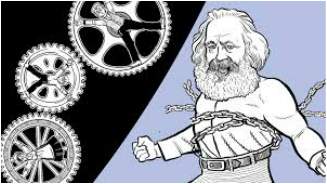
 Marx argued that the only thing workers stands to lose by collectively revolting are their chains Marx argued that the only thing workers stands to lose by collectively revolting are their chains
Tags: capitalism, class, marx/marxism, organizations/occupations/work, theory, alienation, division of labor, species essence, 00 to 05 mins
Year: 2015 Length: 1:57 Access: YouTube Summary: This video summarizes Karl Marx's concept of alienation. Marx wrote about alienation as a condition that uniquely arises from capitalism, and it comes in two basic flavors: first, workers are alienated from the product of their labor, and second, they are alienated from each other. It's useful to consider each of these claims separately. In the first instance, workers are alienated from the stuff they create because it disappears to shops in far off places; however, under capitalism, it is often the case that even when a product is sold in a shop just down the road from the factory or farm where it was created, workers often cannot afford it. For instance, many Ivory Coast cocoa farmers cannot afford to buy the chocolate they produce and just as many have never even tasted it. • In terms of the second type of alienation, workers are alienated from each other, meaning that the capitalist mode of production generally prevents workers from forming meaningful relationships with one another. Consider that one characteristic feature of capitalist production is the division of labor, which means that each worker becomes efficient at completing a single, tedious task, leaving him or her with neither the time nor opportunity for the kind of interpersonal interactions that were once a part of the production process (recall how Charlie Chaplin's character in Modern Times couldn't tighten bolts on an assembly line fast enough and how Lucille Ball's character in an episode of I Love Lucy couldn't wrap candy on an assembly line fast enough). In any case, as the video's narrator states, Marx argued that the only way out of this alienating mode of production is to organize and revolt. As Marx and his coauthor penned in The Communist Manifesto: "Workers of the world unite; you have nothing to lose but your chains." Submitted By: Lester Andrist
1 Comment
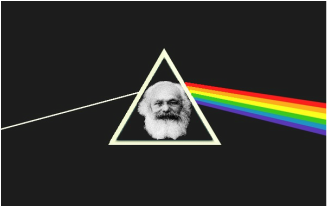 Pink Floyd is useful for teaching sociological theory Pink Floyd is useful for teaching sociological theory
Tags: class, education, foucault, government/the state, inequality, knowledge, marx/marxism, theory, alienation, althusser, gramsci, hegemony, state apparatuses, subtitles/CC, 00 to 05 mins
Year: 1982 Length: 5:13 Access: YouTube Summary: In my Classic Sociological Theory class, I ask students to write a reflective essay on Marxist concepts of alienation (see also here, here, here, here, and here) and class conflict, and then I ask them to relate the concepts to Pink Floyd's "Another Brick in the Wall." It is a common misunderstanding that Marx was solely a materialist who ignored the sphere of ideas. On the contrary, Marx explicitly argued that "the ideas of the rulling class were in every epoch the ruling ideas." To stretch students’ analytical skills I ask and encourage them to also incorporate Althusser’s idea of state apparatuses (repressive and ideological). That is, drawing from the video, what does it mean to say that the state is repressive in order to further the interests of the ruling classes? I then ask students to push their argument even further and incorporate a discussion of Gramsci’s notion of hegemony (see also here, here, and here). Here the question is, how does the bourgeoisie develop a hegemonic culture, wherein its own values and norms become common sense for all? Instructors should feel free to press for a more radical departure from Marx. For instance, it might be fruitful to draw on Foucault to analyze resistance, punishment, and the complex notion of power-knowledge. I remind students that the objective is not to merely summarize the theories and create links between concepts and the video, but to use the video as a springboard for a deeper discussion about resistance and oppression. Submitted by: Hadi Khoshneviss, University of South Florida  A boy sings to the rich about the plight of the poor. A boy sings to the rich about the plight of the poor.
Tags: capitalism, class, economic sociology, inequality, marx/marxism, political economy, theory, class consciousness, class conflict, 00 to 05 mins
Year: 2012 Length: 2:48 Access: YouTube Summary: This clip from the 2012 film of the musical Les Misérables begins by showing beggars and urchins pressing against the carriages of the rich, begging for food or money. Gavroche, the lead urchin, explains to the audience the political situation in France (in 1832) and then joins a crowd of people expressing their anger at the situation so many of them are in. For the most part, the classes are polarized binto the rich and the poor (lower and upper classes). Particularly in the case of the working class, there seems to be minimal gap between their actual needs and experiences and their attitudes toward their situation. The scene and its accompanying song reflect key concepts in much of Marx and Engels' Manifesto of the Communist Party. For example, it illustrates the lower class's class consciousness, as both their objective class position and subjective consciousnesses are aligned; they realize their own position in the class system and how it affects them. As noted by Marx and Engels, the poor can “live only so long as they find work, and who [can] find work only so long as their labour increases capital” and are therefore wholly dependent on the upper class for their livelihood. However, the upper class is not acting in the interests of these poor, and the leaders that could make decisions to the benefit of the poor are absent and unhelpful. Therefore, the only people that can act in the interests of the lower class are the poor themselves. In order to live the life they want to live, the poor need to rise up collectively and make the necessary changes in the system. As this collective action is “continually being upset again by…the workers themselves” (Marx), the young men function to facilitate the inevitable conflict with the upper class. When Gavroche explains the continuous political loop the people have been in, finding themselves struggling again after seeming to have fixed the problem, he demonstrates the idea that class struggle is continuous and, according to Marx, present in “the history of all hitherto existing society.” With this understanding of the sociological factors in play in this clip, the viewers can make connections between the clip, albeit fictional, and other instances of class conflict throughout history. It is a strong representation of the differences between different classes and the consciousness that leads to conflict and change. Submitted By: Kiersten Payne  Stephen Colbert discusses the politics of class warfare. Stephen Colbert discusses the politics of class warfare.
Tags: class, inequality, marx/marxism, theory, american dream, class conflict, ideology, 00 to 05 mins
Year: 2006 Length: 3:50 Access: The Colbert Report Summary: This segment of "The Word" from the Colbert Report focuses on class warfare. It examines John Edwards' 2006 presidential run in which he wanted to wage a war on poverty in order to restore the “dream that is America.” His platform proposed to reduce poverty by 30% in ten years and totally in thirty. Colbert makes a bold claim that the Bush administration worked too hard to “create” poor people. He cites that “the amount of people living under the poverty line had increased by 4.1 million,” while Congress has voted against raising the minimum wage 9 years running and given themselves a raise in recent months. He argues that we need the poor because they provide inspiration for the rest of us to work hard in order to succeed, just like the American Dream created hundreds of years ago. This illustrates the ideological functions of the American dream. Specifically, it suggests that there are ample opportunities to get ahead in life, so if someone is struggling economically, then they are at fault. This way of understanding American society ignores the dramatic structural inequalities, and helps to keep the working class from resisting the class system and keeps the wealthy in control. The clip also illustrates Marx's concept of class struggle, in which the class interests of the capitalist class and working class are inherently opposed, thereby making class conflict inevitable. The class interests of business owners who oppose raising the minimum wage, or the wealthy members of Congress who voted to give themselves a raise, are diametrically opposed to the interests of the working class, who would clearly benefit from an increase in the minimum wage and other economic opportunities. Furthermore, it is the capitalist class which controls the means of production (and government), and therefore are in a better position to benefit themselves. Instead of raising wages or implementing better conditions, they work to maximize their own profits and salaries, thereby hurting everyone else. Submitted By: Dan Weintraub  This ad celebrates materialism and the American Dream. This ad celebrates materialism and the American Dream.
Tags: class, consumption/consumerism, culture, marketing/brands, marx/marxism, nationalism, theory, american dream, commercial, ideology, 00 to 05 mins
Year: 2014 Length: 1:02 Access: YouTube Summary: This Cadillac commercial starts with actor Neal McDoungh looking over his private, in-ground pool as he poses the question “Why do we work so hard? For this? For stuff?” He talks about why Americans don’t slack off like other countries, which take a whole month of vacation. He spouts a list of famous innovators, and asks if we think they took an entire month off? Nope, because they were busy being innovators, and living the American dream. The ad is exemplary of the hegemonic ideology of the American Dream. Ideology is a collection of shared beliefs and ideas for understanding the social world that explain and justify power or challenge social relations. In this commercial we see that the actor has achieved economic success. As he walks around his expensive house and material possessions, he discusses why it’s great to be a hard working, no vacation-taking American. McDoungh directly calls out our desire for all the “stuff” which aligns with the value our culture places on material things as a value of success. Then at the end of the commercial he directly ties together the concept that taking only two weeks off means we can have more stuff, enforcing the ideology that hard work will get you the things you want: “It’s pretty simple, you work hard, you create your own luck, and you gotta believe anything is possible.” Similar to a second Cadillac ad, the emphasis on "American" suggests that this idea is a uniquely American characteristic, even though upward mobility is more common in other developed countries. It is like other dominant ideologies that are reproduced throughout institutions (i.e. the media), and this particular ideology is hegemonic because for many Americans, this way of understanding our culture is taken-for-granted. It reproduces existing class relations because it suggests that material success is based upon our degree of effort, passion, and hard work (rather than our class background or other environmental factors), and that if we are not successful, then we accept that we only have ourselves to blame. After watching this ad, it is interesting to see this Ford commercial. It emphasizes local efforts, and parallels the format and style of the Cadillac ad (it really makes fun of the smugness of their competitor, Cadillac). Submitted By: Alexis Blaylock  A vintage video game is used to discuss Marxism. A vintage video game is used to discuss Marxism. Tags: capitalism, class, economic sociology, marx/marxism, political economy, theory, alienation, dialectical materialism, philosophy, subtitles/CC, 00 to 05 mins Year: 2014 Length: 3:51 Access: YouTube Summary: This video is part of a series of 8-bit Philosophy, which seeks to “communicate even the most complex of philosophical concepts in a fun, easy-to-understand way.” It uses vintage video games (from the original Nintendo) to explain complex philosophical ideas. Using quotes from The German Ideology and other works, with altered scenes from Super Mario Brothers, the narrator explains several concepts within Marxist theory. For example, the narrator explains that Marx argued it was not ideas that drive historical change, but "it is our conflict arising out of our relation to material goods" that shapes history. This process of historical materialism is explained in terms of the economic systems and social relations of a society; it is simultaneously illustrated using a character from the video game (Toad) and its weapons (a turnip) that reflect commodities that the character produces. Other concepts include exploitation, the four forms of alienation, and communism—all placed in the context of familiar Super Mario Bros references, such as Bowser, collecting coins, and the classic background music. Submitted By: Paul Dean  Cocoa farmers may go their entire lives without tasting chocolate Cocoa farmers may go their entire lives without tasting chocolate Tags: capitalism, class, food/agriculture, globalization, marx/marxism, organizations/occupations/work, theory, alienation, chocolate, cocoa farming, commodity chains, ivory coast, species-being, subtitles/CC, 06 to 10 mins Year: 2014 Length: 5:55 Access: YouTube Summary: It is quite common to hear people discuss Karl Marx's notion of alienation as a term that simply describes widespread feelings of unhappiness and psychological distress among workers. It's true that one result of alienation may be unhappiness, but the term was intended to describe much more than workers' feelings. It's important to remember that Marx wrote about alienation as a condition that arises from the social relations that form within a system of capitalist production. For instance, Marx worried that one consequence of the division of labor in capitalist societies is that workers had become estranged from each other. Marx was also interested in drawing attention to workers' relationships to their work (i.e., species-being). For example, prior to modern capitalism, a woodworker could express herself through her work by making unique decisions about how pieces of furniture were to be constructed. However, under capitalism workers are often not afforded the ability to express themselves through their work. Work has instead become a series of routinized movements, making every new piece of furniture identical to the last. In addition to the relationship between workers and their work, Marx also wrote about alienation in reference to the relationship between workers and the products they produce. If one thinks about it, capitalism is a peculiar system in that it compels people to produce objects that do not belong to them. Again, the woodworkers of long ago could conceivably keep the furniture they built, or if the mood struck them, they could give it away as a gift. Under modern capitalism, the furniture workers produce generally belong to their employers. Moreover, modern capitalism is a system that has people creating things they may never even use. Although an Ikea employee might spend her day helping construct the components of low cost furniture, her home may not actually contain a single product from Ikea. Another rather vivid example of this last form of alienation can be observed in the above video, which features Ivory Coast cocoa farmers who have never even tasted chocolate. Note that The Sociological Cinema has also explored Marx's notion of alienation as it can be observed on assembly line work and on modern chicken farms. Submitted By: Lester Andrist 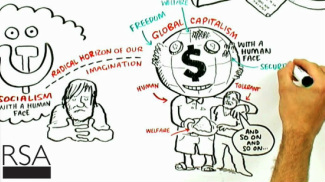 Žižek argues charitable consumption prolongs capitalism's ills. Žižek argues charitable consumption prolongs capitalism's ills. Tags: capitalism, consumption/consumerism, corporations, culture, economic sociology, marketing/brands, marx/marxism, political economy, theory, charity, corporate social responsibility, cultural capitalism, morality, starbucks, žižek, 06 to 10 mins Year: 2010 Length: 10:56 Access: YouTube Summary: In this animated segment of a longer lecture, Slavoj Žižek critiques the cultural dimensions of contemporary capitalism. Žižek begins by stating how capitalism has changed from a dichotomy between production and traditional charity (e.g. Soros earns money by exploiting workers then gives it back to humanist causes), to a form of capitalism that brings the dimensions of morality and consumption together. He offers several examples of this "cultural capitalism," including Starbucks and Tom's Shoes. In each of these instances, the act of consumption and doing good are part of the same process, which has now been universalized throughout capitalism. It is meant to make people (i.e. consumers) feel good about themselves in that they are helping poor people or a degraded environment. However, Žižek argues that by participating in this system, consumers are actually "prolonging the disease ... rather than curing it." He promotes changing the structure rather than this sort of charitable act: "The proper aim is to try and reconstruct society on such a basis that poverty would be impossible and the altruistic virtues have really prevented the carrying out of this aim." He compares this system to slave owners who were kind to their slaves because they prevented oppressed slaves from realizing the core injustice of slavery; in other words, it suggests that we are doing enough to address the system's ills and prevents more significant change. While there is an implicit argument to do away with capitalism here, Žižek explicitly states that 20th century socialism was a "mega catastrophe" and does not promote a return to that system. The clip also works well to initiate critical discussions of corporate social responsibility, Fair Trade, and other social certifications, and begin to imagine what more radical alternatives might look like. Submitted By: Paul Dean  An arts-based exploration of global capitalism's contradictions. An arts-based exploration of global capitalism's contradictions. Tags: art/music, capitalism, class, globalization, historical sociology, inequality, marx/marxism, race/ethnicity, social mvmts/social change/resistance, alienation, counter-hegemony, crisis, ideology, patriarchy, social justice, subtitles/CC, 06 to 10 mins Year: 2013 Length: 6:20 Access: YouTube Summary: Blind Eye Forward (BEF) is an attempt to convey in words, music, and imagery the contradictory character of contemporary global capitalism, with attention to its historical formation, the social and ecological maladies that issue from its logic of dispossession and commodification, and the movements that, in response to those maladies, are struggling for a better world. A minor blues accompanied by still images and popular-cultural video clips, BEF begins at an ideological juncture and moves successively through issues of militarism, alienation and reification, and the challenge of creating the new within an obdurate present. In its middle part, which is carried musically by an extensive guitar solo, the piece moves through a world-historical narrative of colonial dispossession, slavery and the construction of "race", patriarchy, and capital and class. The final verse, though pessimistic, invites us to keep a red rose fastened to our chest, and to temper our pessimism with a Gramscian optimism of the will. Blind Eye Forward is useful as a discussion piece in learning contexts that problematize social inequality and the irrationalities of capitalism, within a broadly Marxist perspective. Pedagogically, it employs an arts-based approach, which can complement more expository communicative styles. Students generally find it both inspiring and troubling. It is important to reserve time after showing it in class for comments, questions, and dialogue. (Note: The piece does not have subtitles but the complete lyrics can be accessed by clicking "show more" under the description on the YouTube site.) Submitted By: William K. Carroll  This ad reinforces viewers' belief in the American Dream. This ad reinforces viewers' belief in the American Dream. Tags: class, consumption/consumerism, marketing/brands, marx/marxism, nationalism, theory, american dream, commercial, ideology, 00 to 05 mins Year: 2014 Length: 0:30 Access: YouTube Summary: Ideologies are sets of ideas and beliefs through which people make sense of the social world. Ideologies are always related to power, with dominant ideologies reinforcing existing power relations. The American Dream is a particularly powerful ideology that reinforces class relations by perpetuating the belief that anyone who works hard can be economically sucessful (despite the overwhelming evidence of how class inequality shapes economic outcomes). This car commercial illustrates this ideology with a discussion of the excellence that has come out American garages: "The Wright brothers started in a garage, Amazon started in a garage, Hewlett Packard started in a garage ... the Ramones started in a garage. My point? You never know what kind of greatness can come out of an American garage." It suggests that anyone can do great things from humble beginnings, a fundamental element of the American Dream. The emphasis on "American" suggests that this idea is a uniquely American characteristic, even though upward mobility is more common in other developed countries. The ad goes on to show a Cadillac literally and metaphorically emerging from an American garage, thereby using notions of the American Dream to appeal to consumers' aspirations and nationalistic pride. It is not only an attempt to sell both Cadillac cars and attach those meanings to its brand, but also reinforces viewers' sense of the American Dream as reality. However, this association begs the question: Who does the American Dream apply to? In reality the American dream is not for the poor, but for the rich. Furthermore, it is not just the corporations that utilize the American Dream to market products to society; politicians and public figures often utilize images of the American society to convince people to support public policy, similar to how it is being used in this car commercial. For a scathing critique of the American dream, see this clip from George Carlin. Submitted By: Kelsey Gallaher |
Tags
All
.
Got any videos?
Are you finding useful videos for your classes? Do you have good videos you use in your own classes? Please consider submitting your videos here and helping us build our database!
 |
 RSS Feed