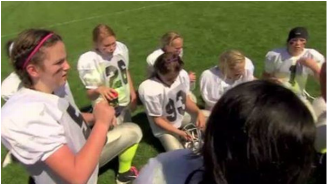
 Girls gather for practice in their all-girls tackle football league. Girls gather for practice in their all-girls tackle football league.
Tags: biology, children/youth, gender, social construction, sports, american football, girls, 06 to 10 mins
Year: 2015 Length: 6:45 Access: ESPN Summary: This ESPN video explores the first all-girls tackle football league. They are changing what it means to "play like a girl" and the video shows girls excited to play a physically aggressive sport, which is more traditionally associated with boys and masculinity. But the video does more than challenge gender norms by providing an opportunity to think about the distinctions between sex and gender on shaping the body and body perceptions. Dr. Robert Cantu, Clinical Professor of Neurosurgery and Co-Director of the Center for the Study of Traumatic Encephalopathy, is an outspoken critic of boys (and girls) playing football before high school. He argues that children under the age of 12 that play tackle football have a "significantly greater late life chance to have cognitive problems, depression, and lack of impulse control, compared to the same group of people that started playing football at a later age." He goes on to argue that "young ladies [i.e. girls under 12] have much weaker necks than guys ... so that it takes less of a hit to produce a greater amount of shaking of the brain inside the skull" (the girls wear lighter helmets than those worn by the boys, and the football they use is smaller). But are these differences based in sex or gender? We might consider the degree to which weaker necks are a result of sex-based differences in average neck size and strength, or to what degree girls are socialized to do different types of activities in which they do not build comparable neck muscles? A further implication is that football is more dangerous for girls than boys, which begs the question of how we, as a society react to this claim about different neck sizes. Should we treat girls unequally and disallow them to play a sport that may carry greater risk for them, or should we promote gender equality in giving them equal opportunity to play a sport for which they have great passion? Towards the end of the clip, one of the girls interviewed receives a big hit during a game and "black[s] out." The mother discusses her concern for her daughter, but the young girl says "this is girls tackle football, and I need to toughen up." Submitted By: Paul Dean
3 Comments
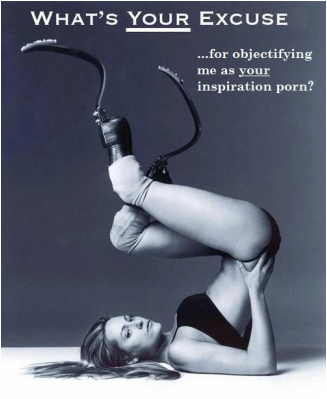 "What's your excuse...for objectifying me as your inspiration porn?" Amy Purdy poses while wearing her running blades "What's your excuse...for objectifying me as your inspiration porn?" Amy Purdy poses while wearing her running blades Tags: bodies, culture, disability, emotion/desire, inequality, knowledge, marketing/brands, media, sports, inspiration porn, super bowl, 00 to 05 mins Year: 2015 Length: 1:15 Access: YouTube Summary: Every year the Super Bowl proves to be a rich site for sociological investigation, and we have analyzed many different aspects of this American spectacle, including the commercials. All media, but the commercials of the Super Bowl in particular, can be seen as cultural artifacts. Ads are saturated with resonant images and meanings, and with a little work, one can deduce information about the society that created the ads, how they see themselves and what they believe about the world. The commercials of Super Bowl XLIX featured a surprising number of people with disabilities. Among them, Reebok and Toyota showcased athletes with prosthetic legs engaged in rather punishing exercise regiments. Our video of the week is the Toyota ad, which tracks world-class snowboarder and double amputee, Amy Purdy, on the slopes, in a dance hall, and as the subject of a photo shoot. Microsoft's ad, by contrast, centered on Braylon O'Neil, a toddler learning how to walk and play T-Ball with his prosthetic legs. All of the ads were accompanied by narration that attempted to inspire and somehow leave audiences with the impression that Microsoft, Toyota, or Reebok are central players in helping humanity realize its full potential. • The problem is that the ads reek of what is sometimes referred to as inspiration porn. That is, to the extent that people with disabilities feature in media at all, they are typically portrayed in a very one-dimensional way; as a narrative device that has been fashioned with the sole intent of inspiring the able-bodied majority. For those who think inspiration porn isn't a big deal, consider the awkward similarities it shares with the old practice of featuring people with disabilities as freaks in circus sideshows. Toyota is using Amy Purdy to inspire the able-bodied majority, whereas P. T. Barnum used double amputees to amuse. In both cases, people with disabilities are being objectified to give the majority a big emotional experience. Find more information and resources about disability and media representation on our Pinterest board. Submitted By: Lester Andrist 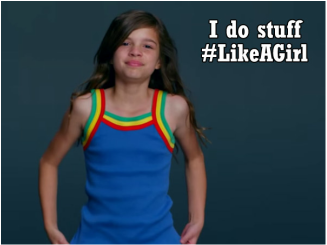 What does it mean to run "like a girl"? What does it mean to run "like a girl"? Tags: children/youth, gender, marketing/brands, sports, femininity, 00 to 05 mins Year: 2014 Length: 3:18 Access: YouTube Summary: In the beginning of this video, teenage girls and boys are asked to perform certain actions "like a girl." For example, they are asked to run like a girl and throw like a girl. Both the girls and boys adopt stereotypical behaviors. Then younger girls are asked to illustrate these actions, but they perform as they normally would (e.g. running as fast as they can). Both the teenagers and younger children are asked to reflect on what it means to do something "like a girl" and if it is a good or bad thing. They offer very insightful comments and come to acknowledge the negative connotations of doing something "like a girl." Finally, they offer alternative and positive meanings for doing something like a girl, arguing that it is a natural thing to be a girl and to do things as a girl. Along the way, captions (from the corporate sponsor, Always) note that a girl's confidence drops during puberty, and that we must make "like a girl" have positive meanings. The clip is an interesting way to engage a common expression, that is often taken for granted, and to show how cultural meanings get assigned to gender in a way that is very harmful. Specifically, it shapes how meanings of sport, athleticism, and physical activity are gendered, and suggest how they lead to certain gender inequalities. The clip can also be explored from an economic sociology perspective in terms of branding and marketing. This sort of advertisement is outside the traditional form of advertising, but is an example of a growing trend in which corporations address social issues in their communications as part of their branding strategy. For another example, see this Dove Evolution commercial and a critical analysis of it. Similarly, viewers might further reflect critically on Always' depiction of gender, femininity, and girls' bodies in this ad. Thanks to Abi Horvat for suggesting this clip! Submitted By: Paul Dean 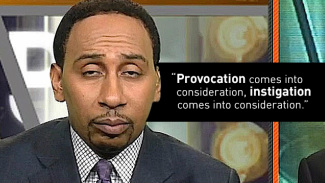 Stephen A. Smith blames the victim in an ESPN broadcast Stephen A. Smith blames the victim in an ESPN broadcast
Tags: crime/law/deviance, discourse/language, gender, inequality, media, sports, violence, assault, blaming the victim, domestic abuse, intimate partner violence, nfl, 00 to 05 mins
Year: 2014 Length: 2:15 Access: YouTube Summary: [Trigger warning for a discussion of domestic abuse and intimate partner violence] An important news story has once again put the spotlight on America's problem with domestic abuse and gender-based violence, and it involves (former) Baltimore Ravens running back Ray Rice assaulting then fiancée, Janay Palmer, in an elevator of an Atlantic City casino. Video footage of the incident confirms the couple got into a heated argument, and then somewhere during the course of the elevator's descent toward the lobby, Rice delivered a blow with enough force to seemingly render Palmer unconscious. A security camera from the lobby captures Rice dragging his fiancée's limp body out of the elevator and onto the lobby floor. Isn't this just an isolated incident of a man losing his temper? Since most men and women agree that physically assaulting another person is wrong, what is left to discuss? Here's something to consider: women are victims of rape and assault at the hands of men far more than the reverse. According to the Department of Justice, about 1 in 4 women have been victimized by an intimate partner, and this asymmetry suggests Americans still have much to discuss in terms of gendered patterns of violence. The same is true for only about 7% of all men. To be sure, there are certainly interpersonal details that led Rice and Palmer to quarrel that day, but it is no less true that Ray Rice assaulted Janay Palmer because Ray Rice lives in a society where it is sometimes permissible, and even expected, for men to enact physical violence against women. Sure, in the abstract, people agree it's wrong, but if one listens to how people actually make sense of instances of assault, it becomes clear that assault against women is only wrong with qualifications. For instance, the above video features commentator Stephen A. Smith on ESPN's "First Take" imploring viewers to "make sure we [sic] don’t do anything to provoke wrong actions.” As a sociologist, I can appreciate the importance of contextualizing social phenomena, but understanding the causal chain of events that lead to a given conflict is something different than excusing violence or saying the violence is understandable (i.e., morally acceptable). Rather than using his media platform to simply denounce Rice's behavior as wrong, Smith appears to ask his audience to consider the ways in which Janay Palmer was asking to be hit. In the spirit of truly contextualizing the abuse, Smith would do well to ask viewers to consider how a discourse of blaming the victim (also discussed here) perpetuates a state of affairs where women are the overwhelming victims of physical abuse (Note that Smith later offered an apology for his comments). Submitted by: Lester Andrist 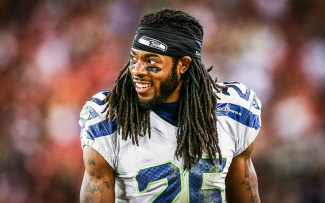 Race and gender shaped the media's "thug" portrayal of Sherman. Race and gender shaped the media's "thug" portrayal of Sherman. Tags: discourse/language, emotion/desire, gender, intersectionality, media, prejudice/discrimination, race/ethnicity, sports, American football, racialized masculinity, racism, 06 to 10 mins Year: 2014 Length: 6:39 Access: msnbc Summary: On January 19, 2014, the Seattle Seahawks defeated the San Francisco 49ers in a game thrilling victory that secured their spot in Super Bowl XLVIII (which they went on to win). Immediately following the Seahawks' defeat over the 49ers, Seattle cornerback Richard Sherman gave an emotional, on-field post-game interview with FOX Sports reporter Erin Andrews. In the interview, Sherman portrayed a loud and brash display of aggression, in which he “trash talked” San Francisco receiver Michael Crabtree. In this clip, political commentator and TV host Chris Hayes highlights how the media framed Sherman--a black football player--as a “thug” after the interview. Hayes discusses the framing of black men and athletes as violent and hypermasculine with Dr. Jelani Cobb from the University Connecticut. This clip would be useful to guide discussions on the intersections of race and gender, racialized masculinity, and perceptions of threat and violence. Submitted By: Denae Johnson 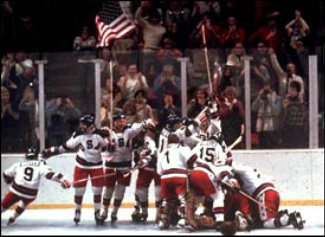 Film about 1980 US Olympic win illustrates social identity theories. Film about 1980 US Olympic win illustrates social identity theories. Tags: psychology/social psychology, sports, theory, henri tajfel, intragroup processes, intergroup processes, john turner, role identities, self-categorization theory, social identities, social identity theory, 06 to 10 mins Year: 2004 Length: 10:25 Access: YouTube Summary: This montage of two clips from the 2004 movie Miracle documents the United States Hockey Team’s win over Russia to secure the gold medal at the 1980 Winter Olympics; the montage also features footage from the actual game. In the first clip, U.S. head coach Herb Brooks asks the players to introduce themselves, which they do using their names, cities of origin, and university affiliations. In the second clip, the team has just lost a scrimmage game and Brooks keeps them on the ice to run drills despite the players’ exhaustion and coaching staff’s disapproval, until one of the players “reintroduces” himself; Brooks asks again who the player, Mike Eruzione, plays for, and Eruzione replies, “I play for the United States of America.” Upon hearing this, Brooks appears satisfied and ends the drills. This video can be used to illustrate several dimensions of Henri Tajfel’s social identity theory and/or John Turner’s self-categorization theory. I show this clip after students have read an overview of role and social identity theories by Thoits and Virshup (1997). First, it can be used to distinguish generally between role identities (who I am) and group or social identities (who we are). Sports teams, in general, are basic examples of I’s coming together to form we’s. Second, more specific principles within theories of social identity are illustrated. Tajfel’s psychologically oriented social identity theory focuses on intergroup processes of in-group and out-group formation, group conflict, and prejudice. Turner’s self-categorization theory is more focused on intragroup processes of categorization and depersonalization; in other words, the process by which individuals form a group. The Miracle montage is an illustration of both intergroup and intragroup processes, with the U.S.-Russia rivalry illustrating group conflict (intergroup) and the post-loss drills leading Eruzione to declare that he plays for the United States (depersonalization and categorization). This montage is especially useful at illustrating the processes of depersonalization and categorization as we watch the players go from identifying themselves as individuals to identifying themselves as members of the U.S. team. The somewhat artificial context of sports can be an accessible entry point to talking about other more “real world” contexts of group identity, both in terms of intergroup conflict and intragroup processes of depersonalization (e.g., ethnic, tribal, and state identifications and conflicts). Submitted By: Kathleen E. Denny  This American Indian ad opposes the "Redskins" name. This American Indian ad opposes the "Redskins" name. Tags: culture, race/ethnicity, sports, american indian, cultural representation, football, native american, racism, washington redskins, 00 to 05 mins Year: 2014 Length: 2:00 Access: YouTube Summary: Just before the 2014 Superbowl, the National Congress of American Indians (NCAI) released this PSA targeting the use of the name "Redskins" for the famed NFL franchise. The video moves through a great variety of images of American Indians with words that they use to describe themselves (e.g. proud, forgotten, Navajo, Blackfoot, survivor, patriot, Sitting Bull, mother, father, son, daughter, chief, Apache, etc.). The final words from the narrator are: "Native Americans call themselves many things; the one thing they don't ..." and the video ends by focusing on a Washington Redskins football helmet, and refers the viewer to Change the Mascot. For a full analysis of this specific topic, see the Washington Redskins Name Controversy. But more broadly, and like many other posts on this site, this debate begs the question: who has the right to represent whom? For example, Adrienne Keene, a member of the Cherokee Nation of Oklahoma, and author of the Native Appropriations Blog, insists that it must be "the right of the community to represent themselves" (see our full analysis of an interview with Keene). While proponents argue that the mascots of professional sports teams are forms of appreciation, Keene counters that the such representations are actually "a continuing form of colonialism and oppression." Like the NCAI, Keene argues they are racist depictions of Native Americans and that they "shrink an extremely diverse community of over 565 tribes in the United States alone down into one stereotypical image of the plains Indian." Viewers may also be interested in our other videos examining depictions of American Indians in Hollywood films, Native appropriation in a parade, or this satire from South Park. Submitted By: Paul Dean 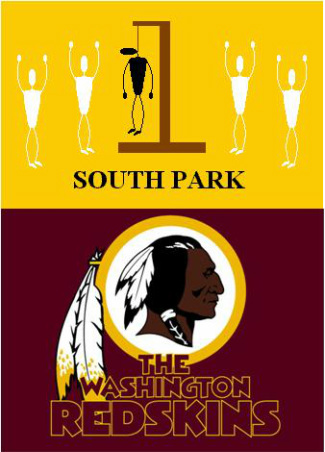 South Park offers insight on the "Redskins" controversy South Park offers insight on the "Redskins" controversy Tags: community, culture, discourse/language, prejudice/discrimination, race/ethnicity, social mvmts/social change/resistance, sports, politics of representation, symbolic representation, racism, subtitles/CC, 00 to 05 mins Year: 2000 Length: 1:06 Access: South Park Studios Summary: In this short clip from the animated television series South Park, Jimbo and Chef argue over whether the town flag should be changed. Keeping the flag unchanged might be seen as a noble cause for Jimbo and the other white residents of South Park, but given that the flag depicts the lynching of a black person, most viewers of the show will recognize the flag for the racist relic that it truly is. Working as satire, the racist flag controversy is clever misdirection, for the episode is really taking aim at much more polarizing issues, such as the display and celebration of confederate flags, and more pointedly, the widespread use of Native people as sports mascots. Jimbo and Chef briefly discuss the Cleveland Indians at the 45 second mark, but the controversy over the Washington "Redskins" is also relevant. Begun by the Oneida Indian Nation, there is a growing movement to end the use of the racial epithet currently used as the team's name. For the many people who have trouble understanding why Native Peoples are offended, the South Park clip suggests a useful thought experiment. Suppose the town and its flag were real. The depiction of a lynching victim would likely be offensive in its capacity to trigger public memories among Blacks of a particular form of racial violence that prevailed in the U.S. at the beginning of the twentieth century. Second, the flag would also likely be an uncomfortable reminder of the violence blacks must still face today, which in at least one form persists as racist policing, Finally, it should be obvious that the fact any community would proudly hang such a flag would be a slap in the face of the black community, who would rightfully perceive that their trauma is less important than preserving some image on a town flag. Like the fictional South Park flag, the "Redskins" name is offensive in that the slur recalls the white racism and genocidal policies imposed on Native peoples. The name triggers public memories among Native peoples regarding the U.S. government's campaign to annihilate and drive tribes from their homes. As a slur, "Redskin" seems to have fallen out of favor, but racism toward Native peoples continues and the association of the slur with the nation's capital certainly does nothing to engender hope that times have changed. Finally, as with the South Park flag, the continued use of the slur is a slap in the face of Native peoples, who rightfully perceive that their trauma is less important than preserving the name of a sports team. Symbolic representations, such as those that make their way onto flags and bumper stickers, are always born from relations of power; namely, who has the power to represent whom and what is the effect of those representations (Note that we also consider the question of who has the right to represent whom in another post). Submitted By: Lester Andrist  The "You Can Play" project promotes sexual equality Tags: gender, inequality, lgbtq, prejudice/discrimination, sex/sexuality, social mvmts/social change/resistance, sports, 00 to 05 mins
Year: 2012 Length: 1:00 Access: You Can Play Project Summary: The You Can Play project brings athletes, gay and straight, together to promote and educate other athletes and sports fans about equity in all levels of sport from professional to recreational. The project argues "It’s time to talk about sports and it’s time for us to create change. It’s one of the last bastions of society where discrimination and slurs are tolerated. It doesn’t have to be this way. There’s an assumption in sports that gay and lesbian players are shunned by all athletes. It’s just not true and You Can Play is dedicated to providing positive messages from athletes, coaches and fans." Their website features a growing library of video clips, each 30-60 seconds long, with professional and collegiate athletes and team personnel describing their support for the initiative. Some videos simply show athletes' meanings of sport without vocalizing their support, while other videos feature explicit statements of support (e.g. San Jose Sharks forward Tommy Wingels says "I am proud to support LGBT athletes everywhere"). The videos can be used to discuss gender and sexuality stereotypes in sport, to challenge these stereotypes, and show how sport can also function as a site for education and social change. Submitted By: Margaret Austin Smith  U.S. Olympic athlete McKayla Maroney, August 5, 2012. Tags: gender, media, sex/sexuality, sports, athletes, male gaze, olympics, self-objectification, sexual objectification, 00 to 05 mins
Year: 2012 Length: 2:18 Access: LiveLeak Summary: Hockey blogger for Yahoo! Sports, Greg Wyshynski, offered a scathing critique of NBC's video ode to the women athletes of the 2012 London Games. He sees straight through the flimsy defense that the video montage was merely a celebration of the human form, and he exposes it for the vulgar artifact of sexual objectification it truly is. He writes: "The 2012 London Games have been labeled 'the women's Olympics' thanks to record-setting performances and watershed moments like the dawn of women's boxing as well as the participation of female athletes from Saudi Arabia. How did NBC decide to help celebrate this incredible time for women in sports? With meaningless objectification, of course! 'Bodies in Motion' was an online video produced by NBC in which women competing in various Olympic sports were featured in softcore, fetishist slow-motion highlights, while porn-tastic jazz music played on the soundtrack. It looked like something a horny teenager with a DVR would have spliced together for YouTube; instead, it was the official rights holder of the Olympics in the U.S. that produced it.” Wyshynski's admonishment is spot on, but he doesn't go far enough. The sexual objectification during the 2012 Olympics needs to be discussed, not because its execution is reminiscent of low budget porn, but because widespread sexual objectification is harmful to girls and women. As political scientist Caroline Heldman has argued, an environment of sexual objectification leads women to self-objectify, which is the "phenomenon of girls and women viewing themselves from an external vantage point, constantly monitoring their behaviors and bodies to maximize their appeal." The harm for girls and women is quite measurable. For instance, Heldman notes the psychological harm. Women who self-objectify are more prone to depression, have lower self-esteem, and lower personal efficacy. They are also more likely to feel body shame, including shame about their menstrual cycles, and they are more likely to exhibit symptoms of anorexia and bulimia. They have lower cognitive functioning on average as well, which is expressed by lower grade point averages. Finally, they are more likely to experience sexual dysfunction, and Heldman's own research links self objectification to lower political efficacy. Image by Brian Snyder/Reuters Submitted By: Anonymous |
Tags
All
.
Got any videos?
Are you finding useful videos for your classes? Do you have good videos you use in your own classes? Please consider submitting your videos here and helping us build our database!
 |
 RSS Feed