 A vintage video game is used to discuss Marxism. A vintage video game is used to discuss Marxism. Tags: capitalism, class, economic sociology, marx/marxism, political economy, theory, alienation, dialectical materialism, philosophy, subtitles/CC, 00 to 05 mins Year: 2014 Length: 3:51 Access: YouTube Summary: This video is part of a series of 8-bit Philosophy, which seeks to “communicate even the most complex of philosophical concepts in a fun, easy-to-understand way.” It uses vintage video games (from the original Nintendo) to explain complex philosophical ideas. Using quotes from The German Ideology and other works, with altered scenes from Super Mario Brothers, the narrator explains several concepts within Marxist theory. For example, the narrator explains that Marx argued it was not ideas that drive historical change, but "it is our conflict arising out of our relation to material goods" that shapes history. This process of historical materialism is explained in terms of the economic systems and social relations of a society; it is simultaneously illustrated using a character from the video game (Toad) and its weapons (a turnip) that reflect commodities that the character produces. Other concepts include exploitation, the four forms of alienation, and communism—all placed in the context of familiar Super Mario Bros references, such as Bowser, collecting coins, and the classic background music. Submitted By: Paul Dean
1 Comment
 The Lorax warns that industrial activity will destroy our natural environment. The Lorax warns that industrial activity will destroy our natural environment. Tags: capitalism, consumption/consumerism, economic sociology, environment, theory, ethical consumption, externalities, industrial production, ipat formula, markets, 21 to 60 mins Year: 1972 Length: 25:13 Access: YouTube Summary: Written by Dr. Seuss, The Lorax is a children's book that tells the story of a stereotypical industrialist who clear-cuts a forest of trees to produce "Thneeds" for growing consumer markets. The Lorax, who "speaks for the trees," continuously but unsuccessfully explains that the industrial activity is destroying the forest and the homes of its many animals. The industrialist, Mr. Onceler, explains he is only "meeting consumer demand" and that "if I didn't, someone else would." But eventually, the trees are gone and the landscape is destroyed, thus making Mr. Onceler's business go bankrupt. Seeing the errors he made, Mr. Onceler encourages a boy passing by to plant new Truffula trees and regrow the forest. The original cartoon based on the book offers a familiar and entertaining way to discuss the relationship between industrial production, consumption, and environmental problems (note the cartoon was more recently made into a computer-animated film with 70+ controversial product-placements, offering additional points of discussion). The cartoon illustrates many key concepts, including the externalization of environmental costs, the consumer demand that partially drives the treadmill of production, and the popular IPAT forumla (Impact = Population X Affluence X Technology) for conceptualizing factors that explain environmental degradation. However, as Maniates (2001) argues in "Individualization: Plant a Tree, Buy a Bike, Save the World?," the story narrowly suggests individualistic solutions. He argues the proposed "response half-consciously understands environmental degradation as the product of individual shortcomings (the Once-ler's greed, for example), best countered by action that is staunchly individual and typically consumer-based (buy a tree and plant it)" (pp. 32-33). As such, the video can be used to distinguish the individualist explanations of production and consumption, from the more sociological explanations that link Mr. Onceler and the Lorax's activities to broader structural and institutional forces (and the limits of consumer-driven prospects for change). Maniates further notes that the popular IPAT formula excludes several important factors related to power and governance that impact environmental degradation. Another interesting theme, noted by Maniates (p. 32), is the "seeming inability of science (represented by the fact-spouting Lorax himself) and objective fact to slow the damage." Submitted By: Paul Dean  Sociologist Nicholas Christakis discusses structure, agency, and the concept of emergence Sociologist Nicholas Christakis discusses structure, agency, and the concept of emergence Tags: durkheim, emotion/desire, methodology/statistics, organizations/occupations/work, science/technology, theory, adam smith, agency, artificial social network, centrality, collective identity theory, emergence, georg simmel, human capital, methodological holism, methodological individualism, natural social network, nicholas christakis, obesity, social capital, social network analysis, structure, suicide, transitivity, subtitles/CC, 21 to 60 mins Year: 2011 Length: 56:35 Access: YouTube Summary: In this nice introductory lecture to the discipline of sociology, physician and sociologist Nicholas Christakis explodes the popular myth that people are masters of their own destiny. As the YouTube blurb states, "If you think you're in complete control of your destiny or even your own actions, you're wrong. Every choice you make, every behavior you exhibit, and even every desire you have finds its roots in the social universe." 1. This insight is an expression of a fundamental tension explored in the discipline—that between the power of individual agents (i.e., agency) and the power of supra-individual forces (i.e., structure), such as the neighborhood in which one lives or one's location within a social network. 2. The second big idea Christakis explores in his lecture is emergence, or that society is something more than simply the sum of its individuals and that collective phenomena are not mere aggregations of individual phenomenon. To illustrate the concept of emergence, Christakis embarks on a discussion of social networks and other central concepts to the discipline, such as social capital. He then concludes his lecture by pointing out that while many scientific disciplines have broken up phenomenon into smaller and smaller bits, and are now engaged in an effort to put the pieces back together in order to discern how their assembly gives rise to new, emergent properties, this pattern of disassembly and reassembly has always been a central feature of sociological work. Submitted By: Lester Andrist  Image by Will Varner Image by Will Varner Tags: corporations, crime/law/deviance, foucault, goffman, government/the state, science/technology, theory, back stage, edward snowden, glenn greenwald, mass surveillance, n.s.a., panopticon, surveillance state, 00 to 05 mins, 11 to 20 mins, 21 to 60 mins
Year: clip 1: 2013 | clip 2: 2014 Length: clip 1: 20:41 | clip 2: 5:38 Access: YouTube: clip 1: TED Talks clip 2: New York Times Summary: Taken together, the above two clips make three distinct points about why we should all take the unfolding revelations about N.S.A. surveillance very seriously, and the clips can be used to kick off a sociologically-informed discussion about the surveillance state and it's practice of mass surveillance. 1) In the first clip, journalist Glenn Greenwald delivers a TED Talk where he argues against the claim that only criminals have something to hide. People should take the N.S.A. revelations seriously because everyone has something to hide, even those of us who believe ourselves to be innocent of all crimes. After all, people routinely lock their bathroom doors and use passwords to access their email. To borrow a page from sociologist Erving Goffman, people all have a back stage. 2) In the second clip, journalist David Sirota argues we should take state surveillance seriously because the fact is, we are all criminals. That is, there are so many statutes on the books that virtually anyone could be found guilty of a crime. Chances are that even those who loudly profess they have nothing to hide have unknowingly committed crimes, and as the amount of data being collected and saved increases, the state stores aways more and more opportunities to charge any given citizen of a crime should it prove politically expedient to do so. 3) Finally, Greenwald alludes to a long standing observation in sociology that surveillance changes people; it controls them, even if charges of a crime never materialize and no formal interaction with the criminal justice system occurs. People drastically, if unknowingly, alter their behavior when they suspect they are being watched. No where is this reality more vividly illustrated than in what philosopher Jeremy Bentham described as a panopticon, a prison tower that offers a vantage point from which a guard can see all prisoners in their cells, but does not offer any single prisoner the ability to know whether he or she is being observed. Bentham imagined it as a means of controlling prisoners, but subsequent thinkers—namely Michel Foucault—have used the idea of a panopticon as a metaphor to describe the distinct way in which modern states exercise power and control. The prison tower is now the speed camera inconspicuously perched atop a traffic light; it's also the tablet that tracks it's user's browsing history. This architecture, which claims to exist for the purpose of reducing criminal behavior, is already also changing non-criminal behavior as well. Consider the journalistic practice of offering sources anonymity. As the surveillance state becomes ever more bold, the ability to promise such anonymity slips away, and some would argue, so too does an important check on government power (Note: The Sociological Cinema has explored the topic of the surveillance state here, here, and here, and we maintain a Pinterest board on the topic). Submitted By: Lester Andrist  Cocoa farmers may go their entire lives without tasting chocolate Cocoa farmers may go their entire lives without tasting chocolate Tags: capitalism, class, food/agriculture, globalization, marx/marxism, organizations/occupations/work, theory, alienation, chocolate, cocoa farming, commodity chains, ivory coast, species-being, subtitles/CC, 06 to 10 mins Year: 2014 Length: 5:55 Access: YouTube Summary: It is quite common to hear people discuss Karl Marx's notion of alienation as a term that simply describes widespread feelings of unhappiness and psychological distress among workers. It's true that one result of alienation may be unhappiness, but the term was intended to describe much more than workers' feelings. It's important to remember that Marx wrote about alienation as a condition that arises from the social relations that form within a system of capitalist production. For instance, Marx worried that one consequence of the division of labor in capitalist societies is that workers had become estranged from each other. Marx was also interested in drawing attention to workers' relationships to their work (i.e., species-being). For example, prior to modern capitalism, a woodworker could express herself through her work by making unique decisions about how pieces of furniture were to be constructed. However, under capitalism workers are often not afforded the ability to express themselves through their work. Work has instead become a series of routinized movements, making every new piece of furniture identical to the last. In addition to the relationship between workers and their work, Marx also wrote about alienation in reference to the relationship between workers and the products they produce. If one thinks about it, capitalism is a peculiar system in that it compels people to produce objects that do not belong to them. Again, the woodworkers of long ago could conceivably keep the furniture they built, or if the mood struck them, they could give it away as a gift. Under modern capitalism, the furniture workers produce generally belong to their employers. Moreover, modern capitalism is a system that has people creating things they may never even use. Although an Ikea employee might spend her day helping construct the components of low cost furniture, her home may not actually contain a single product from Ikea. Another rather vivid example of this last form of alienation can be observed in the above video, which features Ivory Coast cocoa farmers who have never even tasted chocolate. Note that The Sociological Cinema has also explored Marx's notion of alienation as it can be observed on assembly line work and on modern chicken farms. Submitted By: Lester Andrist  This baby is engaged in what Mead calls "pure play." This baby is engaged in what Mead calls "pure play." Tags: children/youth, psychology/social psychology, theory, game, george herbert mead, I, play, pure play, the self, subtitles/CC, 00 to 05 mins Year: 2009 Length: 2:39 Access: YouTube Summary: In many of my classes, I have students explore George Herbert Mead’s discussions regarding the genesis of the self. Although the phases of play and game seem to be very well spelled out, I like to see just how well students can actually identify them and use that as a chance to explore what they may look like in the actual activities of others. In the classroom, I solicit example stories of children’s behaviors and activities, and we have fun exploring them and their variations in some depth. Since it is not as well spelled out in Mead’s discussions, students typically find it more difficult to grasp the idea of “pure play,” which precedes and helps to better develop the play and game of older individuals. This difficulty is often confounded by a common misunderstanding I’ve discovered among students who have previously been taught or read about Mead’s ideas. Specifically, students have indicated an understanding that “imitation” is the first thing babies do on the road to self genesis. So, in addition to exploring Mead’s lengthy assertion that a baby/child cannot imitate until after they have begun to develop a sense of self (until after they develop at least a rudimentary ability to play), I encourage students to give concerted attention to the engagement of “pure play.” This clip (which was submitted to me by a student) is an excellent example of what Mead referred to in various places as pure play: as those attitudes and activities which are not oriented to others, are not part of the construction of meaning with others, but which emerge from an unsocialized ‘I’, and, as Mary Jo Deegan emphasizes, emerge from a stimulus that calls out a detached act. The time lapsed video very clearly shows how a continuous and random shifting of focus expresses itself as the baby moves from stimuli to stimuli. From here the conversation can move to what a parent would do if they were in the room: helping the child learn to connect response and stimuli by acting as though the child were making meaningful choices and channeling/directing the child’s attention. In addition to the concept of pure play, it would seem very appropriate as an example of a human who is not yet able to treat themselves as an object and is acting only as a subject in the environment. (Note: A longer version of this post originally appeared on The Society Pages.) Submitted By: Timothy B. Gongaware, PhD  How do certain behaviors get labeled "tacky" or deviant? How do certain behaviors get labeled "tacky" or deviant? Tags: crime/law/deviance, culture, theory, labeling theory, social control, social norms, 00 to 05 mins Year: 2014 Length: 3:01 Access: YouTube Summary: In this parody of Pharrell's "Happy," Weird Al Yankovic sings about various tacky and rude behaviors. The lyrics include lines such as "It might seem crazy, wearing stripes and plaid / I instagram every meal I've had ... 43 Bumper Stickers and a YOLO license plate (because I'm tacky)." The video can serve as a fun pop culture introduction to the concepts of social norms and deviance. Social norms are informal rules that guide what people do in a particular culture. As viewers, we can identify a variety of norms implied throughout the video regarding acceptable forms of dress, conversation, decoration, inter-personal behaviors, etc. Social deviance includes any transgression of socially established norms, and Weird Al's entire song is a display of his forms of deviance, which society might label as "tacky." For example, it is considered "tacky" to wear a "belt with suspenders and sandals with my socks," it is unprofessional to print your "new resume ... in Comic Sans," and it is distasteful to take the "whole bowl of restaurant mints" (even though they are free). But viewers might go deeper by thinking more theoretically about these norms and acts of deviance. From a symbolic interactionist perspective, we might conceive of the shared meanings and assumptions of these norms as emerging from everyday interactions. Labeling theory suggests that people subconsciously notice how people react to certain behaviors and form their self-identity through such repeated reactions. There is nothing inherently deviant, or "tacky," about these behaviors, but those labels get developed through these social interactions. From a functionalist perspective, we can theorize how individuals are socialized to acquire these meanings by being integrated within social groups. The deviant acts are discouraged through a system of social control, including formal and informal sanctions (e.g. ridiculing someone for wearing sandals with my socks). These forms of control function as a system of social regulation, thereby guiding daily life and what to reasonably expect in social settings, and encouraging conformity to acceptable norms. Submitted By: Jenelle Clark 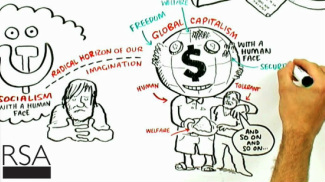 Žižek argues charitable consumption prolongs capitalism's ills. Žižek argues charitable consumption prolongs capitalism's ills. Tags: capitalism, consumption/consumerism, corporations, culture, economic sociology, marketing/brands, marx/marxism, political economy, theory, charity, corporate social responsibility, cultural capitalism, morality, starbucks, žižek, 06 to 10 mins Year: 2010 Length: 10:56 Access: YouTube Summary: In this animated segment of a longer lecture, Slavoj Žižek critiques the cultural dimensions of contemporary capitalism. Žižek begins by stating how capitalism has changed from a dichotomy between production and traditional charity (e.g. Soros earns money by exploiting workers then gives it back to humanist causes), to a form of capitalism that brings the dimensions of morality and consumption together. He offers several examples of this "cultural capitalism," including Starbucks and Tom's Shoes. In each of these instances, the act of consumption and doing good are part of the same process, which has now been universalized throughout capitalism. It is meant to make people (i.e. consumers) feel good about themselves in that they are helping poor people or a degraded environment. However, Žižek argues that by participating in this system, consumers are actually "prolonging the disease ... rather than curing it." He promotes changing the structure rather than this sort of charitable act: "The proper aim is to try and reconstruct society on such a basis that poverty would be impossible and the altruistic virtues have really prevented the carrying out of this aim." He compares this system to slave owners who were kind to their slaves because they prevented oppressed slaves from realizing the core injustice of slavery; in other words, it suggests that we are doing enough to address the system's ills and prevents more significant change. While there is an implicit argument to do away with capitalism here, Žižek explicitly states that 20th century socialism was a "mega catastrophe" and does not promote a return to that system. The clip also works well to initiate critical discussions of corporate social responsibility, Fair Trade, and other social certifications, and begin to imagine what more radical alternatives might look like. Submitted By: Paul Dean  Josh Zepps criticizes Suey Park's protest as "stupid" Josh Zepps criticizes Suey Park's protest as "stupid" Tags: discourse/language, knowledge, prejudice/discrimination, race/ethnicity, social mvmts/social change/resistance, theory, privilege, racism, standpoint theory, 00 to 05 mins Year: 2014 Length: 5:49 Access: YouTube Summary: This short clip from Huffington Post Live features social media activist Suey Park, who is interviewed by the program's host, Josh Zepps. With Park at the helm, the interview plays as a virtual thrill ride, careening through the convoluted caverns of white male privilege and deftly swerving to miss the host's attempts to sabotage and derail. Before elaborating, a little background is in order. Zepps' interview with Park was based on #CancelColbert trending on Twitter, a hashtag Park started. The hashtag was in response to a tweet sent from an account affiliated with The Colbert Report, which reads, "I'm willing to show the Asian community I care by introducing the Ching-Chong Ding-Dong Foundation for Sensitivity to Orientals or Whatever." It's worth mentioning that the tweet was apparently sent with the intention of lampooning Dan Snyder's recent announcement that he'll start a foundation to benefit Native Americans, instead of changing the racist name of his Washington, D.C. football team (more on that topic, here and here). During the interview, Zepps presses Park to concede that "the intent of the Colbert tweet was to criticize," but Park responds that irrespective of the ironic intention, the tweet missed its mark. "I really don't think we're going to end racism by joking about it," Park explains, "I'm glad white liberals feel like they are less racist because they can joke about people who are more explicitly racist, but that actually does nothing to help people of color." Zepps counters by suggesting that Park's energy would be better spent attacking Dan Snyder, and to this, Park recenters the discussion, explaining that the issue is about changing the behavior of white liberals, not what Josh Zepps thinks people of color should protest. Then, refusing to mince words, Park adds that Zepps is in no position as a white man to decide whether people of color are misguided in protesting the Colbert tweet. In response, Zepps resorts to calling his guest's opinion "stupid," and the segment ends shortly thereafter. There is a lot going on in this five-minute exchange between Zepps and Park, but I'll mention one point here. First, I think the conversation is an interesting example of how whites--including white liberals—often attempt to discredit and minimize the grievances of people of color. Zepps is following in the timeworn tracks of minimization and silencing: 1) "It's not a legitimate grievance because you don't understand the intent"; 2) "Okay, you understand the intent, but it's not a legitimate grievance because there are more important problems to protest"; and finally, 3) "Your opinions are stupid." The problem, as I see it, and the reason Zepps and Park will never find common ground, is that Zepps fundamentally rejects the legitimacy of Park's claims about what she and other people of color find offensive. Certainly, as a matter of principle, neither Zepps nor any other white person can be the one who ultimately decides whether a person of color has a right to be offended, but more to the point, white people occupy a structural position of privilege and power, and from that position, it is even predictable that they will not see eye to eye with people of color. Zepps clearly counts himself a logical man, who is capable of arriving at reasoned perspectives, but his logic is infected by the false premises of white privilege. He would do well to consider the many insights of standpoint theory, which argue that people working from the "outsider-within" perspective occupy a unique position, allowing them to recognize patterns of domination. Submitted By: Lester Andrist  Film about 1980 US Olympic win illustrates social identity theories. Film about 1980 US Olympic win illustrates social identity theories. Tags: psychology/social psychology, sports, theory, henri tajfel, intragroup processes, intergroup processes, john turner, role identities, self-categorization theory, social identities, social identity theory, 06 to 10 mins Year: 2004 Length: 10:25 Access: YouTube Summary: This montage of two clips from the 2004 movie Miracle documents the United States Hockey Team’s win over Russia to secure the gold medal at the 1980 Winter Olympics; the montage also features footage from the actual game. In the first clip, U.S. head coach Herb Brooks asks the players to introduce themselves, which they do using their names, cities of origin, and university affiliations. In the second clip, the team has just lost a scrimmage game and Brooks keeps them on the ice to run drills despite the players’ exhaustion and coaching staff’s disapproval, until one of the players “reintroduces” himself; Brooks asks again who the player, Mike Eruzione, plays for, and Eruzione replies, “I play for the United States of America.” Upon hearing this, Brooks appears satisfied and ends the drills. This video can be used to illustrate several dimensions of Henri Tajfel’s social identity theory and/or John Turner’s self-categorization theory. I show this clip after students have read an overview of role and social identity theories by Thoits and Virshup (1997). First, it can be used to distinguish generally between role identities (who I am) and group or social identities (who we are). Sports teams, in general, are basic examples of I’s coming together to form we’s. Second, more specific principles within theories of social identity are illustrated. Tajfel’s psychologically oriented social identity theory focuses on intergroup processes of in-group and out-group formation, group conflict, and prejudice. Turner’s self-categorization theory is more focused on intragroup processes of categorization and depersonalization; in other words, the process by which individuals form a group. The Miracle montage is an illustration of both intergroup and intragroup processes, with the U.S.-Russia rivalry illustrating group conflict (intergroup) and the post-loss drills leading Eruzione to declare that he plays for the United States (depersonalization and categorization). This montage is especially useful at illustrating the processes of depersonalization and categorization as we watch the players go from identifying themselves as individuals to identifying themselves as members of the U.S. team. The somewhat artificial context of sports can be an accessible entry point to talking about other more “real world” contexts of group identity, both in terms of intergroup conflict and intragroup processes of depersonalization (e.g., ethnic, tribal, and state identifications and conflicts). Submitted By: Kathleen E. Denny |
Tags
All
.
Got any videos?
Are you finding useful videos for your classes? Do you have good videos you use in your own classes? Please consider submitting your videos here and helping us build our database!
 |
 RSS Feed