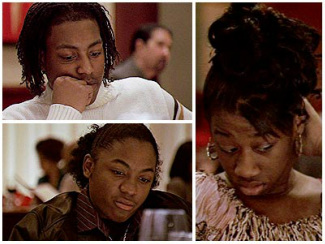
 Tags: race/ethnicity, class, inequality, cultural capital, privilege, 00 to 05 mins Year: 2006 Length: 4:33 Access: YouTube Summary: Ex-cop turned public school teacher Howard "Bunny" Colvin has taken it on himself to help reach the badly underprivileged children who have been deemed essentially unteachable by their West Baltimore junior high school. After his students do well on a project, Colvin decides to take them out to dinner at an upscale restaurant. Initially the students are excited and pleased--but over the course of the meal they become increasingly uncomfortable and discouraged. This is a good way to open a discussion of cultural capital in the context of class inequality, especially with an eye toward intersections of race and gender. Useful questions to ask: Why are Bunny's students so uncomfortable? What assumptions do they bring to their situation about what is expected of them? What if the situation were reversed and the people dining at the restaurant were on the streets of West Baltimore? The differences in the characters’ behavior at the beginning and the end of the clip are especially striking—why the change, and what does it say about what has happened in the scene? Submitted By: Sarah Wanenchak
4 Comments
Karen Trachtenberg
10/30/2012 11:06:27 am
here is a video you should also add to this discussion. I think it illustrates the importance of cultural capital and stratification just as clearly as the Bunny Colvin clip above. There are elements of Marx in here too, as Donette discusses what the power of money can do.
Bambi
11/23/2012 01:42:11 pm
Thank you so much for posting this! I have been using this scene in my cultural anthro class to talk about cultural capital, but cuing it up from the DVD. Such a good illustration.
Karen Trachtenberg
11/23/2012 04:30:19 pm
Sure thing! I am obsessed with this show. ;) I can't lie about that. And, I'm also a huge Bourdieu fan.
Manuel Franco
7/31/2023 09:52:40 am
I just want to say Thank You to everyone who supported me through the years. My name is Manuel Franco, New Berlin, Wisconsin. My story of how I won the Powerball lottery of $768.4M is a bit of a tale. I have been playing Powerball tickets for 6 years now since I turned 18. I bought my first ticket on my 18 birthday. I was feeling very lucky that day because I had contacted Dr. Odunga Michael to help me with the winning Powerball numbers. I really had that great great feeling that I looked at the camera wanting to wink at it. I only did a tiny part of it and trusted him. He gave me the numbers after I played a couple other tickets along with it for $10. I checked my ticket after the winnings came online and saw the numbers were correct including the Power play. I screamed for about 10 minutes because it felt like a dream. I had won $768.4M. You can check my winning testimony with the lottery officials just with my name search. Thank you Dr Odunga. Well, his email is odungaspelltemple@gmail.com and you can also call or Whats-app him at +2348167159012 so you guys can contact him Leave a Reply. |
Tags
All
.
Got any videos?
Are you finding useful videos for your classes? Do you have good videos you use in your own classes? Please consider submitting your videos here and helping us build our database!
 |
 RSS Feed