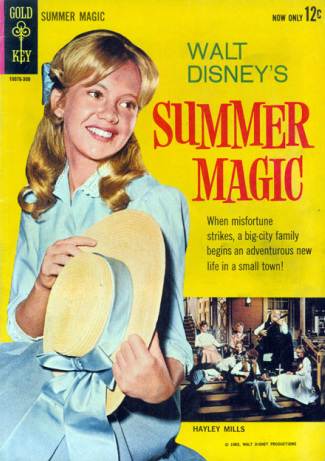
 Tags: gender, theory, feminist theory, judith butler, performativity theory, queer theory, 00 to 05 mins Year: 1963 Length: 1:22; 3:12 Access: YouTube (clip 1; clip 2) Summary: Key concepts in Judith Butler's "gender as performance" theory are illustrated by a simple close reading of these two mainstream Hollywood films from 1963, (the very same year, incidentally, that Betty Friedan published The Feminist Mystique). The first shows the tom boyish Nancy (Hayley Mills) and Nancy's girly cousin Julia (Deborah Walley) teaching the dowdy Una (played by Mariah Popham) that being a socially successful woman is simply a matter of walking, talking and smiling in a feminine way, as well as dressing in equally feminine clothes. As Butler suggests, gender is something we "make" and "make-up." The next clip takes this idea a little further, with popular and newly pinned Kim (Ann Margaret) singing about the virtues of growing from a girl into a woman. However, importantly, although Kim's lyrics remind us that being a woman is all about "wearing mascara" and "smiling a woman's smile" she is, at the same time, pulling a sweet, vaguely flirtatious switcheroo by almost completely disrobing, taking off her dress and pulling on an oversized sweater, socks, jeans and a baseball cap. As Butler might describe it, she is "subverting" her gender through "parody" or "drag," for the perfectly socialized Kim, as distracted by love as she may seem, is herself still very well aware that defying gender norms are as easy as following them, especially when the naked body is only hinted at and never fully exposed or seen. Submitted By: Audrey Sprenger
6 Comments
Laurel Westbrook
5/22/2012 03:40:40 am
Not to be difficult, but Judith Butler does not argue that gender is a performance. She argues that gender is produced through performative gestures. While her argument is a little vague in Gender Trouble, she spends a lot of time in Bodies that Matter explaining how she is NOT arguing that gender is a performance. http://en.wikipedia.org/wiki/Performativity
Horacio
2/8/2013 02:32:44 am
Excellent comment. In her book Excitable Speech she explores the consecuences of the capacity of our language to generate social reality through performative acts of speech.
Having a rough time in the field while playing or during practice, DRAG MAT REVIEWS has got you covered. To enhance a smooth and well-leveled area that enables players to do better practice and rehearsal as it improves their infield quality
Manuel Franco
7/30/2023 05:52:50 pm
I just want to say Thank You to everyone who supported me through the years. My name is Manuel Franco, New Berlin, Wisconsin. My story of how I won the Powerball lottery of $768.4M is a bit of a tale. I have been playing Powerball tickets for 6 years now since I turned 18. I bought my first ticket on my 18 birthday. I was feeling very lucky that day because I had contacted Dr. Odunga Michael to help me with the winning Powerball numbers. I really had that great great feeling that I looked at the camera wanting to wink at it. I only did a tiny part of it and trusted him. He gave me the numbers after I played a couple other tickets along with it for $10. I checked my ticket after the winnings came online and saw the numbers were correct including the Power play. I screamed for about 10 minutes because it felt like a dream. I had won $768.4M. You can check my winning testimony with the lottery officials just with my name search. Thank you Dr Odunga. Well, his email is odungaspelltemple@gmail.com and you can also call or Whats-app him at +2348167159012 so you guys can contact him Leave a Reply. |
Tags
All
.
Got any videos?
Are you finding useful videos for your classes? Do you have good videos you use in your own classes? Please consider submitting your videos here and helping us build our database!
 |
 RSS Feed