 Tags: children/youth, crime/law/deviance, discourse/language, emotion/desire, lgbtq, sex/sexuality, bi-curiousity, conversion therapy, 21 to 60 mins
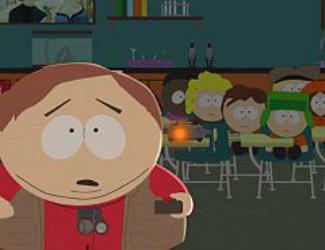
Year: 2007 Length: 21:26 Access: southparkstudios.com Summary: [Trigger warning: Not all instructors will feel comfortable screening an episode of South Park in the classroom, a show that is notorious for its "crude language and dark, surreal humor" on a wide range of often taboo topics. This episode is no exception. Specifically, instructors might be uncomfortable with this episode's treatment of youth suicide, violence, sex, sexual consent, and cultural/ethnic insensitivity.] In this South Park episode (season 11, episode two), South Park Elementary School student Cartman takes a photo of his own penis in his friend Butters's mouth while Butters is sleeping. Afterwards, Cartman tells his friends about what he did in order to ridicule Butters. However, Cartman didn't count one thing: this behavior is interpreted as a homosexual act and his friends start calling him "gay." Hoping to prove that he's not gay, Cartman believes he must convince Butters to reciprocate the act. Just as Cartman is about to carry out his plan in front of a blindfolded and unknowing Butters, Butters's father walks into the bedroom. Concerned that his little boy is bisexual, his father takes Butters to the priest, who diagnoses Butters as "confused" and suggests Butters attend a bi-curious boy's camp to heal Butters from this "disease." This video can be used as an example of how bisexual people are perceived as being confused about their sexual identity. As Ryle (2012) writes in Questioning Gender: A Sociological Exploration: "Bisexuals can receive negative reactions from both homosexuals and heterosexuals." She cites Ault's (1996) work that showed how some lesbian feminists "insist that there is no such thing as bisexuality. Bisexuals are either confused lesbians or heterosexuals who are experimenting" (201). The clip can also be used to initiate a discussion about cultural definitions of sexual orientation: Is it about behavior? Desire? Identity? Finally, the episode offers a framework for talking about sexuality as a choice or innate, and illustrates the ways in which heterosexuality gets defined as "normal" through a discourse of shame, guilt, and "fixing" or "curing" anything that deviates from a cultural heterosexual norm. Submitted By: Nihal Celik
4 Comments
merlyn
7/19/2014 11:55:50 am
we nver had this discussions .. and thank God now we cud define all these areas.. there ar many ppl because off the fear off social out cast try to escape their original self and their intentions .But try to marry like anyother normal person and destroied many womens life ,inthe proces of prooving dem selves....bt ultimately failed ... and made the wifes and childrens lifeahell as well his own.... the society shud aknowledge them n approve them ...
noah james
2/22/2019 06:34:03 am
Hello everyone, am very happy to share this little awesome testimony about Dr olu a great herbal doctor who help me enlarge my penis size.3.2 cm to 8.3 cm longer with his herbal cream mixture, my girlfriend is now so amazed with the autonomous size of my penis , if you you are also in need of help on how to enlarge your penis to become bigger and stronger I adverse you to contact Dr on his email (drolusolutionhome@gmail.com) ) you or contact on whatsapp number +2348140654426 because he is one of the best herbal doctor that i can only show you up to, if your penis is 4.2 cm and want to get it reach 9.2 cm within three weeks i Dr olu is also specialized on obey m breast and boobs enlargement i advise you to contact him for help
Manuel Franco
7/30/2023 12:26:23 pm
I just want to say Thank You to everyone who supported me through the years. My name is Manuel Franco, New Berlin, Wisconsin. My story of how I won the Powerball lottery of $768.4M is a bit of a tale. I have been playing Powerball tickets for 6 years now since I turned 18. I bought my first ticket on my 18 birthday. I was feeling very lucky that day because I had contacted Dr. Odunga Michael to help me with the winning Powerball numbers. I really had that great great feeling that I looked at the camera wanting to wink at it. I only did a tiny part of it and trusted him. He gave me the numbers after I played a couple other tickets along with it for $10. I checked my ticket after the winnings came online and saw the numbers were correct including the Power play. I screamed for about 10 minutes because it felt like a dream. I had won $768.4M. You can check my winning testimony with the lottery officials just with my name search. Thank you Dr Odunga. Well, his email is odungaspelltemple@gmail.com and you can also call or Whats-app him at +2348167159012 so you guys can contact him Leave a Reply. |
Tags
All
.
Got any videos?
Are you finding useful videos for your classes? Do you have good videos you use in your own classes? Please consider submitting your videos here and helping us build our database!
 |
 RSS Feed