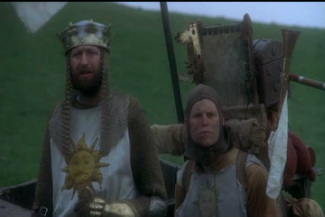
 Dennis the peasant gets an impromptu visit from the King Dennis the peasant gets an impromptu visit from the King Tags: class, inequality, marx/marxism, political economy, theory, weber, charasmatic authority, class conflict, class consciousness, exploitation, ideology, labor, rational-legal authority, subtitles/CC, 00 to 05 mins
Year: 1975 Length: 3:11 Access: YouTube Summary: This hilarious clip from Monty Python and the Holy Grail, illustrates several key concepts from Marx. After Dennis (a peasant) gets a presumptuous greeting from a visitor, he states "what I object to is you automatically treating me like an inferior." The visitor responds with "well, I am King." Dennis challenges him by arguing: "How'd you get that? By exploiting the workers. By hanging on to outdated imperialist dogma which perpetuates the economic and social differences in our society." Marx's concept of exploitation refers to the value that comes from workers' labor, but which gets taken by the ruling class (whether it be feudal lords, kings, or capitalists) because they own the means of production. The peasant describes this process as an unfair dimension of the class system. This awareness reflects his own class consciousness, or understanding of the class system, how it affects him, and how to act in his own class interest. Another peasant notes they are part of autonomous collective, which Dennis describes as their own self-rule based on equality. When they challenge the King's authority because they didn't vote for him, the king argues he obtains his authority from "the Lady of the Lake" that gave him Excalibur and right to rule by divine providence. Dennis comically responds that "Strange women lying in ponds distributing swords is not basis for government; supreme executive power derives from a mandate from the masses, not from some farcical aquatic ceremony." Their competing interests reflect the class struggle in which the workers' interest (self-rule that allows them collective ownership of the means of production) are inherently in conflict with those of the ruling class (who seek to control the workers and keep the value of their labor for themselves). Finally, the notion of divine right to rule is an example of ideology, or ideas supported by the ruling class, and which legitimate the current order and obscure the oppressive class system. I would like to thank Camilla Hayes and Andrew Hanko for recommending this clip. Submitted By: Paul Dean
11 Comments
4/9/2012 12:21:46 am
I've used this same clip in teaching classical sociology. But rather than Marxian concepts, I've used it to illustrate Weber's distinction between charismatic and rational-legal authority. Upon being aked how he became King, Arthur offers a classical charismatic account: He has been appointed by God, with the Lady of the Lake offering him Excalibur. This is challenged by the peasant, who offers a typical rational-legal critique: "Supreme executive power derives from a mandate from the masses, not from some farcical aquatic ceremony". To my mind, this is the perfect example of the distinction between the two types of authority: the anarchist peasant's critque is almost ideal-typical of (legitimations of) rational-legal authority under democracy. In a way, this is quintessential of the whole movie, which so often parodies our modern conceptions of medieval times - the countless examples of completely irrational (to our eyes) practices (whipping water with sticks in the same scene, seemingly unmotivated beating of cats).
Mattias De Vuyst
5/5/2012 06:05:38 am
It is definitely more illustrating Weber than Marx in my opinion. It also has some Rousseau in it as well.
raymond
6/21/2013 05:46:03 pm
The problem with this clip is the ideological frame which informs it: public school ironic jesting which places itself above the critique and renders that critique jargonised rubbish: the effect is in fact to mock the supposed egalitarian perspective and make it a product of rote learning. Monty Python is far from radical but like all that satire from Private `eye is deeply conservative and traditionalist.
Nick Ames
10/17/2016 11:10:05 pm
I hear this skit as having fun with BOTH perspectives/belief systems
Phillip Wand
4/1/2024 06:27:36 am
It's supposed to be funny and it is
An anarcho-syndicalist(perhaps)
3/20/2015 04:28:32 am
anarcho-syndicalism has got absolutely nothing to do with marx, or anything above this comment.
Pseudonym
9/12/2018 01:47:39 am
The thing is, the commie is wrong. He presupposes that violence being inherit in the system is a negative aspect of it. In fact, all governments, even anarcho-syndicalist governments, had one ever been able to effectively exist, are dependent on the use of violence to enforce the will of some over the will of others. Even majoritarian democracies will enact violence should some minority choose to oppose their rulings.
Pseudonym
11/14/2018 09:47:45 am
yea we should just give the power to the guys with the biggest weapons thats a just system *rolls eyes*.
Eric Watkins
6/2/2022 07:32:42 am
Humans naturally function as an autonomous collective. Maybe ten years is a bad number; how about 120,000 years? The advent of tyrannical rulers is truly about 10,000 years and even that started out as the desertification of Mesopotamia, resulting in the idea of water rights, and turned Egypt White (yup, Egypt was black before the "Noah Aharka"). Then about 4,000 years ago some guy named Zarathustra wandered out of the Afghan mountains with one true God, Ahura Mazda, a new era in controlling man had begun. We're born to rule no further than the reach of our own fingertips, but what put all those fingertips together you might get somewhere.
Manuel Franco
7/30/2023 12:26:41 pm
I just want to say Thank You to everyone who supported me through the years. My name is Manuel Franco, New Berlin, Wisconsin. My story of how I won the Powerball lottery of $768.4M is a bit of a tale. I have been playing Powerball tickets for 6 years now since I turned 18. I bought my first ticket on my 18 birthday. I was feeling very lucky that day because I had contacted Dr. Odunga Michael to help me with the winning Powerball numbers. I really had that great great feeling that I looked at the camera wanting to wink at it. I only did a tiny part of it and trusted him. He gave me the numbers after I played a couple other tickets along with it for $10. I checked my ticket after the winnings came online and saw the numbers were correct including the Power play. I screamed for about 10 minutes because it felt like a dream. I had won $768.4M. You can check my winning testimony with the lottery officials just with my name search. Thank you Dr Odunga. Well, his email is odungaspelltemple@gmail.com and you can also call or Whats-app him at +2348167159012 so you guys can contact him
Phillip Wand
4/1/2024 06:30:10 am
Well I didn't vote for you Leave a Reply. |
Tags
All
.
Got any videos?
Are you finding useful videos for your classes? Do you have good videos you use in your own classes? Please consider submitting your videos here and helping us build our database!
 |
 RSS Feed