 Tags: discourse/language, gender, inequality, media, prejudice/discrimination, decentering, eve teasing, india, sexual harassment, sexism, street harassment, 00 to 05 mins
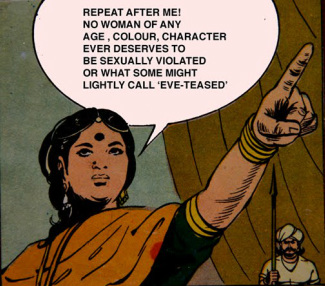
Year: 2012 Length: 3:32 Access: YouTube Summary: It is often the case that when incisive critiques are leveled against an oppressive system, such as patriarchy, there will be efforts to derail or decenter that conversation. For example, one might critique patriarchy in India by pointing out that there is a marked tendency to blame the victim in cases of harassment. Defying all probability, time and again the original critique of power slips from the conversation, and those who were instrumental in exposing the problem suddenly find themselves defending whether their critique is in fact proof of their own prejudice against men. Or, even more befuddling, the focus of the conversation shifts from the problem of sexual harassment to the hurt feelings of a few men who claim they have never harassed women. As explored elsewhere on The Sociological Cinema, YouTube videos can be understood as social activism, and in that context, any single clip can be seen as a discrete contribution to an unfolding public conversation about a particular social issue. In the above video, one finds a young man catching a ride on a not-so-crowded Delhi bus. In the course of the ride the driver abruptly presses on the brake, and the young man accidentally falls on the woman standing next to him. On the mistaken assumption that the man was attempting to physically harass her, the woman slaps him across the face (a perfect Indian response!), and the woman's friend chides the man for “not having any manners.” Later in the ride, the driver again abruptly presses the brake, but in this instance, it is the woman who falls on the man, and it is now his turn to slap her. The video encourages the viewer to see the man's response as entirely valid and even legally justified (The video's caption references Article 15 of the Indian constitution, which prohibits gender based discrimination). It is a cautionary tale, which promotes the absurd idea that men must frequently bear the burden of being unjustly accused of street harassment, or what is euphemistically referred to as eve teasing in India. The conversation no longer contemplates the tendency to blame the victim, and it no longer dwells on why violence against women is now the fastest-growing crime in India. Instead, this video and others like it attempt to reorient the discussion so that people must now contemplate the indignity suffered by a minority of men who have been unjustly accused. Submitted By: Manjistha Banerji Image by Blank Noise
6 Comments
Bily K
7/10/2012 11:02:01 am
Reading this article was such a beautiful and enlightening experience to me. I will definitely used these arguments in the future when dealing with that kind of men. 7/11/2012 04:28:58 pm
Hello. This image is sourced from Blank Noise. We created a twitter and Facebook event based on this image. Would be delighted if you could kindly link the image to http://blog.blanknoise.org/2010/02/tweet-now-feb-17-27.html
The Sociological Cinema
7/16/2012 12:19:01 am
First of all, great job on the images on your site! Thank you for reaching out to us. We have credited you and linked to you in the post. Keep up the good work!
Mejor
12/14/2012 08:26:35 am
I am confused. This post seems to celebrate the woman slapping the man but not the man slapping the woman. That seems like the double-standard-sexism that tends to permeate the left (e.g., it is celebrated in "The Technology of Orgasm"). Even better: don't slap people. I'm all about women's physical autonomy, but don't get slap happy on people who don't deserve it.
Gwendolyn Claflin
4/4/2013 07:10:13 am
It's not about the woman slapping the man or vice versa. It's about critiquing the video for not focusing on the larger social issue.
Manuel Franco
7/30/2023 12:20:42 pm
I just want to say Thank You to everyone who supported me through the years. My name is Manuel Franco, New Berlin, Wisconsin. My story of how I won the Powerball lottery of $768.4M is a bit of a tale. I have been playing Powerball tickets for 6 years now since I turned 18. I bought my first ticket on my 18 birthday. I was feeling very lucky that day because I had contacted Dr. Odunga Michael to help me with the winning Powerball numbers. I really had that great great feeling that I looked at the camera wanting to wink at it. I only did a tiny part of it and trusted him. He gave me the numbers after I played a couple other tickets along with it for $10. I checked my ticket after the winnings came online and saw the numbers were correct including the Power play. I screamed for about 10 minutes because it felt like a dream. I had won $768.4M. You can check my winning testimony with the lottery officials just with my name search. Thank you Dr Odunga. Well, his email is odungaspelltemple@gmail.com and you can also call or Whats-app him at +2348167159012 so you guys can contact him Leave a Reply. |
Tags
All
.
Got any videos?
Are you finding useful videos for your classes? Do you have good videos you use in your own classes? Please consider submitting your videos here and helping us build our database!
 |
 RSS Feed