|
The following short essay is part of a project initiated by The Sociological Cinema to introduce young people to sociological ideas and explanations regarding important social issues. In this case, I met via Zoom with one precocious young sociologist named Halcyeon for about 30 minutes each week from April to December 2020. Drawing from a wide range of resources, including The 1619 Project from The New York Times, we surveyed the history of race and racism in the United States. As the new year and our final class together approached, I asked Halcyeon to write down his thoughts about the cause of racism and what can be done to end it. What follows is his answer.

he root of racism in the U.S. is hard to pinpoint because it is so twisted. But the U.S. is not the only place that is racist. A lot of other countries are racist too. The main source, or as close as I can get to it, is the white slavers bringing black people over from Africa. The root cause of racism is because white slavers started to treat blacks as animals. Over time that started to create racism. Also white slavers beat black people, and to not feel guilty, white slavers thought black people were animals. At first, slavery and racism were not the same thing, slavery was “I conqured you, so you are my slave” and racism was “your black and I’m white, so I have more power than you.” The U.S. brought slavery and racism together. 
After slavery when black people got rights, white’s didn’t like it because, to them, giving black people rights is giving animals rights. Whites tried to suppress them again, so whites would not be equal to blacks. This piece of history is how racism started.
Racism is not a one-person problem. Racism is a group problem because people who have racist ideas find other people to back them up. In this way, racist people won't look weird because they are surrounded by a crowd of people who seem to share their ideas. Racism is a group problem so a group has to fix it. One person can’t change all the people’s minds in the U.S. just because he or she said something. That is not how the world works. You have to persuade them. Without the help of others, persuading them would take forever, so you need to have an antiracism group to back you up. So here it is: this is your one easy step to stop racism. Your antiracism group will slowly persuade people to join your group and then you can change so many people's minds at once. As you slowly change people's minds, people will slowly start to dislike racism even more until everyone hates racism. We don’t have to create a new antiracism group because such antiracism groups exist, like the Black Lives Matter group. So, we can jump into the fray and try to help overturn racism. We can all support Black Lives Matter just by putting a sign outside our front lawns. At least racism is not as bad as it was in the past because there was Jim Crow segregation and blacks could not go to the same school as whites. So let's pray that does not happen again. I hope the U.S. and all the other countries stop being racist. If we all work together, one day racism will cease to exist. Halcyeon A. Halcyeon A. is a 12-year-old 7th grader in middle school, who likes to play video games and watch anime. He also enjoys playing the clarinet and the sax while contemplating life during the pandemic.
The following short essay is part of a project initiated by The Sociological Cinema to introduce young people to sociological ideas and explanations regarding important social issues. In this case, I met via Zoom with one precocious young sociologist named Aeonian for about 30 minutes each week from April to December 2020. Drawing from a wide range of resources, including The 1619 Project from The New York Times, we surveyed the history of race and racism in the United States. With our final class approaching, I asked Aeonian to write down her thoughts about the cause of racism and what can be done to end it. What follows is her answer.

he root cause of racism in the U.S. is that racist people don’t want to be overpowered. Don’t just say white people are racist, that is a lie! White people aren’t the only racist people, other people can be racist too. My guess is 40% of white people are racist or have a racist history. The key point is that we must pay attention to how some people try to overpower other people based on race. 
How can American Society overcome racism?
Racist people could try to welcome BIPOC folks more. If a racist person were in a BIPOC person's shoes, the racist person would know how bad they are acting. I think racist people should think more about what they do. Racist people might think, “Well, ‘Black Lives Matter’ means other people's lives don’t matter,” but Black Lives Matter isn’t saying other lives don’t matter. Black Lives Matter is saying, “Our lives matter too.” Like I said, a lot of white people are racist, but other people can be racist too. There was a racist guy at my school who was in my brother’s fourth grade class, who went up to white people and said,” you need milk,” and then went up to black people and said, “you need chocolate milk.” He wasn’t white, he was Hispanic. Consider John H. Brown, who was a white abolitionist leader in America. He was able to support the abolitionist cause by becoming a conductor on the Underground Railroad and by establishing the League of Gileadites, an organization established to help runaway slaves escape to Canada. Whether people are Black, Indigenous, Asian, Hispanic, or white, the point is everyone should be against racism and willing to risk their lives to save other people’s because we all need to help each other. Aeonian A. Aeonian A. is a 5th grader in Connecticut. In her free time, she likes to read books, such as Fuzzy Mud or Holes, and she likes to play video games with her friends. Her favorite subjects are writing, reading, and sometimes math. 
e've all seen and heard it before: Smart. Rich. Asian. This stereotype is what's called the Model Minority Myth, and it characterizes Asian Americans as a polite, law-abiding group that has achieved a higher level of success compared to the general population through some innate talent somehow brought about by race and culture. We all know about this, but do we really understand how it came to be? 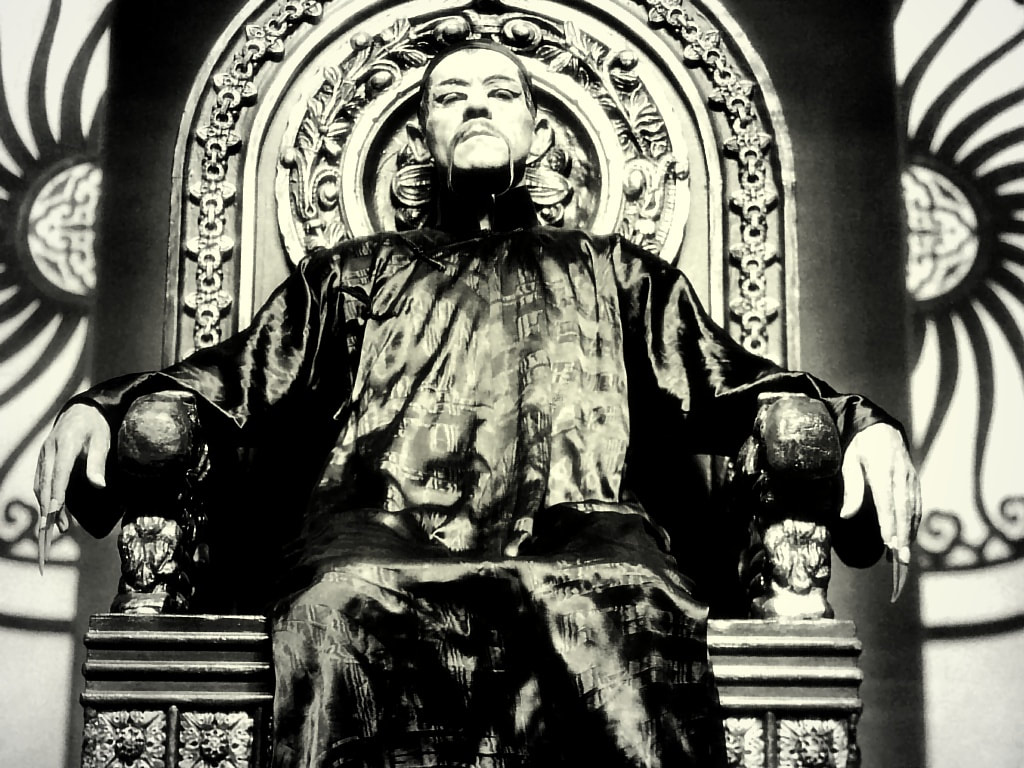
Boris Karloff in The Mask of Fu Manchu (1932)
Now, a myth like this didn't penetrate the public consciousness without outside help, and much of it can be traced back to media. To truly understand where this myth comes from, we'll have to go back to the 19th century, when Asians weren't perceived as model citizens just yet.
In fact, Asians in America were once seen as a scourge and were referred to as the Yellow Peril. This took on a new life in the United States, among pioneers and early settlers who were promised prosperity but were then met with nothing. Their anger was redirected to Chinese workers building the railroads along the Pacific, who became the scapegoats. It is because of this that Asians were originally perceived to be nefarious people looking to steal jobs and soil everything that America stands for. This stereotype stuck around and even inspired some early films. Such portrayals can be found in the Chinese character in the 1932 film The Mask of Fu Manchu, where the titular Fu Manchu, played by Boris Karloff, was one of the earliest evil genius archetypes in modern cinema. Echoes of Yellow Peril can even be found in modern films, too, as the upcoming Marvel movie Shang-Chi and the Legend of the Ten Rings puts Shang-Chi, who is canonically the son of Fu Manchu, at the forefront. So if Asians were painted in such a bad light, when did this all change? There are two events that perpetuated this shift. One is the Immigration and Naturalization Act of 1965, which abolished the quota system for immigration. Instead, the law based immigration off of familial ties and prioritized people who were skilled professionals. This led to an influx of Asian professionals migrating to the United States. Then there was William Petersen's January 1966 article in The New York Times, entitled "Success Story: Japanese American Style." The article proposed that the apparent success of Japanese Americans was due to their incarceration in internment camps during World War II, which gave them a great work ethic and strong cultural values. Petersen even proposed that this made Asians inevitably more successful than white Caucasians. 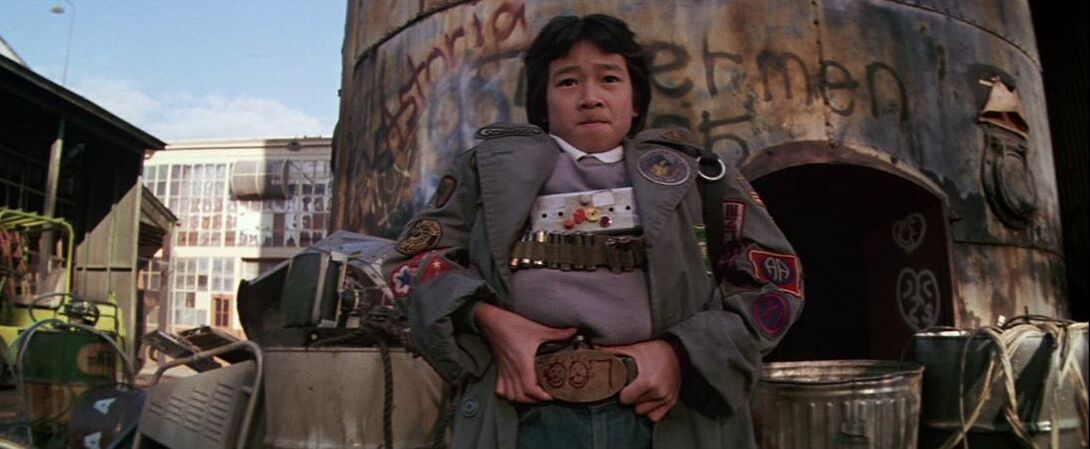
Ke Huy Quan as "Data" in The Goonies (1985)
To this day, iterations of this idea can be seen in modern film through characters like Data from The Goonies (1985) and Takashi Toshiro from Revenge of the Nerds (1984). Hollywood's insistent portrayal of Asian Americans as stereotypically smart characters feeds off of and reinforces these biases. In fact, researchers at Harvard and Ohio State Universities have found that media affects our subconscious judgments toward others. But the effects of film go way beyond just perception — as it can manifest in one's opportunities, developmental experiences, and even mental health.
According to the National Alliance on Mental Illness, the stereotype of all Asian Americans as wealthy, highly educated, and stable puts undue pressure on them. This makes them less likely to reach out for help regarding mental health issues and ultimately affects how they live their day-to-day lives. This is something highlighted by psychologists at Maryville University, who point out that mental health and learning success are intricately intertwined. And in the case of minorities who experience the enduring pressure of this cultural myth in Hollywood and the world that worships it, this can have drastic consequences. One such manifestation of this might be seen in how the Centers for Disease Control and Prevention now ranks suicide as the ninth leading cause of death among Asian Americans and Pacific Islanders. 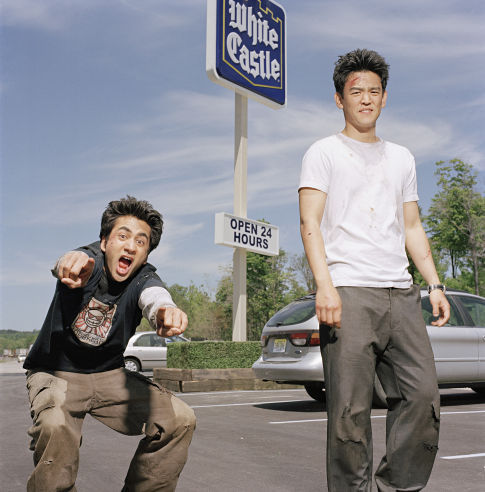
John Cho and Kal Penn in Harold & Kumar Go to White Castle (2004)
So, are all stereotypes bad? While that may sound like an absurd question to ask, the nuances of this subject are best described under the lens of what many perceive as a positive stereotype: Asian Americans are all brilliant in the fields of math and science. Unlike other stereotypes, especially those surrounding other racial and ethnic groups, this one pushes a positive narrative. But not unlike other stereotypes, all the Model Minority Myth does is cause harm to the minority that it pertains to.
This is why films like Harold and Kumar Go To White Castle (2004) are admirable when put under the lens of the Model Minority Myth, as the inherent incompetence of the characters can be seen as a subversion of years upon years of systemic discrimination. The bottom line, of course, is that although Asian characters can be portrayed as intelligent, they should never be defined as intelligent for simply being Asian. Y. Gbadamosi Y. Gbadamosi is a 21-year-old business studies student who enjoys traveling and a good cup of coffee. She loves Film and its influence on mainstream culture 
Glance at the news or scroll through your Twitter feed and you're likely to encounter stories about racism in the criminal justice system. Alton Sterling, Philando Castile, Korryn Gaines, and Mike Brown are just a few of the names of African Americans who have been victims of police violence. One recent study demonstrated that Black males are 21 times more likely than white males to be killed by a police officer, and social class offered no protection. High-income Blacks were just as likely as low-income Blacks to be killed.
Despite these grim figures, it's also the case that the way police violence is discussed in the public is problematic. The problem is too often framed as one about bad officers, when it would be more accurate to talk about a bad system, or as sociologists would point out, a racist institution. This podcast is the first of two parts. In part 1 (below), Lester Andrist sits down with Rashawn Ray, Associate Professor of sociology from the University of Maryland, and the two sociologists discuss what makes police violence institutional, what does institutional racism look like, and what can be done about it. In part 2 the discussion continues as Dr. Ray offers his thoughts on the effectiveness of the Black Lives Matter movement.
Originally posted on SOCIOLOGYtoolbox
The problem with overt racism (other than its bigoted, undemocratic, violent and discriminatory nature) is that whites (myself included as a white heterosexual male) too often think that as long as we don’t fly the Confederate flag, use the n-word, or show up to the white supremacist rally that, well…we aren’t racist. However, researchers at Harvard and the Ohio State University among others show that whites, even today, continue to maintain a negative implicit bias against non-whites. This negative bias is subconscious and is activated in split second decisions we make…judgments about others. Harvard’s Project Implicit explains the Implicit Association Test (IAT) as follows: “The IAT measures the strength of associations between concepts (e.g., black people, gay people) and evaluations (e.g., good, bad) or stereotypes (e.g., athletic, clumsy). The main idea is that making a response is easier when closely related items share the same response key." When doing an IAT you are asked to quickly sort words that are on the left and right hand side of the computer screen by pressing the “e” key if the word belongs to the category on the left and the “i” key if the word belongs to the category on the right. The IAT has five main parts. In the first part of the IAT you sort words relating to the concepts (e.g., fat people, thin people) into categories. So if the category “Fat People” was on the left, and a picture of a heavy person appeared on the screen, you would press the “e” key. 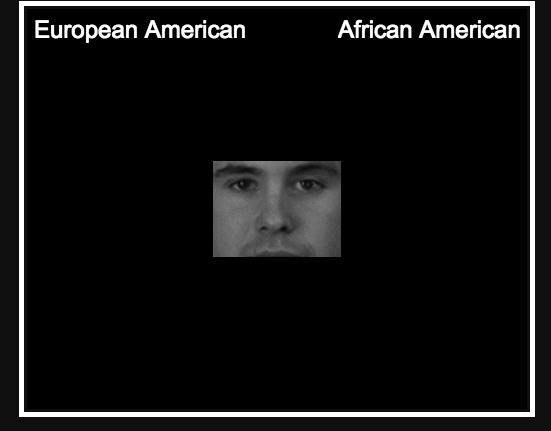
In the second part of the IAT you sort words relating to the evaluation (e.g., good, bad). So if the category “good” was on the left, and a pleasant word appeared on the screen, you would press the “e” key. In the third part of the IAT the categories are combined and you are asked to sort both concept and evaluation words. So the categories on the left hand side would be Fat People/Good and the categories on the right hand side would be Thin People/Bad. It is important to note that the order in which the blocks are presented varies across participants, so some people will do the Fat People/Good, Thin People/Bad part first and other people will do the Fat People/Bad, Thin People/Good part first. 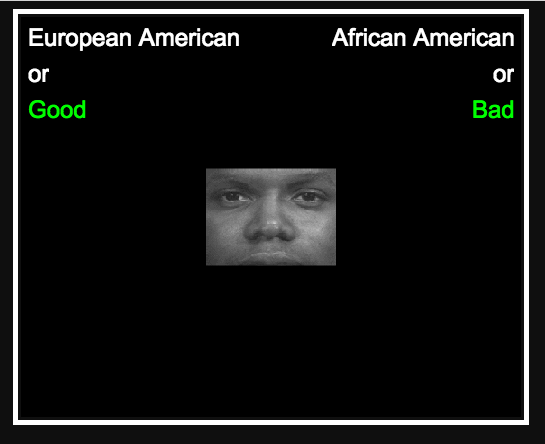
In the fourth part of the IAT the placement of the concepts switches. If the category “Fat People” was previously on the left, now it would be on the right. Importantly, the number of trials in this part of the IAT is increased in order to minimize the effects of practice. In the final part of the IAT the categories are combined in a way that is opposite what they were before. If the category on the left was previously Fat People/Good, it would now be Fat People/Bad. The IAT score is based on how long it takes a person, on average, to sort the words in the third part of the IAT versus the fifth part of the IAT. We would say that one has an implicit preference for thin people relative to fat people if they are faster to categorize words when Thin People and Good share a response key and Fat People and Bad share a response key, relative to the reverse.” But where do these negative subconscious attitudes come from?
The Kirwan Institute for the study of race and ethnicity at Ohio State states: “These associations develop over the course of a lifetime beginning at a very early age through exposure to direct and indirect messages. In addition to early life experiences, the media and news programming are often-cited origins of implicit associations.”
I recently came across one such example in the media. A seemingly harmless billboard in Chicago’s O’Hare International airport for Hiperos, a company that works to protect clients against reputational impact, regulatory exposure and revenue loss, particularly when dealing with a third party. I tried to ignore the large flatscreen monitor, however, as it flipped through the images I began to notice an interesting trend. The ad implied that, as a business, you need to be leery of the relationships you engage in with third parties. Of particular risk is exposure to bribery or corruption. 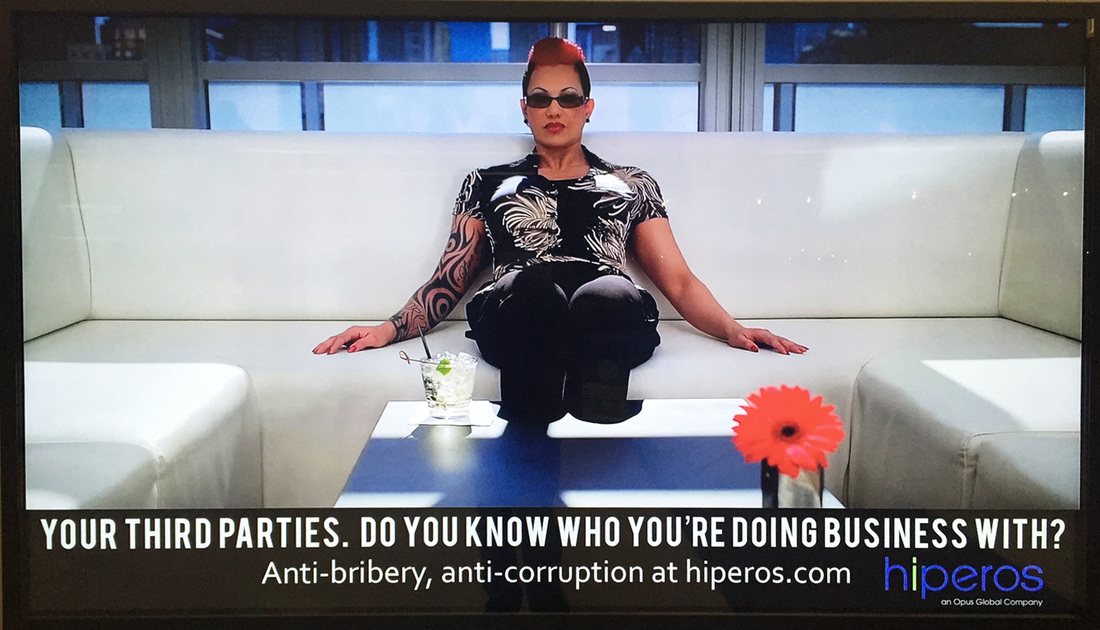
So, who can you trust? Who are the people you should be afraid of? Suspicious of? What does a deviant look like? Who might be corrupt or ask you for a bribe? I took a photo of each of the screens as they cycled through. Turns out, the ad wants you to think the people you should be worried about are mostly non-white people. 
Who is untrustworthy? Those that seem exotic – brown people, black people, Asian people, Latinos, Italian “mobsters”, foreigners. 


Of course, this ad alone could not define for me or anyone whom I should consider suspicious, whom I should not trust. BUT this combined with thousands of other images in the news, movies, and television shows sink into my subconscious – developing a negative implicit bias. Other patterns that emerge in these images are that tattoos are still seen as a mark of deviance. Also, deviance occurs in dark, unusual places, not the boardrooms of corporate America. Non-traditional hairstyles may also make you suspicious – Afros, mohawks, brightly colored hair. There were a few non-Hispanic whites represented: 
While most people in the US today are not explicitly and overtly racist, subtle messages still embed themselves into our subconscious through all types of avenues. Extensive research shows that we are not aware of these beliefs, but they are activated in split second decisions when we judge someone and a situation. Over 1.5 million (nonrandom) people have taken the IAT since it appeared online. The tests show higher IAT scores, reflecting a greater negative racial bias against blacks and darker skin people, in southern states. 
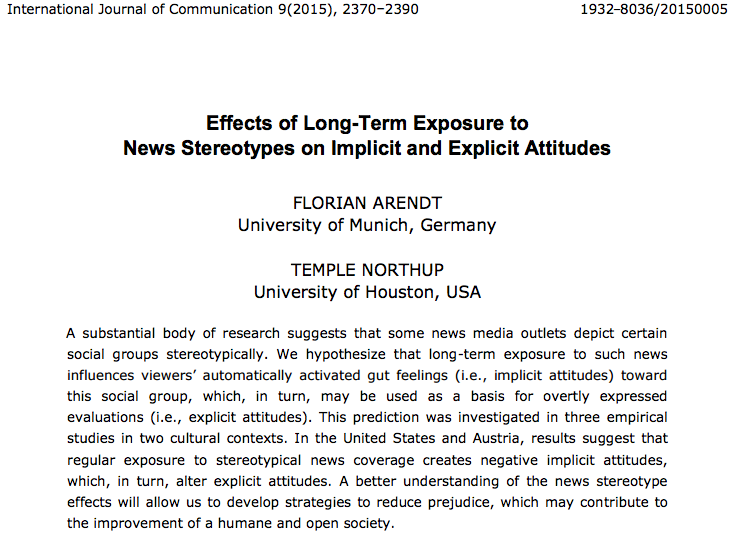
It is not just advertising but also, and likely even more so, the news media that contributes to the development of negative implicit racial bias. Research shows a correlation between the minutes of news media watched by whites and the level of negative implicit bias against blacks. Other studies have shown that US news media over-represents blacks as criminals. Click on the image of the article below to download a pdf.
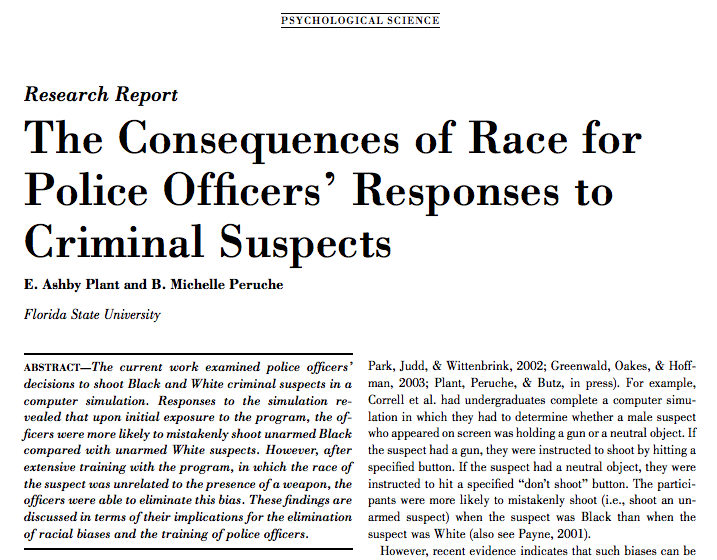
This has very real consequences when applied to police officers and the use of deadly force on unarmed citizens. Research shows that officers are initially more likely to mistakenly shoot unarmed black suspects compared to white suspects. Click on the image of the article below to download a pdf.
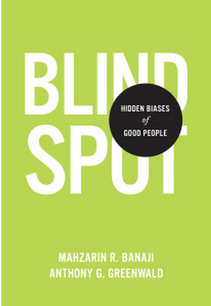
Here are a few excellent summary pieces on the research of Implicit Bias (click on the images below for links to more research):
Todd Beer Todd Beer is an Assistant Professor at Lake Forest College. His research and teaching interests include globalization, social movements, Sub-Saharan Africa, climate change, environmental sociology, inequality, and culture, among others. His blog, SOCIOLOGYtoolbox, is a collection of tools and resources to help instructors teach sociology and build an active sociological imagination.
Originally posted on Sociology in Focus
Read this with the movie trailer voice in your head:
In a world where men and masculinity are valued above women and femininity and the voice of god sounds like a man. Can there be any sense of justice? Can a hero rise from the ashes that were this country’s dreams of equality? Now read this with a nerdy sociologist voice: In this piece, Nathan Palmer discusses how we manipulate our voices to perform gender and asks us to think about what our vocal performances say about patriarchy in our culture. 
As a sociologist concerned with inequality, I think the juiciest question to ask is, are all voices treated equally? That is, do we empower some gender presentations and disempower others? This question is the central question explored in the movie In A World, which was written and directed by it’s star Lake Bell. The movie is about a young woman who is trying to break into the voice-over acting world, but struggles mightily because the industry is male dominated. In the movie and in reality, when Hollywood wants an authoritative voice, a powerful voice, or simply “the voice of god,” they turn to male voice-over actors more often than not. We should stop and ask, why is it this way? Are masculine voices just naturally more powerful? Nah—If you’ve spent anytime with opera singers you know that both male and female voices can rattle your ribcage. The answer then must be cultural. In any culture the people in it use symbols to communicate with one another. They fill these symbols with shared meaning and connect them with other ideas and symbols. For instance, today we associate blue with masculinity and pink with femininity, but a hundred years ago pink was a, "a more decided and stronger color, more suitable for the boy, while blue, which is more delicate and dainty, is prettier for the girl.” The point here is that any symbol, whether it’s a color or the sound of a voice, is not inherently masculine or feminine, powerful or weak, etc. As a culture we put the meaning into the symbols. So what does it say about our culture if we associate power with masculinity? The answer is simple, it suggests that we live in a patriarchal society (i.e., a society that values men and masculinity above women and femininity). That’s why it was so surprising to me when I read/watched interviews with Lake Bell where she put the blame back on women and something she calls the “sexy baby vocal virus”1.
Bell expanded on this idea further in another interview:
The problem of the sexy baby voice
To be honest, I’m not sure what to make of Bell’s criticism of the women who use the sexy baby voice. She asserts that “these women” have been “victimized” and have “fallen prey to something," but then clearly seems to be angry at them for their use of the voice. Furthermore Bell’s critique of women’s voices takes a social issue (patriarchy and the devaluing of all things feminine) and redefines it as an individual problem. If the women who use the sexy baby voice are using it to present themselves as non-threatening or highly sexual, then where did they get the idea in the first place? I’m not sure if Bell is arguing that the sexy baby voice is a reaction to a patriarchal society or that it creates a patriarchal society. In a world working through the issue of patriarchy, it would seem that even movies that are critiquing patriarchy can reinforce it. Dig Deeper
Notes
Nathan Palmer Nathan Palmer is an educator, writer, speaker, and editor. He currently maintains the blogs SociologySource and SociologyInFocus, and he teaches sociology at Georgia Southern University.
Comedy serves as a fascinating yet controversial area of analysis in sociology. The way comedic performances frame sensitive subjects such as racism, sexism, and classism tell us much about society and about ourselves as viewers. In many instances, comedians seek to make their audience laugh through whatever means possible—including the use and reproduction of harmful stereotypes--in order to gain popularity and earn a living. However, in some cases comedians can serve as formidable weapons of cultural transformation because of their sanctioned authority to progressively debate even the most difficult topics. Accordingly, comedy has the potential to encourage audiences to critically think about why the joke made them uncomfortable and why they laughed at the joke. In analyzing humor from sociological perspective, it is important to consider what these jokes reveal about ourselves and our society. Using Sarah Silverman’s video, "I Love You More" (a.k.a. “Jewish People Driving German Cars”), this post considers what activist role comedians can serve in raising awareness about racism, and what, if any, boundaries should be drawn by comedians targeting race in their performances:
In this video, Sarah Silverman explores and critiques many different racial and ethnic stereotypes. She sings lines like “I love you more than Jews love money” and “I love you more than Asians are good at math.” To elaborate on one example, Silverman articulates that “Jewish people driving German cars” is similar to “Black guys calling each other niggers.” When the narrative cuts short to two deadpan African-American men, they stare at her in all seriousness and do not laugh at the comparison; the tension created from the scene is unsettling. For a moment, Silverman looks taken aback and frowns sheepishly, until one of the African-American men starts laughing and she, relieved, playfully pushes one of them and starts laughing again. Both men immediately stop laughing and stare unbelievably at her in silence. She nervously tries to laugh at the joke again, but this time they do not join in and continue to stare at her, showing that it isn’t funny to them for her to make a joke out of racism against their racial group, even though she also inhabits the identity of another historically oppressed group (she is Jewish). Silverman cuts off the video mid-laugh by turning her head to the camera while smiling and singing "Chachacha!" 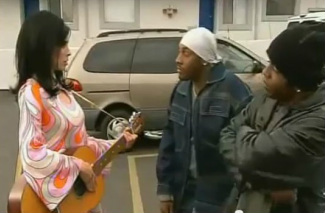 Silverman's use of the "n-word" creates a tense moment. Silverman's use of the "n-word" creates a tense moment.
While many people love Silverman's humor, it is not for everyone. But stay with me here; let’s unpack this to the degree that people do find it funny (and based on the YouTube comments, at least some people do). How should we interpret Silverman’s comedy and the role of her race and ethnicity in her performance? More broadly, how does the race or ethnicity of the comedian telling the joke affect our reception of the joke? Is it okay for black people to do racially prejudiced jokes about African-Americans, or wouldn’t that also be discriminatory of them to do so? Are there times when it is acceptable for dominant racial or ethnic groups to make jokes about racial minorities? To help us understand how humor functions and how audiences receive humor, we can draw upon a number of theories of humor.
First, according to relief theory, we find humor in taboo topics and “naughty” thoughts (Mulder and Nijolt 2002). This theory of humor is based in Freudian theory which sees such taboo subjects as creating a nervousness or “psychic energy,” which is released through laughter. This is especially the case when an individual has suppressed particular feelings, which are addressed in a comedic performance, and relieved through laughter. In our examples here, audiences are likely to recognize that the stereotypes presented in Silverman’s video are taboo or politically incorrect, and to the degree that they feel uncomfortable (which may be compounded if they partially accept the stereotypes but suppress their beliefs), this nervousness may be released through laughter. But this only suggests why we laugh, but not necessarily why we interpret the joke as humorous. Second, incongruity theory posits that people laugh to release physical, mental, or emotional tension when there are incongruities (i.e. things that are perceived to be out of place or inconsistent in relation to the established social norms). From this perspective, humor may be seen as releasing anxiety and tension over incompatibility between the object that is being targeted and how the audience anticipates a different meaning. But given a range of possible audience perceptions, different audiences may identify different incongruities and thus experience humor for distinct reasons. In this case, the analysis hinges on identifying various incongruities, which I will pursue further below. 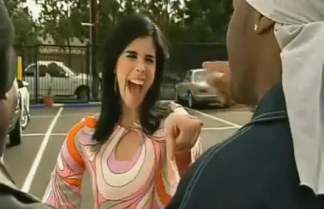
Third, Charles Gruner’s superiority theory helps further explain why and how people find certain jokes about race funny and others offensive. Superiority theory rests on the assumptions that “we laugh about the misfortunes of others [and] it reflects our own superiority” (Mulder and Nijolt 2002: 3). It argues that “every humorous situation has a winner and a loser; incongruity is always present in a humorous situation; [and] humor requires an element of surprise” (Mulder and Nijolt 2002: 3). From this perspective, humor is a means to “compete” with others and “the ‘winner’ is the one that successfully makes fun of the ‘loser’” (Mulder and Nijolt 2002: 3). (Picture the bully making jokes about someone else to put them down.)
When we integrate incongruity theory with superiority theory, we might see some troubling consequences of jokes that play on stereotypes. In short, “the phenomenon of humor requires the participation of at least two parties: an object (probably incongruous) and an appreciator (probably feeling superior)” (Lyttle 2003). This joke becomes funny (for some audiences) because the objects made fun of by Silverman during the performance are black, Puerto-Ricans, gays and lesbians, and Jewish people. From this perspective the incongruity might lie in the unexpected juxtapositions of different stereotypes, their simultaneous juxtaposition to crude statements (e.g. “I love you more than dogs love balls”), her usage of a derogatory racial slur while members of that racial group are present and appear physically threatening, and the audience’s overall struggle to interpret her political incorrectness. In particular, the narrative gets progressively more incongruent as the tension escalates from her sense of entitlement to criticize other oppressed minority groups. While some audiences might feel offended, this humor may empower others to feel superior because they seemingly lack the negative traits of the stereotypes groups.
In extending superiority theory sociologically, we can further draw upon maintenance theory. Maintenance theory argues that comedians' jokes maintain the established social roles and divisions within a society. They can strengthen roles within the family, within a working environment and everywhere there exists an in-group and out-group. When [ethnic] jokes are concerned, jokers choose groups very similar to theirs as the target of the joke only to focus on the mutual differences and in that way strengthen the established divisions between the two groups. (Mulder and Nijolt 2002: 7)
Silverman’s humor supports this theory when she begins playing into an ethnic stereotype about Jewish people. She sings “I love you more than Jews love money” and then branches off into increasingly more offensive stereotypes about marginalized races and ethnicities, and gays and lesbians. The audience could perceive her as acknowledging some of the preconceived notions about her own ethnic groups only to establish that they are very different and separate from the preconceived cultural meanings attached other oppressed groups. This is accomplished by suggesting that her ethnic group has a sense of class-based superiority over these other groups. 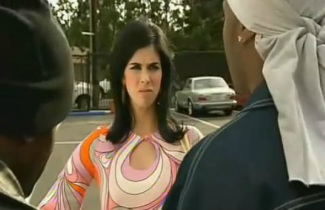
If we interpret Silverman’s video through the lenses of superiority theory or maintenance theory, we should be highly critical of it. As the YouTube comments for the video illustrate, many viewers do indeed take her stereotypes at face-value and find humor in them. If this were the only interpretation, we should critique Silverman, as a white middle-class comedian, to tell jokes that draw so blatantly on stereotypes about other oppressed racial and ethnic groups. From these perspectives, her humor reproduces stereotypes and the power relationship that is built upon them. Many comedians and jokes rely on these very dynamics. However, these are not the only interpretations of Silverman’s humor in this context.
Rather, there is also a deeper, more critical incongruity in Silverman’s humor in this video. This incongruity is situated in how the objects (various racial and ethnic stereotypes) are positioned relative to one another in a way that actually challenges both the stereotypes and their usage by a white, middle-class comedian. The audience perceives a supposed ignorance in her usage of these stereotypes only to recognize that she is juxtaposing them in a critical manner. She produces dramatic irony that makes the audience sensitive to racial dilemmas raised in the performance. In short, one racial stereotype is like any other; they are gross oversimplifications that can be hurtful, but they do not affect all audiences in the same way (as exhibited by the reaction of African-Americans in the video). Or like Louis CK once said, “white people don’t get offended by being called crackers.” Here, Silverman is bringing attention both to the inappropriate usage of the stereotype as well as her usage of it as a white person. 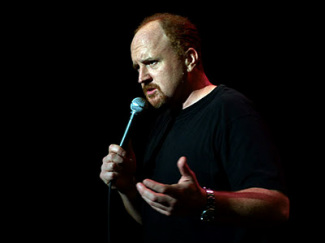 Louis CK also pushes issues of race in his humor. Louis CK also pushes issues of race in his humor.
For those viewers that acknowledge these subtleties, we can interpret her song as raising awareness about why it is not okay for those who benefit from white or class privilege to use racial slurs or make racist comments. By introducing the African-American men in the skit, she holds the mirror up to herself and uses the tense, but humorous, moment to critique her own use of stereotypes. When the skit ends with a harsh realization that the comedian did not have the right to criticize the misfortune of these groups in the first place, the joke serves as a useful tool to unpack the sense of entitlement that white privilege bestows upon certain comedians, including Silverman. From this perspective, the tension is resolved only when the audience realizes through Silverman’s interaction with the two African-American men that it is her and her white privilege that should be made fun of. If we accept this interpretation, we might see her witty humor as exposing her own white privilege.
I leave it up to the reader to determine which of these theories of humor is appropriate for interpreting the video of Sarah Silverman, a white upper-middle class, female, Jewish comedian. Again, when we look at the YouTube comments for the video, I believe we find evidence that viewers draw upon all these interpretations (and more). But the broader questions about the role of race in humor, and the quality of that humor, still do not end there. Even if we accept her humor as an attempt to expose white privilege, is it acceptable that she uses such blatant and derogatory racial slurs to so? As noted on Jezebel, perhaps comedians must actually come from the marginalized position to claim to speak on behalf of them, or perhaps “if you need to rely on jarring, abominable and offensive words, you're probably not that funny” anyway.
Elizabeth Dickson Elizabeth Dickson is a student at Ohio Wesleyan University, where she is double-majoring in Psychology and Sociology. 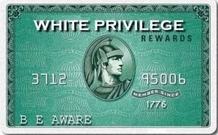
White privilege refers to the unearned advantages that whites receive because of their skin color. It includes a vast array of concrete advantages varying from institutional settings (systemic discrimination in housing markets) to everyday encounters (e.g. being able to shop in a store without getting followed). They provide a variety of social and economic benefits, and can be cashed in, to confer greater power, authority, and status upon whites. But as Peggy McIntosh argues in "White Privilege: Unpacking the Invisible Knapsack," these privileges are usually invisible to people who benefit from.
Largely because these advantages are invisible, it is no surprise that many people deny the existence of white privilege. For example, we have seen this denial throughout our Facebook page, and comments on previous posts. Some of the critics makes claims such as "White privilege is a myth" and "What we really have in America today is black privilege." If you venture over to the entry on white privilege at Urban Dictionary, you see definitions like this: White privilege is "the racist idea that simply being white benefits people in some unexplainable way, and that discriminating against white people is not only okay, but enlightened and necessary" and "A term used as a blanket condemnation of any success a white person may have." Throughout these discussions and comments, you see that not only do some people deny any existence of white privilege, but they do so with such anger and emotion that is very striking. For many people, they feel wronged to be told that they may have unearned advantages from their skin color, and they are more comfortable believing that their accomplishments in life are based solely on their own hard work and merit.
So is white privilege real? Yes. And contrary to the definition above at Urban Dictionary, it is clearly explainable. By drawing upon many of our previous posts here, I will curate a multimedia look at white privilege, how it works, and how we might be able to talk about it with people who deny its existence. INSTITUTIONALIZED ADVANTAGES White privilege is institutionalized when the practices and policies of an institution systematically benefit whites at the expense of other racial groups. There are many examples of this. In the US, institutionalized advantages have been conferred upon whites throughout history in the accumulation of wealth. Beginning with slavery, encoded in New Deal policies, and in institutional practices today, whites continue to gain advantages in wealth accumulation. This first video (below) illustrates the extent of this gap today, and how the recent economic crisis has actually widened this gap. As of 2010, white households ($113,000) now have 18 times the net worth of Hispanics ($6,325) and 20 times the net worth of African-Americans ($5,677). See our full analysis here. White privilege is also institutionalized in the labor market. In this clip from Freakonomics, economist Sendhil Mullainathan discusses his (and co-author Marianne Bertrand's) 2004 field experiment that examined racial discrimination in the labor market (article here). They sent out 5,000 resumes to real job ads. Everything in the job ads were the same except that half of the names had traditionally African-American names (e.g. “Lakisha Washington” or “Jamal Jones”) and half had typical white names (e.g. “Emily Walsh” or “Greg Baker”). As they illustrate, people with African-American-sounding names have to send out 50% more resumes to get the same number of callbacks as people with white-sounding names. This shows a clear advantage given to whites in applying to jobs, and helps explain part of the racial gap in income. White privilege is institutionalized in schools. Whites attend schools that spend more money per student, on average, than racial minorities. On average, they have better teachers. We can see this privilege illustrated in this video examining the role of race and education (see our full analysis here): Follow this link to see further examples of how white privilege is institutionalized the housing market. The key point here is that in each of these examples, whites are given certain advantages over other racial groups. This was not an advantages earned by whites through merit or hard work, but rather, was given to them based on the color of their skin. Of course, there is much variation within people of the same racial group (e.g. class privilege, male privilege, etc). For example, working class whites still experience many disadvantages in society, even if they experience white privilege. However, the simultaneous existence of multiple (and intersecting) privileges does not mean that white privilege does not exist. EVERYDAY ENCOUNTERS White privilege is also experienced in everyday life. Peggy McIntosh provides a list of examples here. Some of our videos found on our site also illustrate how skin color confers advantages in everyday life. For example, this Anderson Cooper video shows the stereotypes held by young children. We can easily imagine how this would provide advantages in how whites with similar attitudes would give preferential treatment over those with darker skin (see our full analysis here).
In this next clip, author and educator Joy DeGruy recounts a story about a time she went shopping with her sister-in-law, who happens to be light-skinned and often "passes" as a white woman. This includes one of the many examples where racial preferences for whites shapes everyday experiences (see our full analysis here):
It is worth noting, however, that while enduring a blatant instance of discrimination from a suspicious store clerk, DeGruy recalls that her sister-in-law stepped forward and confronted the clerk. In other words, she went further than simply recognizing her own white privilege, and in this case, she used it to call out an act of discrimination and highlight the injustice for onlookers. This example highlights the role that individuals can play in combating white privilege ...
COMBATING WHITE PRIVILEGE Despite the evidence, many people resist the notion of white privilege and deny its existence. So how can we engage them to combat white privilege and its inherent injustice? One way is through humor. In this clip from his show "Chewed Up," comedian Louis C.K. examines white privilege (including his own white privilege). One of the benefits of whiteness he explores is his ability to travel to any time period in history and know that, regardless of the historical era, he would be advantaged. He also examines the potential disadvantages of future retribution. Given the fact that whiteness has been so consistently privileged over such a long period of time, the clip can highlight for students the multi-generational privileges that accumulate over time from being white. Part of its power comes from Louis C.K.'s humor, which can help to break through some resistance to the concept, and make some individuals more likely to engage in a conversation. (BUT: note that while the clip may not explain present-day advantages of being white, viewers can critically approach Louis C.K.'s suggestion that "anything before 1980" would be a difficult time for non-white people. Contrary to this comment, white privilege clearly persists today; see our full analysis here)
Another way to help combat white privilege is to be an advocate! Speak up! Part of the privilege that whites have (which they never specifically asked for) is that people will listen to you when you talk about white privilege! Here is scholar and activist Tim Wise speaking on white privilege:
Of course, people of all racial groups constantly struggle against white privilege. And a final way to combat white privilege is to join a group fighting racial discrimination and oppression. Help build cross-race alliances and lend support to marginalized groups speaking out about the racism they experience. Only by talking about and engaging in conversations about racial oppression and white privilege can we overcome it.
Paul Dean
A stereotype is a an exaggerated or distorted generalization about an entire category of people that does not acknowledge individual variation. Stereotypes form the basis for prejudice and discrimination. They generally involve members of one group that deny access to opportunities and rewards that are available to that group. This is a fundamental concept in introductory sociology classes and is an important way to challenge students to address inequality and discrimination.
However, when discussing stereotypes in a classroom, students may be reluctant to discuss their own stereotypes. Videos can be a highly effective way to engage commonly held stereotypes without students feeling singled out. For example, consider the litany of stereotypes (both positive and negative) identified by George Clooney's character in Up in the Air: Stereotypes from Marc Jähnchen on Vimeo.
In this clip, Clooney rattles off several stereotypes of people in an airport (including Asians, people with infants, and the elderly). When his co-star (Anna Kendrick) replies "That's racist," Clooney responds with "I'm like my mother. I stereotype. It's faster." This short clip demonstrates stereotyping, which is used to simplify and control judgments about everyday situations. The media is filled with all kinds of stereotypes, such as distorted depictions of working class people, racist cartoons, mother's work, and Muslims. But what are the effects of stereotypes?
Using a famous quote known as the Thomas theorem, we can begin to understand the potentially damaging effects of stereoptypes: "if [people] define situations as real, they are real in their consequences." In other words, when people accept stereotypes as true, then they are likely to act on these beliefs, and these subjective beliefs can lead to objective results. For example, think about some common stereotypes of feminism:
When men (and women) adopt such stereotypical views of feminism, and misperceptions of gender inequality, then they are less likely to support laws and policies that promote gender equality. They are less likely to consider themselves as feminists and join the struggle. Accordingly, these distorted views of women and of feminists can reproduce the objective reality of gendered inequality. People define these situations as real, and the consequences are therefore real.
But how can we challenge students in overcoming stereotypes? One technique comes from our friend, Michael Miller. He commented on Black Folk Don't, a website that analyzes stereotypes of black people. For example, consider this clip about stereotypes of black people not tipping: Black Folk Don't: Tip from NBPC on Vimeo.
While the clip only offers anecdotal views, Michael suggested it might serve as "research stimulators" by challenging students to locate data or studies that would support or refute the stereotypical claims. By evaluating stereotypical claims through data, students not only come to refute stereotypes that reinforce social inequality; they can also develop essential research skills, critical thinking skills, and appreciation for data-driven research.
A second way to challenge stereotypes is through comedy. While some comedians reinforce stereotypes, the good comedians have a great ability to disarm viewers by playing on their stereotypes. Consider this video from In Living Color:
Finally, viewers may be encouraged to reflect on stereotypes by hearing from the stereotyped subjects themselves. For example, Sociological Images shared a video that features 4 African men discussing stereotypes of them in Hollywood movies:
The young African men in this video (oddly, the video does not refer to their home countries but places them together as "African men") discuss how Hollywood movies depict them as evil men with machine guns delivering one-liners, etc. The men continue stating: "We are more than a stereotype. Let's change the perception." We then learn that the men are in college studying clinical medicine and human resource management, that their likes and interests are much like those of young men in the US and around the world. Thus, this media is used to counter more stereotypical portrayals of the men themselves.
Paul Dean Originally posted on Sociological Images Back in 2007, Dr. Oz stood on the set of The Oprah Winfrey Show and infamously promoted to an audience of 8 million viewers the idea that African Americans experience higher rates of hypertension because of the harsh conditions their ancestors endured on slave ships crossing the Atlantic. This so-called "slave hypothesis" has been roundly criticized for good reason, but I was struck that it was being promoted by such a highly educated medical professional. 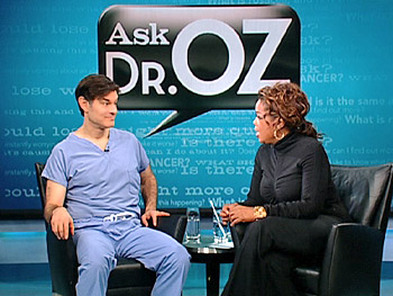
The episode got me thinking about the sociologists Omi and Winant's notion of a racial formation as resulting from historically situated racial projects wherein "racial categories are created, inhabited, transformed, and destroyed" (p. 55-56). These projects take multiple forms but in at least one version, there is an attempt to collapse race—a socially constructed concept—into biology. Such projects are similar insofar as they suggest that the socially constructed distinctiveness between people of different racial categories roughly approximates a meaningful biological distinctiveness. Scientists have been centrally involved in this effort to establish a biological basis for race. In the middle of the 19th century Dr. Samuel Morton attempted to show that average cranial capacities of people from different racial groups were significantly different. Today, many people scoff at the misguided racism of the past, but I think Dr. Oz's promotion of the slave hypothesis demonstrates that the search for a biological, and therefore "natural," basis for race continues. So how do proponents of the slave hypothesis explain hypertension? In 1988 Dr. Clarence Grim first proposed the theory, which is the idea that the enslaved people who survived the Middle Passage were more likely to be carriers of a gene that allowed them to retain salt. Grim argued that this ability to retain salt, while necessary for a person to survive the harsh conditions of a slave ship, would ultimately lead to hypertension as the person aged. Thus Grim proposed that African Americans living in the United States today are the descendents of people who have this selected feature. As I mentioned above, this theory has been soundly refuted but reportedly still remains in many hypertension textbooks. Looking at the clip above, which is from January of this year, it seems that medical professionals like Dr. Oz may be still promoting it. I think it is important to recognize that this particular racial project persists in many forms, and one final example is from 2005, when the FDA approved BiDil as a customized treatment of heart failure for African Americans. The approval was based on highly criticized research, but the approval also implicitly makes the case that a racial group might be so biologically distinct from others as to warrant its own customized medication. Much like the search for different cranial capacities, the propagation of the slave hypothesis, and the marketing of drugs designed for different racial groups, BiDil's emergence can be seen as an attempt to deploy racial categories as if they were immutable in nature (see Troy Duster's article in Science). Criticizing this racial project is more than an academic exercise. As a social construct, race is already a central principal of social organization, which benefits whites at the expense of other racial groups. It is already a powerful basis upon which privileges are meted out and denied. In my view, the effort to loosen race from its moorings as a social construct and anchor it again as a biological fact of nature is an attempt to fundamentally alter the discussion on racial inequality. If this project prevails and race comes again to reflect a biological truth, then fewer people will acknowledge racial inequality as the result of a human-made history. It will instead be seen as the result of humans being made differently. Lester Andrist |
.
.
Tags
All
|
 RSS Feed