On Artificial Intelligence, Symbolic Interactionism, and Whether Robots Will Take over the World7/11/2016
In this first podcast from The Sociological Cinema, sociologist Lester Andrist sits down with computer scientist (and brother) Sean Andrist for a discussion that connects the subfield of symbolic interactionism with robotics. Sean Andrist summarizes research on human-robot interactions, and together they explore the implications of this work on human-human interactions.

Sean Andrist received his PhD from the Department of Computer Sciences at the University of Wisconsin–Madison. His research has involved designing, building, and evaluating socially interactive technologies. He has been particularly focused on the development of communicative characters, including both embodied virtual agents and social robots, that can use humanlike gaze mechanisms to effectively communicate with people in a variety of contexts, including education, therapy, and collaborative work.
Originally posted on Cyborgology

Real Doll assembly line
Recently I saw an episode of TLC’s “My Strange Addiction,” (lets not go into how exploitative this show is) and was first introduced to a man named Davecat. Davecat is a man with a synthetic partner, a growing trend where people marry anatomically correct, fully functional, mostly silicon, lifesize sex dolls. I call them sex dolls because they are clearly created in the image of a sexualized female ideal (i.e., small hips, large breasts, busty lips, flawless skin, long legs).
Now this is just the latest trend in a long list of what many would call “strange” new types of marriage unions. For instance, a few years back I remember a young man in Japan marrying a Nintendo DS character, and there is Zolton, the man who married a robot he built for himself, and the young man in Korea who married an anime character on a body pillow. Synthetic partners appear to be a growing trend, or else these relationships have simply become more visible as of late. There are several companies now specializing in these types of synthetic, lifesize dolls. There is Sinthetics brand, which appears to specialize in the pornstar variety (i.e., unnatural proportions and exotic features), and there is RealDolls, made famous by the BBC Documentary “Guys and Dolls”, and the countless, extremely creepy, celebrity sex dolls you can buy at most adult stores. Now these trends play into what some have called “robot fetishism,” or “technosexuality.” According to the Wiki, this fetish is based on a sexual attraction to humanoid robots, or to humans dressed up like robots. We can see these sorts of anthropomorphic portrayals of humanoid robots in Svedka advertisements, in several popular anime series, and in music videos. But what does it mean when the majority of media representations of robot fetishism are from a male perspective? Are the majority of cases actually male or is this simply a case of phallogocentrism? And why are women’s bodies so often portrayed in sexualized robot form? What does this tell us about our culture, gender, and sexuality? Finally, how has human sexuality changed as a result of these sorts of technological advancements?  A very unnatural Real Doll A very unnatural Real Doll
Although some claim that humans react to real dolls because of our instinctual desires for abnormal, idealized, “freakish” proportions, much like an Australian jewel beetles reacts sexually to beer bottles. I personally think robot fetishism may stem from a desire for control and passivity in one’s partners. Though this is clearly not the case for all individuals with synthetic partners (I am sure many people are just lonely and tired of searching for a partner), it appears to clearly be the case for men like Gordon Griggs.
But there does seem to be a preponderance of males with female synthetic partners and a minority of females with male synthetic partners (Though they do sell male Real Dolls, after all). What does this tell us about gender, power, and culture? I would argue that this overwhelming male bias stems from male privilege, or the belief that men are entitled to females as sexual partners. Tiring of rejection and refusal from human lovers, many men turn to synthetic ones. Watching some of the interviews with RealDoll owners contained in the BBC documentary lends me to come to this conclusion. The men contained in the film, from socially-awkward loners to jilted lovers, all seemed to have psychological issues stemming from alienation and the inability to achieve societal expectations in coupling. Several of the men had girlfriends when they were younger, but had since become recluses unable to talk to women. Other men were simply controlling and abusive, and turned to synthetic partners because they “can’t say ‘no’” like living women can. In conclusion, I find myself lamenting the liberatory possibilities of Haraway’s “Cyborg Manifesto”. Rather than seeing the coupling of human and machine as something which frees us from various forms of oppression (e.g., gender, race, age, infirmity), I see the phallogocentrism of robot fetishism in the mass media as myopic, exploitative, and reinforcing of existing gender oppressions. Namely, these trends reinforce the objectification of women, male sexual entitlement, and controlling behaviors in men. Dave Paul Strohecker (@dpsFTW) David Paul Strohecker is a fourth year PhD student at the University of Maryland in College Park. He studies cultural change, conflict, and social theory, with an emphasis on the role of the media, consumer behavior, and deviant subcultures.
Originally posted on dmlcentral
It is a common theme to complain about the way that writing (or reading or math) skills are declining as our society becomes increasingly digitized. In this post, I look at some examples of the way that digital technologies are making writing more interesting by exploring stories or trends from the past year that have impacted writing and the teaching of writing. Not all of these examples suggest that writing is getting better (or that it is getting worse). Rather, they illustrate how writing is changing under the influence of emerging technologies.
1. Writing is in our environments The introduction of wearable technologies like Google Glass and the growing use of speech-to-text features for mobile phones are continuing the movement of writing from a private task to one that is performed in public. It is possible to compose text messages and even long-form writing by voice alone. As this technology becomes more and more ubiquitous, it is poised to change how writing is experienced by young people, much as texting has, and it will also underscore digital divides among students, as some will have access to this technology while others will not. 2. "@Horse_Ebooks" and algorithmic writing In 2013 it was revealed that of the most popular twitterbots—automated Twitter accounts—turned out to not be automated after all, but a performance art project. Much of the interest around this story focused on how the authors duped their readers, but it also showed how attitudes toward automated writing have shifted in our culture. Some followers were disappointed that @Horse_Ebooks was not automated, suggesting that, as with other media such as music, randomness in writing is becoming increasingly accepted, and as its importance grows, writers will have to learn how to design automated writing systems to avoid embarrassing and offensive results. 3. Programming is writing As computers become more pervasive, there have been a growing number of calls to include computer programming as a core skill, taught along with other core subjects like reading and writing. There are some critiques of this position, but, as algorithmic writing practices show, more and more writing is based on automated processes, or even interchangeable parts designed to be reused in different situations, and this procedural writing requires not just an understanding of coding technique, but of the basics of written communication as well. Computer coding is a specialized writing practice that impacts many other areas of communication, and the skills of writers and writing teachers can be useful to demonstrating the relevance of this writing to students. 4. MOOCs and teaching writing MOOCs, Massive Open Online Courses, received a lot of press in 2013. Much of it took the form of breathless enthusiasm, there have been significant critiques of MOOCs, particularly those that question the approaches to learning they offer. One critique has been that MOOCs shift most learning activities away from critical thinking tasks like writing, to rote memory in the form of short quizzes or multiple choice exams (which can be easily scored by computers). As such, MOOCs challenge teachers to think about the role of writing in learning, as well as how digital technologies can support or hinder that learning. 5. Surveillance and digital culture One pervasive effect of digital technology is that it can record everything. Because digital actions like keystrokes or mouse-clicks are discrete, they can be recorded, and as the Edward Snowden NSA leaks have revealed, potentially all of our digital behaviors are recorded in this way. While these records are not writing in the traditional sense, the widespread availability of such surveillance, such as the ability to monitor students' textbook use, raises serious privacy questions. As digital technologies grow ever more central to writing instruction, the possibility for this form of surveillance will increase, placing a burden on instructors to teach students how to navigate privacy settings and behaviors that limit the impact of this surveillance. Banner image credit: The Pageman http://flic.kr/p/dQkh7W
John Jones
John Jones is an Assistant Professor of Professional Writing and Editing at West Virginia University where he teaches writing and digital literacy. He was formerly a Visiting Assistant Professor of Emerging Media and Communication at the University of Texas at Dallas, and from 2007-2009 he was an Assistant Director of the "Digital Writing and Research Lab" at the University of Texas at Austin. While at the DWRL, John co-founded and served as Managing Editor for Viz, a website and blog investigating the connections between rhetoric and visual culture.
Originally posted on 21 Century Nomad 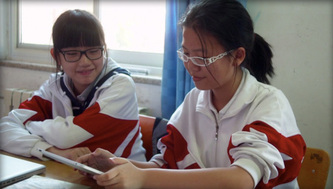 Students use an iPad in the classroom. From Apple's website. Students use an iPad in the classroom. From Apple's website.
Apple has long considered itself a renegade, a breaker of conventions, and a change-maker, and education has been a realm in which it seeks to have a revolutionary impact. Apple is well-known for its long-standing presence in classrooms, and its executives maintain, “Education is in our DNA.”
Apple is proud of its relationships with schools, as shown by the company’s robust education section of their website. While researching Apple’s education customers for my previous post, “The Top 10 Things You Didn’t Know About Apple,” one customer profile, which includes a short film, caught my attention. The “Apple in Education Profile” of Renda Fuzhong (RDFZ) Xishan in Beijing, China, explains that a revolution in education is underway in the country, thanks in part to use of Apple’s MacBook Pro and iPad in the school’s 7-9th grade classrooms. Breaking from what is described as the dysfunctional Chinese educational model focused on “core knowledge” and “rigorous testing,” with the help of Apple products the school has implemented a successful new model that promotes “personal growth, creativity, and innovation.” The description of the school’s “experimental” model of education resonates with contemporary American values and trends present in Apple’s marketing. In my study with Gabriela Hybel of over 200 Apple commercials that have aired in the US since 1984, we found that one of the key themes that courses through them is that Apple products allow their users to cultivate and express intellectual and artistic creativity. The video profile below of the school and its program resonates with this theme, and provides an inspiring take on the what Apple means to the youth of China (Note: Please watch the video! Doing so will allow you to see for yourself the great contrast in how students from different backgrounds experience Apple). As I read the profile of RDFZ and watched the video about the school, I couldn’t help but think that this did not seem to be an accurate depiction of what Apple means to the youth of China. While I certainly think it is great for these students that they are receiving a top-notch and technologically innovative education, a little research revealed that RDFZ Xishan is considered the most prestigious school in Beijing. While it is described by Apple as a public school, it is the sister school of Phillips Academy in Massachusetts and Phillips Exeter Academy in New Hampshire–both exclusive private schools. The middle school is a part of the RDFZ high school, which funnels students to the most elite universities in China, the UK, and the US. It is also a part of the G20 Schools, a collection of elite and mostly private secondary schools around the world. In short, this school serves the children of Beijing’s wealthy elite–a minuscule portion of China’s youth. When we think about what Apple means to the youth of China, we have to consider not only the privileged few who might benefit from using the company’s products in the classroom, but the hundreds of thousands of young workers assembling Apple products in factories throughout the country. Their experience of Apple is vastly different from that of the students of RDFZ Xishan. A recent report from China Labor Watch, which details numerous violations of Chinese labor laws and the employment of minors at Apple suppliers, makes this fact shockingly clear.
This video, published on China Labor Watch’s YouTube channel, showcases labor violations at three Pegatron facilities in China: Pegatron Shanghai where the “cheap” iPhone is in production; Riteng Shanghai, a Pegatron subsidiary where Apple computers are assembled; and AVY Suzhou, another subsidiary of Pegatron that is producing parts for the iPad. China Labor Watch sent “undercover investigators” into these facilities and ultimately identified 36 violations of labor laws, including regular and forced overtime (far over China’s legal limit of a total of 49 hours per week), regular unpaid labor of up to 14 hours per week, lack of safety training, and having to stand for over 11 hours at a time.
Importantly, they found about 10,000 underage and student workers employed across the three sites, comprising nearly 15 percent of the total labor force of 70,000. While China labor law stipulates that workers under the age of 18 must be provided certain protections not afforded adult workers, the researchers found that underage workers experienced the same treatment as all other workers, including staying in over-crowded dormitories with 8-12 people per room, and having limited access to the few group showers for hundreds of people. 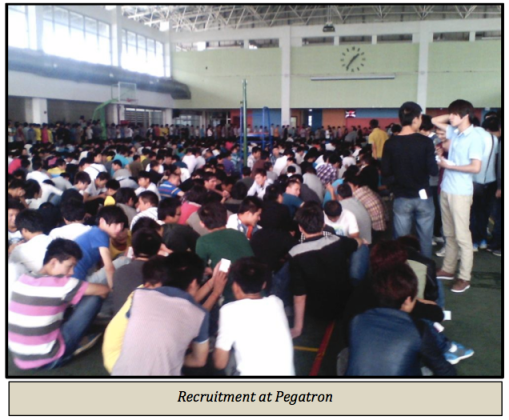
Hundreds of young people seek work at Pegatron Shanghai. Published in CLW’s July 29, 2013 report.
The report from China Labor Watch points out that Apple claims in its Supplier Responsibility Reports that it does not tolerate these legal violations at its suppliers, and that it has corrected most of them throughout its supply base. For instance, Apple claims, “We don’t tolerate underage labor. Our code requires our suppliers to provide special treatment to juvenile workers.” The report from China Labor Watch points out that Apple claims in its Supplier Responsibility Reports that it does not tolerate these legal violations at its suppliers, and that it has corrected most of them throughout its supply base. For instance, Apple claims, “We don’t tolerate underage labor. Our code requires our suppliers to provide special treatment to juvenile workers.” 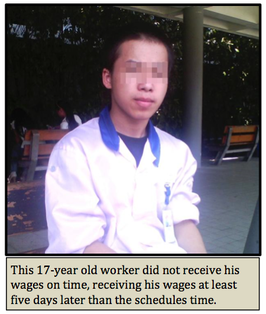 Published in CLW’s July 29, 2013 report. Published in CLW’s July 29, 2013 report.
However, the CLW researchers found this to be overwhelmingly untrue. Further, they found that many underage workers are student “interns” forced to work by their schools, they receive lower pay than the average worker because of this, and often have to pay the school and their teachers fees for the “opportunity.” The report also notes, “Many students are required to work at the factories despite the production work being unrelated to their studies. For example, a Gansu student at Pegatron studying early education was required to work on the production line.”
Through my research with Tara Krishna into Apple’s Chinese supply chain I have found that the problem of student interns is not particular to these Pegatron sites, but is a systemic problem in China that has been folded into Apple’s supply chain and profit structure. While this has not been covered by mainstream media outlets in the US, Chinese media and scholars have been reporting on the problem for years, particularly at Foxconn facilities. Sociologists Pun and Chan report China’s pro-growth economic policy pressures heads of schools to funnel students into low-wage “internships”. Xiaotian Ma, in a piece titled “Interns Behind the iPhone 5” for China’s Southern People Weekly wrote that some schools threaten to withhold degrees from college students who leave their internships (Note: This story was downloaded from the internet by my Chinese research assistant but is no longer available online. I will happily forward a digital copy to anyone who wishes to read it.). A report from Shanghai Daily cited on CNet in September 2012 states that students from universities were driven to and forced to work in exploitative conditions at a Foxconn factory producing iPhones because the site was experiencing a labor shortage just before the release of the iPhone 5. 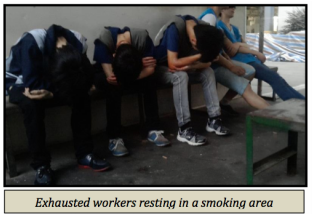 Published in CLW’s July 29, 2013 report. Published in CLW’s July 29, 2013 report.
Of course, Apple is hardly the only company working with suppliers who use underage and forced labor. Foxconn sites producing Nintendo gaming consoles have been found to have workers younger than 16 years old. Given documentation of extensive labor violations throughout the technology sector in China, it stands to reason that this is a systemic problem. In 2000 child laborers were estimated by the International Labour Organization to make up as much as 20 percent of China’s labor force. Most feel compelled to leave school and work because their families live in poverty.
Further, this problem extends beyond factory walls into the social fabric of Chinese society. For the majority of China’s youth Apple and other booming tech companies do not signal a heightened educational experience nor an economic boom, but rather the scattering of communities and closure of rural schools as residents of villages are driven off by the construction of new factories, and the neglect and desperate solitude of China’s 60 million “left-behind kids” whose parents have left villages for work in urban production zones. The principle of RDFZ Xishan is right when he says in the celebratory video hosted on Apple’s education website, “The future is something we create.” For the wealthy, privileged students at the prestigious school, Apple products are no doubt helping to create a future of high social status and economic security. But, for the majority of China’s youth, whether underage workers, student “interns”, left-behind children, or kids whose rural communities have been displaced for factory development, the future that we are collectively creating for them through our consumption of these products is a bleak one. Apple can do better, and so can we as a global society. Nicki Lisa Cole, PhD Nicki Lisa Cole, PhD is a lecturer in sociology at Pomona College in Claremont, CA. A committed public sociologist, Nicki studies the connections between consumer culture and labor and environmental issues in global supply chains. You can read more of her writing at her blog, 21 Century Nomad, and learn more about her research and academic work at her website.
Last semester was a risk. It's always a risk, because we always try new things, every semester refining techniques, every semester looking for new ways to convey what we have to share. But for whatever reason, in the fall of 2012 in my sociology intro course I felt like trying something truly new. I blended my regular non-fictional sociological readings—chapters of textbooks, excerpts from works of social theory, peer-reviewed articles—with works of science fiction and fantasy.
It's worth pointing out that the use of fiction in the context of a sociology classroom isn't new. The Wire, just as one example, has become such a go-to for many instructors covering social inequality that there have been entire courses constructed around it. But, as I make explicit in my syllabus, I'd argue that speculative fiction allows us to engage in a kind of theoretical work that other forms of fiction don't. 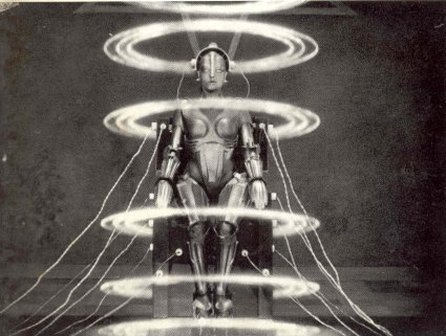
Fritz Lang's Metropolis could inspire students to think critically about social class and gender.
Speculative fiction—both science fiction and fantasy, as well as all permutations in between—has always been implicitly sociological. Its earliest forms deal with technology and science, with magic and legend, but all of these really serve as ways to talk about other things. In The Time Machine, HG Wells is arguably just as concerned with the future organization of human society as he is with the book's namesake. Robert Heinlein explores political power and social change by positing futures in which enfranchisement is linked to military service, and technically-expert revolutionaries carry out a bloodless coup on a colonized moon. Ursula LeGuin, Octavia Butler, and Joanna Russ theorize gender by inviting us to consider worlds in which our binary construction of gender no longer applies.
In fact, I’ve argued before elsewhere that speculative fiction contains conceptual tools that “literary” fiction usually lacks, and suffers for the lacking. Imagining the future is always a part of sociology, even when we have difficulties in being a traditionally “predictive” science. This is especially true in a world within which our relationship with technology is ever-more difficult and complex. As I wrote in another post pushing for the place of fiction in theoretical work: Speculative fiction, among other genres, allows us to explore the full implications of our relationship with technology, of the arrangement of society, of who we are as human beings and who we might become as more-than-human creatures. It’s useful not because it’s expected to rigidly adhere to the plausible but because it’s liberated from doing exactly that: it’s free to take what-if as far as it can go. This differentiates it from futurism, which is bound far more to trying to Get It Right and therefore so often fails to do exactly that. William Gibson didn’t set out to imagine right now, but he was able to get far closer to it than a lot of futurists precisely because he wasn’t subjected to the pressure to do so. I think it was far more chance than any temporally piercing insight, but when we can imaginatively go anywhere, we usually get somewhere. And then we can look back on what we imagined before, and it can tell us a great deal about how we got to where we are now and where we might go in the future--and where we need to go.
The result of this is usually mixed, and I expected it to be going in; in fact, I expected a poorer reaction than the one I’ve been getting. Some students seem resistant, or at least puzzled. Some seem excited by the opportunity to do something unusual and unexpected in a class within which they may not have know what to expect to begin with. In class discussions, I ask them to consider a central question from which all other questions about the readings proceed: Why did I assign this? What is it about this particular story that speaks to anything we’ve learned? What can it tell us?
Fiction in general - and speculative fiction in particular - is not merely escapism. It’s conceptual voyaging. It’s pushing beyond what we know into what we can grow to understand. Myths and legends are all-too-often dismissed as untrue; what this attitude fails to recognize is that the deepest, most foundational stories are persistent precisely because the best of them are vectors for the most profound elements of who we are, of how we understand ourselves to be, of where we imagine we might go. These things may be harmful, they may reproduce things that we find undesirable, but we need to understand them on their own terms before we can act. In my course, I characterize most forms of social inequality to be based on myth - on origin stories. We’re better than these other people. This thing is bad. This is what it means to live a good life. This is what justice looks like. And when we find the worlds these myths create to be undesirable, we depend on the ability to imagine the alternatives to work toward those alternatives. Sometimes understanding these alternatives involves spaceships and robots. Or it can. And sometimes it’s better when it does. My Sociology Intro syllabus containing my fiction readings can be found here. Currently I’m teaching an Intro to Social Problems course that follows this model very closely, and contains most of the same readings. Dig Deeper. Consider drawing from the following films for your next sociology class.
Sarah Wanenchak Sarah Wanenchak is a fourth year PhD candidate at the University of Maryland and writes speculative fiction under the pseudonym Sunny Moraine. Originally posted on Sociological Images Back in 2007, Dr. Oz stood on the set of The Oprah Winfrey Show and infamously promoted to an audience of 8 million viewers the idea that African Americans experience higher rates of hypertension because of the harsh conditions their ancestors endured on slave ships crossing the Atlantic. This so-called "slave hypothesis" has been roundly criticized for good reason, but I was struck that it was being promoted by such a highly educated medical professional. 
The episode got me thinking about the sociologists Omi and Winant's notion of a racial formation as resulting from historically situated racial projects wherein "racial categories are created, inhabited, transformed, and destroyed" (p. 55-56). These projects take multiple forms but in at least one version, there is an attempt to collapse race—a socially constructed concept—into biology. Such projects are similar insofar as they suggest that the socially constructed distinctiveness between people of different racial categories roughly approximates a meaningful biological distinctiveness. Scientists have been centrally involved in this effort to establish a biological basis for race. In the middle of the 19th century Dr. Samuel Morton attempted to show that average cranial capacities of people from different racial groups were significantly different. Today, many people scoff at the misguided racism of the past, but I think Dr. Oz's promotion of the slave hypothesis demonstrates that the search for a biological, and therefore "natural," basis for race continues. So how do proponents of the slave hypothesis explain hypertension? In 1988 Dr. Clarence Grim first proposed the theory, which is the idea that the enslaved people who survived the Middle Passage were more likely to be carriers of a gene that allowed them to retain salt. Grim argued that this ability to retain salt, while necessary for a person to survive the harsh conditions of a slave ship, would ultimately lead to hypertension as the person aged. Thus Grim proposed that African Americans living in the United States today are the descendents of people who have this selected feature. As I mentioned above, this theory has been soundly refuted but reportedly still remains in many hypertension textbooks. Looking at the clip above, which is from January of this year, it seems that medical professionals like Dr. Oz may be still promoting it. I think it is important to recognize that this particular racial project persists in many forms, and one final example is from 2005, when the FDA approved BiDil as a customized treatment of heart failure for African Americans. The approval was based on highly criticized research, but the approval also implicitly makes the case that a racial group might be so biologically distinct from others as to warrant its own customized medication. Much like the search for different cranial capacities, the propagation of the slave hypothesis, and the marketing of drugs designed for different racial groups, BiDil's emergence can be seen as an attempt to deploy racial categories as if they were immutable in nature (see Troy Duster's article in Science). Criticizing this racial project is more than an academic exercise. As a social construct, race is already a central principal of social organization, which benefits whites at the expense of other racial groups. It is already a powerful basis upon which privileges are meted out and denied. In my view, the effort to loosen race from its moorings as a social construct and anchor it again as a biological fact of nature is an attempt to fundamentally alter the discussion on racial inequality. If this project prevails and race comes again to reflect a biological truth, then fewer people will acknowledge racial inequality as the result of a human-made history. It will instead be seen as the result of humans being made differently. Lester Andrist |
.
.
Tags
All
|
 RSS Feed