 News clip editing reproduces stereotypes of black boys. News clip editing reproduces stereotypes of black boys.
Tags: crime/law/deviance, inequality, media, prejudice/discrimination, psychology/social psychology, race/ethnicity, confirmation bias, framing, linguistic intergroup bias, journalism, news media, 00 to 05 mins
Year: 2011 Length: 1:42 Access: YouTube Summary: This video is put together by the Maynard Institute, which is "dedicated to helping the news media accurately portray all segments of society, particularly those often overlooked, such as communities of color." The beginning of the video shows a real Chicago CBS news segment that covers the shooting of two teenagers, which was witnessed by several children, including a 4-year old. The commentator describes the "disturbing reaction" by the 4-year old boy, who is shown saying that “I’m not scared of nothing.” When the reporter asks him if he will stay away from guns, the boy responds: “I’m going to have me a gun!” The segment ends with Anchor Steve Bartelstein saying, “that is scary indeed.” The issue with this clip is what was omitted from the story. In the actual interview with the 4-year old boy, the reporter next asks “Why do you want to have [the gun]?” The boy states “I'm going to be the police!” and the reported responds “Okay then you can have one." Subsequent content from the video, and this Maynard Institute analysis, outline some of the problems with the edit, including its portrayal of African American boys in a stereotypical manner. While it is unclear why this particular video was edited in this way (the news station removed the story once the problem was identified), the reality is that such editing decisions frequently occur and continue reproducing stereotypes. Indeed, "studies of media content consistently find that black criminal suspects are portrayed more frequently and more menacingly than white suspects in television news stories of violent crime" (Peffley et al 1996). It could be a result from a news editor's confirmation bias, where an individual looked for content in the video that confirmed his expectations, thereby using that footage and eliminating the (real) footage that would have led to an alternative framing. It might also derive from the economic drive for media to present controversial news that they believe viewers will be more interested in watching (thereby consuming more advertisements). For example, research shows that viewers find crime news stories more memorable when the perpetrator is dark-skinned male. What is the impact of this on race relations? Experimental studies show that such "even a brief visual image of an African American male suspect in a televised crime story was capable of activating racial stereotypes, which in turn heavily biased whites’ evaluations of the suspect along racial lines" (Peffley et al 1996). Such race-related TV news stories also lead to linguistic intergroup bias, where "people use more abstract language to describe stereotype-congruent behaviors, particularly when that person is a member of an out-group" (Gorham 2006). Thanks to Logan Webster for suggesting this video. Submitted By: Paul Dean
20 Comments
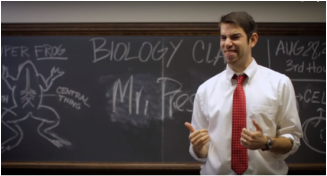 White savior films: who needs to be saved and why? White savior films: who needs to be saved and why?
Tags: children/youth, education, media, race/ethnicity, stereotypes, white savior complex, 06 to 10 mins
Year: 2015 Length: 9:54 Access: YouTube Summary: This short film flips the typical white savior teacher narrative and offers a counterpoint to the cliché of a white teacher who endures the perilous journey each day into the inner city in order to teach "at-risk," students of color. The Sociological Cinema has previously taken up the topic of the white savior complex in a pair of satirical videos poking fun at the Kony 2012 campaign (here and here) and in an essay about the film McFarland, USA. Along with a few guiding questions, this video would be useful as a writing prompt. Instructors could ask students to consider how one might successfully combat the stereotypes typically found in white savior films. What would a counter to those movies look like? White savior films like Dangerous Minds, which the above film references, are fueled by the idea that a group of people need to be saved. Who needs to be saved in Dangerous Minds, and why do they need to be saved? The above film can prompt broader discussions about the role played by media in perpetuating or challenging stereotypes. Finally, are white savior films racist? Why or why not? Check out this Pinterest board for even more examples of white savior films and white-centered media. Submitted By: Esteban Gast 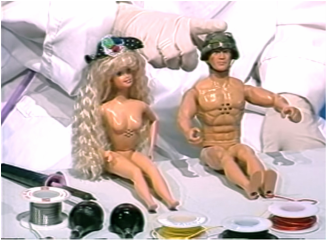 An early example of culture jamming using new media strategies. An early example of culture jamming using new media strategies.
Tags: art/music, consumption/consumerism, gender, marketing/brands, media, science/technology, social mvmts/social change/resistance, activism, culture jamming, new media art, gender socialization, 21 to 60 mins
Year: 1993 Length: 28:29 Access: YouTube Summary: How does social change happen? For more than a century, this question has inspired much sociological research. Within the study of social change, sociologists have often focused their attention on social movement activism and various forms of contentious politics. More recently, some sociologists have sought to move beyond these parameters to ask what other things might “count” as activism. For example, Notre Dame’s Center for the Study of Social Movements Mobilizing Ideas blog recently featured a two-part series entitled “New Ways to Define Activism” (Part I and Part II). Often, sociologists cite new digital media environments and technologies as timely reasons for why we must revisit “old” definitions of activism. While this question might be relevant in the contemporary context, this video illustrates how activists began to strategically draw upon digital media technologies more than twenty years ago. In 1993, a group of artist-activists launched a multi-faceted media campaign call the Barbie Liberation Organization (BLO) in reaction to Mattel’s new talking Barbie, which contained an electronic voice box that played stereotypical phrases such as “Math class is tough” (listen to talking Barbie). The campaign mixed traditional and electronic media, hardware hacking, and “boots on the ground” activism, resulting in this video, which sought to raise awareness of gender stereotypes in a normally difficult-to-reach population of Americans. This video would become one of the earliest and most influential demonstrations of electronic media culture jamming. Instructors can use this video to elicit discussion of successful culture jamming in several ways. First, the video is presented as a legitimate news report, which begs larger questions about the trust we place in news media or the authority of corporations in general. Second, the purported newscast is peppered with clips from actual investigative news reports, such as A Current Affair, to further enhance the legitimacy of BLO’s report. However, many of the clips are taken out of context and edited to subvert the original message, such as when one toy expert’s words are used to accuse Mattel of "terrorism against children” when she was instead accusing BLO of such tactics. Here, we see the artist-activists employing the very medium they challenge to contradict the intended message, which is the crux of culture jamming practice. Finally, the video serves as a DIY tutorial—no different than the myriad of how-to videos populating the web today—which instructs viewers how to perform the voice box swap at home, thus giving consumers and activists alike agency to subvert the toy’s intended message. For a culture jamming video assignment, also posted on The Sociological Cinema, click here. Submitted By: Josh Gumiela and Valerie Chepp  See how queerness on TV has, and hasn't, changed over time. See how queerness on TV has, and hasn't, changed over time.
Tags: inequality, lgbtq, marriage/family, media, sex/sexuality, representation, 00 to 05 mins
Year: 2014 Length: 3:55 Access: YouTube Summary: At the 2015 Emmy Awards, Viola Davis won an Emmy for her role in the TV show, “How to Get Away With Murder,” making her the first African-American to win an Emmy for best lead actress in a drama series. Her acceptance speech was equally important, as she “placed her award within the larger context of diversity in Hollywood.” Davis’s win and acceptance speech reflect a situation that is simultaneously characterized by changing and static social dynamics. This resembles what sociologist Patricia Hill Collins has called the “changing-same” nature of contemporary social inequality, a situation in which new opportunities for change are presented as a result of dramatic shifts in the global political economy, yet where patterns of racial, gender, class and other inequalities nonetheless remain intact. This video clip provides another opportunity to consider the changing-same feature of social inequality in Hollywood. Focusing specifically on representations of queer characters on television, the clip illustrates how these representations have changed over the past several decades. As explained in this Slate article, “These days there are more queer TV characters than ever before, and television representations of gay life are increasingly rich and nuanced, even as the old lesbians-titilate, gays-entertain tropes sometimes remain in play. This video considers all the out-queers on the small screen—as well as all the gay wannabes, pretend-to-bes, and should-bes—taking stock of how far we've come and looking forward to where we might go next.” Yet, given Collins' insight on the changing-same nature of social inequalities, viewers are encouraged to consider how patterns of inequality around sexuality, queerness, and gender non-conformity remain entrenched in American popular culture. Thanks to Michael Miller for suggesting this clip. Submitted By: Valerie Chepp  The intersection of teen identity, consumption, and social media. The intersection of teen identity, consumption, and social media.
Tags: children/youth, consumption/consumerism, corporations, marketing/brands, media, science/technology, identity, internet, social media, teenagers, youth culture, subtitles/CC, 21 to 60 mins
Year: 2014 Length: 53:41 Access: PBS Summary: This 2014 PBS Frontline documentary, Generation Like, serves as a nice updated follow-up to the popular 2001 documentary, The Merchants of Cool. As in the 2001 episode, Generation Like explores how large corporations and marketing firms seek to tap into young consumer markets. However, unlike the teens that came of age during the making of The Merchants of Cool, today’s young adults are navigating a radically different media and advertising environment, namely, one dominated by social media. As explained in this plot summary, “Thanks to social media, today's teens are able to directly interact with their culture - artists, celebrities, movies, brands, and even one another - in ways never before possible. But is that real empowerment? Or do marketers still hold the upper hand? In Generation Like, author and FRONTLINE correspondent Douglas Rushkoff (The Merchants of Cool, The Persuaders) explores how the perennial teen quest for identity and connection has migrated to social media - and exposes the game of cat-and-mouse that corporations are playing with these young consumers. Do kids think they're being used? Do they care? Or does the perceived chance to be the next big star make it all worth it? The film is a powerful examination of the evolving and complicated relationship between teens and the companies that are increasingly working to target them.” While this documentary would be useful for teaching ideas related to teen consumption and corporate advertising, it could also serve as a useful way to examine characteristics of the generational cohort following the Millennials, who have been dubbed "Generation Z." Submitted By: Valerie Chepp 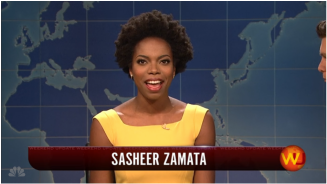 Sasheer Zamata wonders why there aren't any Black emojis. Sasheer Zamata wonders why there aren't any Black emojis.
Tags: discourse/language, inequality, media, prejudice/discrimination, race/ethnicity, science/technology, representation, subtitles/CC, 00 to 05 mins
Year: 2014 Length: 2:27 Access: Hulu Summary: Given the current media spotlight on racist patterns of violence, it's easy to lose sight of more subtle forms of racism. For instance, a daily barrage of media featuring white protagonists simply becomes an unremarked upon backdrop of everyday life, like the piped elevator music that cajoles one into humming along despite being ambivalent about the tune. One racist backdrop might be the book covers one encounters at a typical bookstore. For instance, one analyst found that in 2011 a white person was featured on roughly 90% of all young adult book covers, whereas a Person of Color could only be found on somewhere between 10% and 15% of covers. The quiet tendency to whitewash media is but one reason why representations of whiteness have come to dominate the media landscape. Black and brown characters in popular books are routinely rewritten as white characters in Hollywood film adaptations. And speaking of film and television, one 2013 study found that while whites comprised 63% of the population, they were featured on the evening cable news shows 79% of the time. • The point is not to simply draw attention to the disproportionate number of roles being written for white men and women, or the fact that whites are being given more of a voice in popular media. Instead, my aim is to simply point out that visual media, such as advertising, television, and film, play a key role in promoting the idea of whiteness as the default or universal human. More pointedly, such visual media reinforce the idea that People of Color are deviations, somehow not fully compatible with the human ideal. • Consider the phrasing, "normal to dark skin," recently spotted on a bottle of Dove body lotion. It escapes most people's attention that "normal" is being used as a synonym for "white." Whiteness is the default. In the above comedy sketch from Saturday Night Live, Sasheer Zamata points out a second example of how whiteness becomes normalized in the selection of emojis used in texting. Not one of the more than 800 emojis depicts a Black person, and as Zamata notes, "Unicode, the company that creates emojis, thought that instead of one black person we needed two different kinds of dragons, nine different cat faces, three generations of a white family. And all the hands are white, too. Even the Black power fist is white!" Submitted by: Lester Andrist  TV show deploys the sexist trope of the incompetent father TV show deploys the sexist trope of the incompetent father
Tags: gender, marriage/family, media, fatherhood, parenting, representation, single parents, 00 to 05 mins
Year: 2012 Length: 0:30 Access: YouTube Summary: This clip is a promo trailer for the TV show Baby Daddy. In Baby Daddy, Ben, a single man who was living "the bachelor life" is suddenly confronted with the consequences of his lifestyle when his ex leaves a baby on his doorstep. The trailer jokes at how quickly the presumed mother "got away" after leaving the child to Ben. This implies that she is running from her responsibilities to the child by leaving them to Ben. It is presumed that the mother would have been a better parental figure for the baby than Ben will be. This clip illustrates the unique challenges faced by single parents, and it can also be useful for examining gender norms around parenting. After being left with the child, Ben struggles to deal with his new responsibilities. The promo says that it takes a village to raise a child, and Ben does just that. By bringing in everyone from his brother to his next-door neighbor, Ben "kind of" manages. Yet, he is portrayed as rather incompetent and his parenting is seen as something of a joke. It is implied that Ben cannot raise a kid on his own, and needs to bring in his mom to help him. The young group of fellow bachelors that try to help him are portrayed to be so useless that they put a diaper on the baby with duct tape. This show is one of many media examples that enforce gender norms by portraying fathers as incompetent when dealing with children and needing a woman's help to get anything done. These sexist tropes aren't new, as the same themes are present in other media, such as the 1980s movie Three Men And A Baby, which follows almost the exact same storyline as Baby Daddy. These types of cultural messages contribute to unequal divisions of household labor, as men are portrayed as simply not being good at raising children. When a man raises a kid on his own, he is seen as either a hero or a joke, not a parent doing what a parent does. Submitted By: Abigail Adelsheim-Marshall 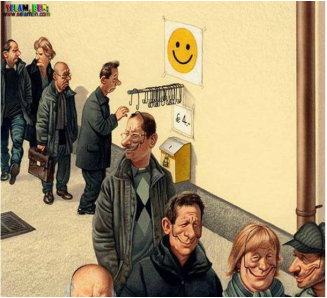 The Facebook mood study raises questions about ethics in research The Facebook mood study raises questions about ethics in research
Tags: emotion/desire, media, methodology/statistics, ethics, facebook, institutional review board, irb, social media, stanley milgram, 00 to 05 mins
Year: 2014 length: 3:41 Access: YouTube Summary: This is a useful video from DNews for getting students to begin thinking about the importance of ethical questions in social scientific research. Hosts Laci Green and Trace Dominguez discuss a study published last year in the Proceedings of the National Academy of Sciences. Researchers reported to have found evidence that emotions can be transferred to others via an emotional contagion. Basically, the design of the study involved manipulating the timelines of 689,003 Facebook users. The researchers found that when they filtered people's timelines to only include negative content for a week, people were more likely to post morose status updates. Positive content, on the other hand, seemed to produce positive status updates. The findings of the study aside, the research certainly puts a new spin on longstanding questions regarding ethics in social science. • Back in 1961 social psychologist Stanley Milgram began a series of controversial experiments intended to investigate obedience to authority, and today one can flip through any introductory sociology textbook to learn of Milgram's results. It turns out that under the right circumstances a substantial number of people can be persuaded to kill, or at least electrocute, others with very little coercion. Milgram's research on obedience was timely and interesting, but it was also controversial. Unbeknown to the research subject, no one was actually on the receiving end of the electric shocks, but the experiment forced the subjects who delivered the shocks to confront an unsettling truth about their own morality. For ethicists, herein lies the ethical dilemma. Many have argued the study was unethical, since the subjects may have been psychologically harmed by the realization that they would kill another person simply because a man in lab coat instructed them to do so. • Is the Facebook study, then, similarly unethical? One person framed the concern nicely when he sardonically tweeted "probably nobody was driven to suicide. #jokingnotjoking." The fact is Facebook effectively flexed a substantial muscle when it allowed researchers to tweak its timeline algorithm. The company proved it could change the mood of hundreds of thousands of people. One wonders how many of the users were struggling with depression at the time of this experiment, and if they happened to be included in the group that received a steady diet of negative content, what role did Facebook play in quickening their downward spiral? Submitted By: Lester Andrist 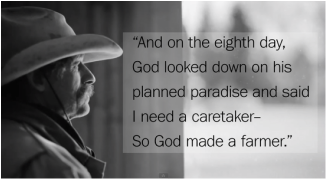 Notions of good, hard-working people are attached to white male farmers in this ad. Notions of good, hard-working people are attached to white male farmers in this ad.
Tags: culture, gender, marketing/brands, media, nationalism, organizations/occupations/work, race/ethnicity, religion, american dream, commercial, farming, hegemony, ideology, 00 to 05 mins
Year: 2013 Length: 2:02 Access: YouTube Summary: This commercial, which aired during the 2013 Superbowl, is a montage of pictures of farmers, their families, and their lifestyle. Throughout the whole ad there is a Paul Harvey speech, known as his “So God Made a Farmer” speech, that was delivered at a 1978 farmer’s convention. The ad connects the speech with the montage of the people in a way that shows how farming is part of American culture, very hard work, and is of great moral and religious value. The ad promotes the new Dodge Ram truck, although the truck only appears a limited number of times. It illustrates the hegemonic ideology of the American Dream in a gendered and racialized manner. In short, the American Dream is the belief that obtaining success and upward social mobility for your family comes through hard work. In the ad, the farmer is working hard because it is their duty to be a hard working American. As a political conservative, Harvey was a big believer in the American Dream and promoted rugged individualism throughout his radio shows, and reflect the meanings that Dodge is attributing to its brand of trucks. This ideology is hegemonic because people take this cultural attitude, and its uniquely American expression, for granted, thereby reinforcing societal power relations. It ilso illustrates gender ideology, which can be referred to as the attitude regarding the roles, rights, and responsibilities of men and women in society. In the traditional sense, the men work blue-collar jobs while the women take care of the household and children. The ad both reflects and reinforces this traditional gender ideology, with 6 females shown in the ad compared to 21 men. None of the women were shown doing the “dirty work” while many of the men showed were actually involved in acting on their farm duties. The second to last picture in the montage is of a young child staring off into the farm with a cowboy hat while Harvey narrates, “When his son says that he wants to spend his life doing what dad does, so God made a farmer,” which reinforces the notion of farming as a masculine activity. Finally, the vast majority of farmers in the clip are white. There is a single image of an African American male farmer, and a Hispanic woman and her son, but for the most part, the video links the notions of good, hard working moral people with white male farmers, and of course, people who drive Dodge trucks. Submitted By: Omar Mendez 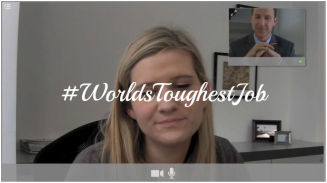 Job seekers unknowingly interview for the job of mother Job seekers unknowingly interview for the job of mother
Tags: gender, marriage/family, media, organizations/occupations/work, fatherhood, housework, labor force participation, motherhood, parenting, 00 to 05 mins
Year: 2014 Length: 4:06 Access: YouTube Summary: In this new ad dubbed "World's Toughest Job," Cardstore pleads its case for why people need to celebrate their mothers. The video appears to be a series of excerpts from online job interviews aiming to fill a Director of Operations position. The job would have unlimited hours and no breaks. Ideally, applicants should have degrees in medicine, finance, and the culinary arts, and be willing to eat lunch only after the associate has eaten. And the position will pay absolutely nothing. At the end, the interviewer divulges that in fact billions of people already hold the position. They are called mothers. If online commentary is any gauge, the video has succeeded in tapping into many viewers' sepia toned memories of their own mothers, which makes it an excellent springboard for launching into a discussion about whether Cardstore's appraisal of mothers is simply based on nostalgia or empirical research. Drawing from the American Time Use data, the reality is that mothers spent about 18 hours each week doing unpaid housework, compared to fathers, who only devoted about 10 hours. On average, mothers devote about 14 hours each week to child care, whereas fathers only devote seven hours. Sociologist Suzanne Bianchi found that despite a steady increase in mothers' labor force participation since the 1960s, they are spending approximately the same amount of time with their children. To accomplish this feat, working mothers have had to adjust their work hours, they have had to do less housework, devote less time to leisure, and rather tragically, they have had to sacrifice sleep. If not the world's toughest job, it would be hard to argue that the job of mothering is not at least one of the toughest. Still it is important to note that while the celebration of mothers in these viral ads may be heartwarming for some, the ads also work to shore up rather narrow and limiting expectations of how women with children should act, which is a topic The Sociological Cinema has explored elsewhere (here and here). Submitted By: Lester Andrist |
Tags
All
.
Got any videos?
Are you finding useful videos for your classes? Do you have good videos you use in your own classes? Please consider submitting your videos here and helping us build our database!
 |
 RSS Feed