 Tea making: a helpful analogy for understanding consent. Tea making: a helpful analogy for understanding consent.
Tags: emotion/desire, sex/sexuality, consent, safe sex, sex-positive, 00 to 05 mins
Year: 2015 Length: 3:14 Access: YouTube Summary: This video was made by Sexplanations, a video show focused on “shame-free, comprehensive efforts to educate on everything sex.” This particular episode is based on a post from the blog Rockstar Dinosaur Pirate Princess, titled “Consent: Not Actually That Complicated.” The piece serves as a nice counter-narrative to the pervasive discourse that frequently surrounds discussions about sexual consent, which too often suggest an element of confusion or “blurred lines” when it comes to consent. In order to make the case that consent is not actually that complicated, the author likens initiating sex to making a cup of tea, and walks the listener/reader through the various scenarios in which people might find themselves initiating sex. When placed in the context of tea making and drinking, suddenly ideas about consent come across as obvious and non-controversial. The author ends the post asking, “Do you think this is a stupid analogy? Yes, you all know this already – of course you wouldn’t force feed someone tea because they said yes to a cup last week. Of COURSE you wouldn’t pour tea down the throat of an unconscious person because they said yes to tea 5 minutes ago when they were conscious. But if you can understand how completely ludicrous it is to force people to have tea when they don’t want tea, and you are able to understand when people don’t want tea, then how hard is it to understand when it comes to sex?” In addition to being useful in a classroom setting, this video would also be effective to show during educational workshops and trainings on consent, safe sex, and/or sexual assault. Submitted By: Valerie Chepp
9 Comments
 See how queerness on TV has, and hasn't, changed over time. See how queerness on TV has, and hasn't, changed over time.
Tags: inequality, lgbtq, marriage/family, media, sex/sexuality, representation, 00 to 05 mins
Year: 2014 Length: 3:55 Access: YouTube Summary: At the 2015 Emmy Awards, Viola Davis won an Emmy for her role in the TV show, “How to Get Away With Murder,” making her the first African-American to win an Emmy for best lead actress in a drama series. Her acceptance speech was equally important, as she “placed her award within the larger context of diversity in Hollywood.” Davis’s win and acceptance speech reflect a situation that is simultaneously characterized by changing and static social dynamics. This resembles what sociologist Patricia Hill Collins has called the “changing-same” nature of contemporary social inequality, a situation in which new opportunities for change are presented as a result of dramatic shifts in the global political economy, yet where patterns of racial, gender, class and other inequalities nonetheless remain intact. This video clip provides another opportunity to consider the changing-same feature of social inequality in Hollywood. Focusing specifically on representations of queer characters on television, the clip illustrates how these representations have changed over the past several decades. As explained in this Slate article, “These days there are more queer TV characters than ever before, and television representations of gay life are increasingly rich and nuanced, even as the old lesbians-titilate, gays-entertain tropes sometimes remain in play. This video considers all the out-queers on the small screen—as well as all the gay wannabes, pretend-to-bes, and should-bes—taking stock of how far we've come and looking forward to where we might go next.” Yet, given Collins' insight on the changing-same nature of social inequalities, viewers are encouraged to consider how patterns of inequality around sexuality, queerness, and gender non-conformity remain entrenched in American popular culture. Thanks to Michael Miller for suggesting this clip. Submitted By: Valerie Chepp 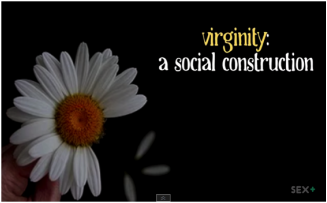 "Virginity” powerfully shapes and controls people’s lives. "Virginity” powerfully shapes and controls people’s lives.
Tags: gender, sex/sexuality, social construction, heterosexism, sexism, virginity, subtitles/CC, 00 to 05 mins
Year: 2013 Length: 4:59 Access: YouTube Summary: In this video, Laci Green, a peer sex educator and YouTube blogger, tackles the issue of virginity and illustrates how past social norms contribute to contemporary ones. Green starts out by establishing the concept of "virginity" as a social construct—that is, the definition of virginity changes over time and across cultures. For instance, the definition of virginity is rather unclear. As Green explains, virginity can be hard to define with same sex partners, or in the absence of vaginal intercourse. So, what is virginity? Well, Green says it started in the Neolithic Period, back when there was no birth control and male-bodied people controlled most of the resources. There was a problem with establishing paternity if a female-bodied person had slept with more that one person. So, virginity was the answer. In order for a young female person to be eligible for marriage she must have been "pure" and virgin. There was also a financial element tied to this. In exchange for a virgin daughter, a father was paid material goods from the husband-to-be. Green highlights remnants of these early social practices in contemporary societies. For example, in honor-based societies, women who lose their virginity out of wedlock are often subjected to beatings and death for dishonoring their families with their "impurity." In other societies, fathers "give away" their white clad daughters at weddings, the white dresses being a symbol of virginity and purity. Importantly, Green acknowledges that, just because virginity is a social construct, doesn’t mean that it’s not "real." Virginity affects people’s material lives and values in many ways. The concept of virginity has a lot of power and shapes many aspects of people’s lived experiences, from controlling their sexualities to promoting heterosexism. Green suggests that we try to take away the power of the term virginity, and call the experience a "sexual debut" instead. For more of Laci Green’s peer sex ed and social justice videos, check out her YouTube channel or another post on The Sociological Cinema featuring one of her videos. Submitted By: Abigail Adelsheim-Marshall  This video chronicles one person's experience being asexual. This video chronicles one person's experience being asexual.
Tags: emotion/desire, lgbtq, sex/sexuality, asexuality, heteronormativity, identity, media, representation, 00 to 05 mins
Year: 2015 Length: 2:25 Access: YouTube Summary: This video is an animated story of a young asexual’s life and her experiences. Asexuality is defined as the lack of sexual attraction to any gender. This is different from celibacy. While a person who is celibate (i.e., someone who choses not to have sex) can still experience sexual attraction, most asexuals are simply not interested in sex. There are asexuals who have sex, but they do not feel sexually attracted to their partners. They may chose to have sex for intimacy, or to feel closer to their partners, but it is not out of sexual attraction. This person's story started out when they were in middle school. The author says that she started to feel different from her friends around that time. This is when most of her friends started to talk about their crushes, which the author never had. Around the same time the author noticed that all of the books they read centered on romance and sexual attraction. This made her feel even more out of place, due to lack of representation in the media, and she felt very alienated. To fit in with cultural norms, the author made up crushes so as not to seem different from her peers. This, however, did not work and she started avoiding the subject of crushes altogether. The author felt as though by not participating in this part of school culture she came off as aloof and "different." Not a pleasant feeling. So, when the author went to high school she started dating to see if she might "get it." However, she was disappointed, as she still didn’t understand everyone’s obsession with the opposite sex. After not doing too well dating men, the author thought she might be gay. So she started dating girls. The results, however, were the same. The author still did not get the appeal of dating or sex. This lead the author to think that she was broken and alone. She felt as though she could not fit in with social norms and was alienated by hyper-sexualized media. Finally, the author found an online community of fellow asexuals. Being able to label how she felt and knowing that there were others like her helped the author finally stop feeling broken. This video is useful for talking about sexualities, and how media representations (or a lack thereof) affects people. If you never see anyone like yourself represented in the media, you start to feel like you’re the problem and that you don’t belong. By finding others like herself, the author was able to accept herself and finally come to terms with her identity. For additional resources, check out The Sociological Cinema's other videos on asexuality. Submitted By: Abigail Adelsheim-Marshall  When it comes to infidelity, does gender and biology matter? When it comes to infidelity, does gender and biology matter?
Tags: abortion/reproduction, biology, bodies, culture, emotion/desire, gender, sex/sexuality, biological determinism, infidelity, sociobiology, 06 to 10 mins
Year: 2008 Length: 6:21 Access: today.com Summary: This segment from the Today Show explores whether humans are “wired”—or, biologically predisposed—to cheat on their mates. The clip can be used to teach biological determinist perspectives of gender, and specifically those rooted in sociobiology. In short, biological determinism argues that the social world is predetermined by biological factors. Sociobiology stems from this tradition of thought, but focuses more specifically on genetic reproduction and evolutionary processes. Often relying on observations of animal behaviors to make claims about human behaviors, sociobiology argues that a fundamental human drive is to ensure genetic reproduction, and many human activities can be reduced to this drive. Using the case of infidelity, this video clip is helpful for shedding light on sociobiological explanations of gender difference. The segment opens with a sociobiological perspective, using Barash and Lipton's (2001) book The Myth of Monogamy as a point of reference. Here, the authors argue that monogamy is not natural; from an evolutionary standpoint, humans have a stake in having multiple sexual partners. Sexual promiscuity is prevalent throughout the animal kingdom, they argue, and humans are not exempt from the same biological urges that drive other animals to be promiscuous. After the opening segment (minute mark 2:17), host Meredith Vieira speaks with Jeffrey Kluger, TIME magazine’s science editor, and psychologist David Buss; the conversation quickly turns to a discussion of gender difference. Kluger represents a fairly classical sociobiological argument when he states: “Nature wants one thing, and what it wants are babies. It also wants lots of them. And it wants variety, because the greater the genetic variety, the greater the likelihood that the babies are going to survive into adulthood and do well.” Kruger goes on to assert that men will look for women who are young and fertile, and women look for men who are good providers, such as those who are rich and powerful. Buss introduces more socio-cultural elements into the discussion, such as strong social norms against cheating, and argues that both men and women feel attraction to others outside of their relationships. He also points to psychological pathologies, namely narcissism, as an explanation for infidelity, and draws attention to infidelity in a cross-cultural context where polygamy is common (that is, cultures where men are legally entitled to have multiple wives). Although Buss mostly draws upon socio-cultural explanations, he also suggests that biological impulses to be non-monogamous are a part of our “human nature.” Asked why men cheat more, Kruger draws upon biological and sociological arguments, arguing that: (1) biologically, men have the ability to breed more, and could conceivably breed offspring everyday; from this he argues that men are “tripwired" for infidelity; and (2) in a patriarchal society such as ours, men are more likely to be in positions of power and feeling entitled to be unfaithful. After screening the video, viewers can be encouraged to identify messages in the clip that cohere with, and deviate from, the sociobiological perspective. Viewers can also be encouraged to explore feminist and/or sociological critiques of biological determinism, such as those outlined in Carmen Schifellite’s (1987) essay, "Beyond Tarzan and Jane Genes: Towards a Critique of Biological Determinism.” Submitted By: Valerie Chepp 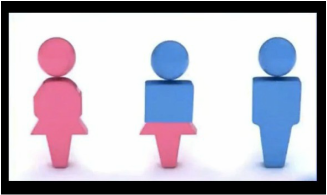 ISU adds gender-neutral labels to its restrooms ISU adds gender-neutral labels to its restrooms Tags: crime/law/deviance, gender, inequality, knowledge, lgbtq, media, prejudice/discrimination, sex/sexuality, social construction, agender, androgyne, bigender, gender fluid, genderqueer, neutrois, non-binary, trans*, transgender, 00 to 05 mins Year: 2014 Length: 0:50 Access: Mediaite Summary: In this clip from Fox & Friends Heather Nauert reports that Illinois State University recently relabeled its "family” restrooms as "gender-neutral." She kicks off the segment by saying,"Someone call the P.C. police!" and warns that viewers are "not going to believe this one.” The giddy laughter of her off-camera colleagues is audible while she delivers her exasperated explanation of the new restroom symbols. The video is useful in any class wrestling with the social construction of gender, the gender binary, and consequences of rigidly enforced gender categories. People who identify as transgender, two spirit, demiguy, demigirl, bigender, non-binary, trigender, third gender, genderqueer, gender fluid, androgyne, neutrois, and agender (and others) have often reported instances of ridicule and danger faced when using public restrooms. For this group, the labeling change means the difference between being able to safely use public restrooms at their university. What is interesting is not the change toward more inclusive signage at Illinois State University, but how Fox & Friends uses their platform as a major news network to actively police the gender binary. Nauert begins by framing the change as an instance of political correctness, a term that suggests the new signs are of trivial importance. The demeanor of both newscaster and her off-camera colleagues is another cue that viewers should not regard the change as an important or positive development at Illinois State University. Although times are changing, news programs still give lip service to the idea that their job is simply to give the public impartial (i.e., fair and balanced) information about important events. What is discussed less is the role the media plays in shaping the public's understanding of those events and reconstituting the state of affairs where excluding people who do not conform to the gender binary is acceptable. For more information about bathrooms as a site of gender politics, check out our Pinterest board on the topic. Submitted By: Lester Andrist 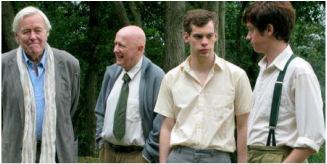 This short film examines the changing lives of gay men in rural UK. This short film examines the changing lives of gay men in rural UK. Tags: aging/life course, emotion/desire, lgbtq, prejudice/discrimination, rural/urban, sex/sexuality, adolescence, gay, performative social science, uk, 21 to 60 mins Year: 2012 Length: 30:00 Access: Vimeo Summary: Rufus Stone is a short film about "love, sexual awakening, and treachery." According to Director Josh Appignanesi, "the story dramatizes the old and continued prejudices of village life from three main perspectives. Chiefly it is the story of Rufus, an ‘out’ older gay man who was exiled from the village as a youth and reluctantly returns from London to sell his dead parents’ cottage, where he is forced to confront the faces of his estranged past. Of these, Abigail is the tattle-tale who ‘outed’ Rufus 50 years ago when he spurned her interest. She has become a lonely deluded lush. Flip, the boy Rufus adored, has also stayed in the village: a life wasted in celibacy (occasionally interrupted by anonymous sexual encounters) and denial (who is) looking after his elderly mother. But Rufus too isn’t whole, saddled with an inability to return or forgive." The film is based on three years of a Research Council UK funded study of the lives of older lesbians and gay men in south west England and Wales, a part of the national New Dynamics of Ageing Programme of research. The project was led by Kip Jones, who also wrote the story and acted as Executive Producer for the film. Winner of two awards, the film has gone on to be screened at film festivals, other universities in the UK, USA and Canada and by organizations such as Alzheimer’s Society UK, LGBT groups, and health, social and aging support networks. Screenings of the film would be appropriate for a wide variety of audiences, including in undergraduate and graduate teaching, community groups, and LGBT and aging support organisations. Viewers can access more information about the project and film at the Rufus Stone Blog. Submitted By: Kip Jones 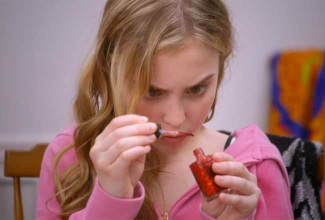 Katie fakes her period and receives a "first moon" party. Katie fakes her period and receives a "first moon" party. Tags: bodies, children/youth, commodification, consumption/consumerism, gender, health/medicine, marketing/brands, sex/sexuality, commercial, humor, menstruation, 00 to 05 mins Year: 2014 Length: 2:20 Access: YouTube Summary: The company HelloFlo has distinguished itself with its innovative marketing of feminine hygiene products, as well as a lively blog and the informative “Ask Dr. Flo” column. This advertisement portrays an adolescent girl who is impatient for the arrival of her first period. At the start, we see her decorating a clean pad with red nail polish. Her mother discovers the pad and pretends that she has been duped. The mother then concocts an extravagant revenge plot in the form of a “First Moon Party,” even though she knows the daughter has yet to have a period. While the advertisement enlists humor to defuse discomfort and embarrassment, the resulting comedy treats male and female characters inequitably and relies upon familiar tropes of conniving girls and devious women. For example, the mother deceives her daughter and exposes her to unwanted attention from men and boys. Grown men do imbecilic things and inspire eye-rolling, while the girl, the supposed protagonist, does something adolescent—after all, she is an adolescent—and suffers punishment. While in the past, a girl might have been daunted by the secrecy and shame surrounding menstruation, here she is discomfited by a denial of privacy, as others take over her rite of passage (one she herself has yet to undergo). The narrative closure comes when the girl admits to her lie and asks whether she will be grounded. Her mother reveals that she has already punished her with the party and then gives her a “period starter kit” as a gift. The advertisement concludes by giving the punchline to a male partygoer who awaits the flow from a sluggish ketchup bottle; he advises another young girl, “Sometimes you just gotta wait.” The ad is framed as a parody, but given the delicate and gendered subject matter, questions arise. How and when can humor dismantle convention? Who is the protagonist? Toward whom is this spot directed? Who is relieved of embarrassment? And to what end? Note that The Sociological Cinema has previously explored how the topic of how menstruation gets handled by the media here and here. Submitted By: Rose Marie McSweeney  This man thinks rape is sincerely hilarious. This man thinks rape is sincerely hilarious. Tags: children/youth, culture, emotion/desire, gender, sex/sexuality, violence, masculinity, rape, sexual assault, 00 to 05 mins Year: 2014 Length: 2:16 Access: YouTube Summary: [Trigger warning for frank talk about rape] In this clip, Andrew Bailey performs a character who awkwardly explains his view that rape is hilarious when it happens to men. The monologue plays as the character's thinly veiled attempt to convince himself that the rape he experienced at the hands of his teacher was something other than a traumatic instance of physical and sexual abuse. At first, he seems to breathlessly struggle to convince viewers that rape is hilarious, then as his face reddens and his defenses appear to be eroding, he attempts to reframe his rape as an experience he actually wanted. After all, in his words he "was a horny 13-year-old boy, and [he] totally wanted to have sex, and now [he] totally had had sex with an adult he trusted." By the end of monologue the character's defenses have fallen away, and the audience is left with his raw testimony. He reveals a more thoughtful side to the character, who explains that he self-consciously chooses to see rape as funny because it is one of the few defenses he has for dealing with the experience. The video works well to underscore a number of ideas about patriarchy. For instance, in contrast to the premises behind many of the arguments posed by so-called men's rights activists, patriarchy very often does not operate as a zero-sum game. In other words, the idea that there is a war between the sexes, where a "loss" for women is simultaneously a "gain" for men is not always a useful idiom, and in fact, as feminists have long noted, patriarchy hurts men too (see for example, these posts featuring Michael Kimmel, Tony Porter, and check out this paper from R. W. Connell, who argues that under patriarchy men orient themselves to a hegemonic masculinity). Bailey's monologue can be used to remind viewers that men and boys are also victims of rape, but because patriarchy constructs the aspirational ideal of a man as someone who cannot be raped and always desires sex, men very often have trouble admitting their experiences, even to themselves. Submitted By: Lester Andrist  In Both, Rebeca learns the truth about a childhood surgery. In Both, Rebeca learns the truth about a childhood surgery. Tags: biology, bodies, gender, lgbtq, science/technology, sex/sexuality, bisexuality, intersex, sexual expression, sexual identity, sexual orientation, 61+ mins Year: 2005 Length: 86:20 Access: Vimeo Summary: [Trigger warning for those who might be traumatized by depictions of the sex reassignment surgery many intersex people experience as children] People often want to know how many people are born intersex? Unless one is specific about the many physical features that often get named "intersex," the question is difficult to answer. For instance, based on research from Blackless et. al. (and reported here), in the medicalizing language of late onset adrenal hyperplasia, 1 in 66 people are intersex; however, only 1 in about 150,000 are intersex if you restrict the label to include only those who have what medical doctors refer to as complete gonadal dysgenesis. The frequency of people receiving surgery to "normalize" the appearance of their genitals is about 1 or 2 people in 1,000. Frequencies are perhaps an interesting place to start a discussion on intersex, but in themselves, numbers do little to give voice to those who are born intersex within a culture and society that upholds a strictly dimorphic understanding of sex. The above film, Both, is a compelling drama, based on the experiences of many intersex adults, and the film tells a story of an issue that has been widely silenced through shame and secrecy. In the film, Rebeca Duarte, played by Jackie Parker, works as a stunt double for indie action films in San Francisco. From rolling out of cars to setting herself on fire, she puts her life at risk on a daily basis. Work, lovers and friends take up most of her time, but deep inside, she feels something is missing. Rebeca feels strangely disconnected from her own body and can’t figure out why. One day she mysteriously receives a photo album from someone in Peru, where she had spent her childhood. The album contains pictures of her parents and her brother who had supposedly died, but no images of herself. Feeling unsettled, Rebeca sets out to discover the mystery and unravel the web of lies that both the doctors and her parents have spun her whole life. Through her fight to uncover the truth, Rebeca discovers her own identity and a renewed passion for life. Both works by posing compelling questions about gender and sexuality through the experiences of its intersex protagonist. For those considering showing the film in class, note that nudity, masturbation, and sexual intercourse are depicted at 17:50 mins, 21:30 mins, and 53:20 mins. Submitted By: Leslie Jaye |
Tags
All
.
Got any videos?
Are you finding useful videos for your classes? Do you have good videos you use in your own classes? Please consider submitting your videos here and helping us build our database!
 |
 RSS Feed