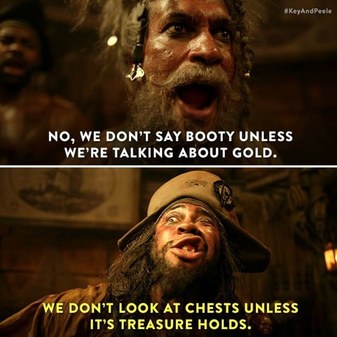
 Pirates sing about respecting women in this skit from Key & Peele's comedy show. Pirates sing about respecting women in this skit from Key & Peele's comedy show.
Tags: bourdieu, culture, gender, inequality, theory, habitus, patriarchy, sexism, sexual assault, sexual harassment, subtitles/CC, 00 to 05 mins
Year: 2015 Length: 3:50 Access: YouTube Summary: Women have been stepping forward with allegations of sexual harassment and assault against powerful men, but it would be a mistake to fall victim to the belief that women's outrage is entirely new. However, what is new is the deluge of allegations, the sustained public attention to the matter, and that the women making the accusations are largely presumed to be telling the truth. With each epiphany, Americans are forced to confront the uncomfortable proposition that sexual harassment and assault are a constitutive part of office politics. Moreover, sexism is alive and well in the halls of American government, and it circulates within the private orbits of our most worshiped celebrities. So while it is certainly true that not all men harass women, women know that everywhere they go, there is the possibility of being harassed by men. It's as certain as the shark-infested waters beneath the plank of a pirate ship. • Back in 2015, when such allegations were more readily ignored and dismissed, the comedic duo Key & Peele seemed to grasp the scale of the problem and developed a comedy sketch featuring a pub full of gravely-voiced pirates. These drunken men of the sea are shown gathered in a dimly-lit tavern as the archetypal masculine men occupying a quintessentially masculine space. However, the brilliance of this skit is that Key & Peele play against type for laughs, and instead of bellowing songs that objectify and degrade women, they offer matter-of-fact statements of men's shared humanity with women: "I once met a lass so fine, 'twas drunk on barley wine, I'd been to sea for months a'three, I knew I could make her mine. And the lass was past consent, and we threw her in bed, and rested her head, and left cuz that's what gentlemen do." • Enter the social theorist Pierre Bourdieu and his concept habitus, which refers to a system of dispositions that vary by time, place, and social position. Drawing on this concept, one might say that the clip is funny because the pirates defy expectations in that they fail to embody and employ a sexist habitus. As viewers, we implicitly understand that casually disrespecting women is, in a sense, the lingua franca among these types of men in these types of spaces. This video can be used to illustrate Bourdieu's famous concept, but students can also be challenged to think beyond Key & Peele's fictional characters. What of the sexist habitus in the halls of government and in corporate boardrooms? What are the dispositions that define these spaces? Lester Andrist, Ph.D.  Jessica Alba Jessica Alba
Tags: biology, knowledge, race/ethnicity, social construction, subtitles/CC, 00 to 05 mins
Year: 2011 Length: 3:33 Access: YouTube Summary: In this short video from 2011, Jessica Alba appears on the talk show Lopez Tonight and endures George Lopez's comedic preamble before hearing the results of her ancestry DNA test. According to Lopez and the language used by the testing company, Alba is 87 percent European and 13 percent Native American. But to the astute observer, the show is actually claiming to reveal more than the details of Alba's genetic composition. It is also claiming to reveal information about her "true" race, and therein lies the problem. • As I have noted elsewhere on The Sociological Cinema, racial categories do not consistently correspond to biological observations (see here and here). To put it another way, race is not based on biology; it merely claims to be. This point often confuses people, for they reason that in some sense race must be biological. After all, skin color is largely a genetically determined characteristic, and so the thinking goes, race must be too. But while genetic instructions largely determine the amount of melanin a body produces, it is through socialization that people become predisposed to notice skin color as one of the most salient features a body can have. The thickness of one's eyebrows, the shape of their ears, or the color of their of eyes—these are also genetically determined characteristcs, but people mostly discount these features as the bearers of useful information. To socially construct race, then, is to teach people which physical characteristics are the salient markers of a racial group, and racism becomes possible once people begin assigning meanings to those salient racial markers. • At about the 45-second mark, Lopez explains that the DNA analysis distinguishes between four ancestral groups, and perhaps sensing that it would resonate with his audience, he incorrectly equates each ancestral group with a race. The Europeans, according to Lopez, are white, Sub-Saharan Africans are black, East Asians are Asian, and the Indigenous American group refers to Native Americans. The results confuse Alba, who racially identifies as Latina and knows her last name comes from Spain. But it is instructive to dwell a bit on the basis of her confusion, for it highlights the incompatibility between ancestral DNA and race. In the United States people with Spanish heritage tend to be racially categorized as Hispanic or Latino, which is a category believed to be distinct from white. However, DNA analyses show that the original inhabitants of the Iberian Peninsula (i.e. Spain, Portugal, the small UK overseas territory of Gibraltar, and the Principality of Andorra) are a part of the same general migratory group of homo sapiens that settled the rest of Europe. As with all racial categories, contemporary distinctions between whites and Hispanics in the United States are socially created and not based on some deeper biological truth. Submitted By: Lester Andrist  Chuck struggles to name any black friends he has. Chuck struggles to name any black friends he has.
Tags: race/ethnicity, racial homophily, social networks, white habitus, 00 to 05 mins
Year: 2015 Length: 3:40 Access: YouTube Summary: In this clip from Jimmy Kimmel Live's Pedestrian Question segment (where they ask people on the street some type of question), his crew asks whites whether or not they have a black friend and the audience predicts their response. For example, a white woman from Australia admits not having a black friend, and Chuck from Ohio claims to have a black friend but then cannot name him/her, and a black man is asked if he has any white friends and he says "not really" because "white people are kind of scary." A couple white respondents do report having a black friend, but are sometimes asked to "prove it." While tackling a socially sensitive topic with humor, the clip works on several levels: it reveals the reality of racially homogeneous networks and the audience's disbelief of some whites having a black friend underscores the tendency of people to claim such connections when they don't exist. This phenomenon must be understood in the context of racial segregation, which has persisted in a very high degree within the US. Through segregation, blacks, whites, and Hispanics all develop group cohesion and identity, and develop networks that are often racially homogenous. However, this practice of racial homophily (in which people tend to associate with members of their own race) is strongest among whites because they experience the highest degree of racial isolation. In Racism Without Racists, Eduardo Bonilla-Silva (2013) conceptualizes this in terms of the white habitus, or whites’ racial taste, perceptions, feelings, and emotions and views on racial matters, including a greater degree of comfort interacting with other whites. Bonilla-Silva argues that this results from a process of racial socialization that comes from all areas of life, including who you interact with in your neighborhood, schools, and social networks. Furthermore, because whites do not want to be perceived as racist in such a society, it is common for them to claim having black (or nonwhite) friends. Chuck's statement that he has a black friend in the clip, but was unable to name him/her, was actually a theme found in Bonilla-Silva's research. For additional context, see this series of clips from Anderson Cooper: this video reveals how this process starts in childhood; this video shows children's views on interracial friendships; and this video shows why racial diversity matters in forming views on race. Submitted By: Paul Dean  Adele, Jazmine Sullivan, and privilege in soul music stardom. Adele, Jazmine Sullivan, and privilege in soul music stardom.
Tags: art/music, culture, inequality, race/ethnicity, black culture, meritocracy, pop culture, privilege, soul, 00 to 05 mins
Year: 2015 Length: 5:44 Access: YouTube Summary: This video examines the history and legacy of soul music, and the advantage "blue-eyed soul" singers may have over Black soul singers in today’s music scene. The video begins noting the traditional dimensions of soul, including ad-libbing, belting, and unpredictability, which "historically symbolized resistance against racist oppression" and the idea of soul music as a form of racial protest and activism. But the history of black music shows that it has been underrated, uncredited, stolen, and absorbed into other genres. At the same time, white artists like Adele and Sam Smith dominate the genre. An argument of meritocracy falsely suggests this is a result of fewer Black artists, that they are not trying hard enough, or they are not writing and making enough soul music (a similar argument was made about the lack of black performances on the 2016 Academy Award nominees). Several examples (e.g. Leon Bridges) are offered to show that this argument of a meritocracy in soul music is a myth, and that black artists tend to get rejected from music competitions and awards at early stages, despite their ability. It explores the role of privilege in the process. It notes that Adele and Sam Smith do indeed deserve success, but emphasizes that all people, regardless of their race, should have an equal shot at it. This video is the third episode from a series by Amraj Lally, called "POPTOPICS". This series is a critical and theoretical analysis on trending pop culture topics, aiming to stimulate intellectual discussion. For a multimedia analysis of the institutionalization of white privilege and how to fight against it, check out our blog post. Submitted By: Amraj Lally  News clip editing reproduces stereotypes of black boys. News clip editing reproduces stereotypes of black boys.
Tags: crime/law/deviance, inequality, media, prejudice/discrimination, psychology/social psychology, race/ethnicity, confirmation bias, framing, linguistic intergroup bias, journalism, news media, 00 to 05 mins
Year: 2011 Length: 1:42 Access: YouTube Summary: This video is put together by the Maynard Institute, which is "dedicated to helping the news media accurately portray all segments of society, particularly those often overlooked, such as communities of color." The beginning of the video shows a real Chicago CBS news segment that covers the shooting of two teenagers, which was witnessed by several children, including a 4-year old. The commentator describes the "disturbing reaction" by the 4-year old boy, who is shown saying that “I’m not scared of nothing.” When the reporter asks him if he will stay away from guns, the boy responds: “I’m going to have me a gun!” The segment ends with Anchor Steve Bartelstein saying, “that is scary indeed.” The issue with this clip is what was omitted from the story. In the actual interview with the 4-year old boy, the reporter next asks “Why do you want to have [the gun]?” The boy states “I'm going to be the police!” and the reported responds “Okay then you can have one." Subsequent content from the video, and this Maynard Institute analysis, outline some of the problems with the edit, including its portrayal of African American boys in a stereotypical manner. While it is unclear why this particular video was edited in this way (the news station removed the story once the problem was identified), the reality is that such editing decisions frequently occur and continue reproducing stereotypes. Indeed, "studies of media content consistently find that black criminal suspects are portrayed more frequently and more menacingly than white suspects in television news stories of violent crime" (Peffley et al 1996). It could be a result from a news editor's confirmation bias, where an individual looked for content in the video that confirmed his expectations, thereby using that footage and eliminating the (real) footage that would have led to an alternative framing. It might also derive from the economic drive for media to present controversial news that they believe viewers will be more interested in watching (thereby consuming more advertisements). For example, research shows that viewers find crime news stories more memorable when the perpetrator is dark-skinned male. What is the impact of this on race relations? Experimental studies show that such "even a brief visual image of an African American male suspect in a televised crime story was capable of activating racial stereotypes, which in turn heavily biased whites’ evaluations of the suspect along racial lines" (Peffley et al 1996). Such race-related TV news stories also lead to linguistic intergroup bias, where "people use more abstract language to describe stereotype-congruent behaviors, particularly when that person is a member of an out-group" (Gorham 2006). Thanks to Logan Webster for suggesting this video. Submitted By: Paul Dean  The latent vs. manifest functions of education. The latent vs. manifest functions of education.
Tags: art/music, children/youth, education, inequality, knowledge, adolescence, hidden curriculum, latent functions, manifest functions, pedagogy, performance poetry, spoken word, structural functionalism, youth studies, 00 to 05 mins
Year: 2014 Length: 3:46 Access: YouTube Summary: In this spoken word performance entitled “Somewhere in America,” three high school students share their experiences as youth in America’s educational system. The video can be used to illustrate features of the structural-functionalist perspective, and specifically how sociologists working within this framework—e.g., Emile Durkheim, Robert Merton, and Talcott Parsons—distinguished between the manifest and latent functions (and dysfunctions) of various social phenomena. Here, the teenagers discuss the functions and implications of the manifest versus latent curriculum, and how these two curriculums play out in the lives of children. The poets argue that the manifest curriculum, which is the content teachers are required to teach, is not what students remember most; rather, the girls suggest that the latent or hidden curriculum is the knowledge that becomes more deeply embedded in students’ memories and daily interactions. The hidden curriculum refers to the values, beliefs, and attitudes that are transmitted to students through the education system; a latent function of these hidden lessons is that these help to socialize young individuals to form a more “cohesive” society. In doing so, the views and values of the dominant culture are coached into the minds of young school-goers. Arguing that the biggest lessons in school “won’t come from a syllabus,” the words of these poets reinforce decades of social scientific research stating that schools go farther than simply advancing the academic success of children; schools also instill social and cultural ideas within students (for one prominent example, see Ann Arnett Ferguson’s research on the role of public schools in constructing Black masculinity). The group closes by saying, “The greatest lessons [in school] are the ones you don’t remember learning.” While we’ve chosen to highlight the structural-functionalist contours of the poem, viewers are encouraged to think about how the teens’ poem can be read through other foundational sociological lenses, namely, social conflict theory and symbolic interactionism. For example, the students’ attention to power inequalities that emerge from the education system resemble a social conflict approach. This supplementary video explaining the three foundational sociological perspectives and how they relate to education can help viewers with this analysis. Submitted By: Jordan Grier and Valerie Chepp  Sociologist Pierre Bourdieu (1930-2002) Sociologist Pierre Bourdieu (1930-2002)
Tags: class, inequality, knowledge, cultural capital, embodied state, institutionalized state, objectified state, pierre bourdieu, 00 to 05 mins
Year: 2015 Length: 5:29 Access: YouTube Summary: This short tutorial video summaries Pierre Bourdieu's (1930-2002) theory of cultural capital, a concept that is defined in this video as “the cultural knowledge that serves as currency that helps us navigate culture and alters our experiences and the opportunities available to us.” The video goes on to elaborate by discussing three different forms of cultural capital—embodied state, objectified state and institutionalized state—and provides examples of each type that students can apply to their own lives. At the end of the video, discussion questions are included that can assist students in applying the concept of cultural capital to what is happening in the world today. This is one of several videos on The Sociological Cinema that illustrate Bourdieu’s ideas, including his theory of taste (here, here, and here), different forms of capital, habitus, and social distance. In addition to this tutorial video, The Sociological Cinema's has several videos that use examples from popular culture to teach Bourdieu’s concept of cultural capital, which includes clips from the popular reality TV show Wife Swap, scenes from The Wire (here and here), the movie Clueless, and this excerpt from the PBS documentary film People Like Us: Social Class in America. Submitted By: Sociology Live!, Cindy Hager  Tea making: a helpful analogy for understanding consent. Tea making: a helpful analogy for understanding consent.
Tags: emotion/desire, sex/sexuality, consent, safe sex, sex-positive, 00 to 05 mins
Year: 2015 Length: 3:14 Access: YouTube Summary: This video was made by Sexplanations, a video show focused on “shame-free, comprehensive efforts to educate on everything sex.” This particular episode is based on a post from the blog Rockstar Dinosaur Pirate Princess, titled “Consent: Not Actually That Complicated.” The piece serves as a nice counter-narrative to the pervasive discourse that frequently surrounds discussions about sexual consent, which too often suggest an element of confusion or “blurred lines” when it comes to consent. In order to make the case that consent is not actually that complicated, the author likens initiating sex to making a cup of tea, and walks the listener/reader through the various scenarios in which people might find themselves initiating sex. When placed in the context of tea making and drinking, suddenly ideas about consent come across as obvious and non-controversial. The author ends the post asking, “Do you think this is a stupid analogy? Yes, you all know this already – of course you wouldn’t force feed someone tea because they said yes to a cup last week. Of COURSE you wouldn’t pour tea down the throat of an unconscious person because they said yes to tea 5 minutes ago when they were conscious. But if you can understand how completely ludicrous it is to force people to have tea when they don’t want tea, and you are able to understand when people don’t want tea, then how hard is it to understand when it comes to sex?” In addition to being useful in a classroom setting, this video would also be effective to show during educational workshops and trainings on consent, safe sex, and/or sexual assault. Submitted By: Valerie Chepp  In the movie Clueless, self-mastery is a skill taught to rich kids. In the movie Clueless, self-mastery is a skill taught to rich kids.
Tags: children/youth, class, education, inequality, marriage/family, bourdieu, cultural capital, parenting, self-efficacy, self-mastery, socialization, status, 00 to 05 mins
Year: 1995 Length: 4:50 Access: YouTube Summary: Several generations of sociological researchers discovered parenting styles vary by social class. Post World War II, Melvin Kohn ([1969] 1977) found middle-class parents stress self-mastery and creativity in their children; working-class parents focus on instilling conformity and making their children obedient to authority. At the turn of the century, Annette Lareau’s ([2001] 2011) research found working-class parents focus on providing basic necessities for their children while largely leaving their kids alone to socialize themselves; middle- and upper-class parents focus on instilling self-mastery in their children, often through activities, constructive interactions with others, and the learning of making choices and actions to bring about desirable outcomes. More recently, Jessica McCrory Calarco (2014) found classed parenting styles influence education, as there is a positive relationship between class status and a student’s likelihood of taking a proactive role in their learning. These cross-class parenting styles and their influence on education is depicted in this edited clip from the movie Clueless (1995), where a wealthy and powerful father encourages his daughter to achieve high academic marks not through hard work and study, but through creative negotiation and maybe even the outright manipulation of teachers. According to generations of research on cross-class parenting styles, it would be unlikely working-class parents would emphasize negotiation as a life skill, perhaps because these fathers and mothers often feel powerless themselves. Thus, alongside the economic resources that are especially important to intergenerational mobility, middle- and upper-class parents also pass along a form of social capital to their child that offers advantages in modern workplaces that do not reward subordination to authority, but rather incentivize the ability to bend and manipulate authorities towards one’s own interests and desires. Submitted By: Jason T. Eastman 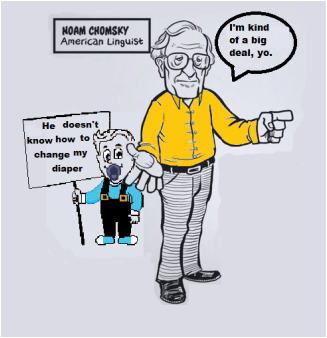 Chomsky hypothesized the existence of an LAD Chomsky hypothesized the existence of an LAD
Tags: discourse/language, theory, language acquisition device, noam chomsky, universal grammar, 00 to 05 mins
Year: clip 1: 2015 | clip 2: 1995 Length: clip 1: 1:47 | clip 2: 2:56 Access: clip 1: YouTube clip 2: YouTube Summary: In this pair of clips, one can find a useful synopsis of Noam Chomsky's theory of Universal Grammar (UG), which is the theory that the ability to learn grammar is hard-wired into the brain. The first clip is an animated video and part of the BBC and Open University’s A History of Ideas series. The second clip comes from Gene Searchinger's Human Language series. • To summarize, Chomsky was unconvinced by other thinkers, like John Locke, who argued that people are born blank slates. Instead, Chomsky argued that children learning to speak cannot possibly start as blank slates because they simply don't have enough information to perform many of the complex grammatical maneuvers he observed them making. According to Chomsky, our proverbial slates cannot be completely blank when we are born; we must be hard-wired with structures in our brains, or what he called language acquisition devices (LADs). The LAD is a hypothetical tool hardwired into the brain that helps children rapidly learn and understand language. • The existence of this language acquisition device means that humans are born with a grasp or an intuition of the rules of language; what they must still learn from their social environments is simply vocabulary. As evidence that a language acquisition device is a genetic endowment common to all people, Chomsky pointed to the fact that language is fundamentally similar across cultures. For instance, every language has something like a noun and a verb, a way to ask a question, and a system for making obligatory distinctions (e.g., singular and plural forms of words). As the narrator of the first clip observes, it would appear that "our slates have been written on before we emerge from the womb." Submitted By: Lester Andrist |
Tags
All
.
Got any videos?
Are you finding useful videos for your classes? Do you have good videos you use in your own classes? Please consider submitting your videos here and helping us build our database!
 |
 RSS Feed