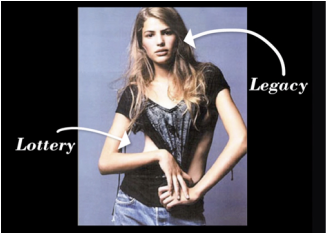
 Model Cameron Russell reveals the elusive nature of “the look.” Model Cameron Russell reveals the elusive nature of “the look.”
Tags: bodies, culture, gender, inequality, prejudice/discrimination, race/ethnicity, social construction, beauty culture, floating norms, laissez-faire racism, model industry, white privilege, subtitles/CC, 06 to 10 mins
Year: 2012 Length: 9:30 Access: TEDTalks Summary: Is being a model really all it’s cracked up to be? In this TED Talk, Cameron Russell answers this and other questions by vocalizing some of her experiences in the modeling industry. This video is useful for illustrating the work that takes place behind-the-scenes of the modeling industry in order to produce what sociologist Ashley Mears calls “the look.” In her book Pricing Beauty: The Making of a Fashion Model, Mears articulates that “the look” is something sought after by clients and bookers alike in the fashion industry. It is defined as the varying traits—both physical and personality—that make a model desirable. Yet, after spending more than two years conducting ethnographic fieldwork, Mears finds that industry professionals have a hard time describing what exactly constitutes a good look; rather, they claim they just “know it” when they see it. In this way, Mears illustrates how the look is characterized by a set of “floating norms” against which models are measured. These socially constructed ideals “are elusive benchmarks of fleeting, aesthetic visions of femininity and masculinity” (Mears 2011:92). The challenge with adhering to these norms is that they are consistently out of reach; models must constantly work to achieve them but, since they are ambiguous and always changing, they are ultimately unattainable. The result is that even models are insecure with, and always questioning, the value of their look. • In addition to illustrating the cultural production of the look, this clip also illustrates the various ways white privilege and laissez-faire racism operate in the modeling industry. Once again echoing Mears’s findings, Russell points to the scouting process as a site where ideas about race result in inequalities within the industry. In addition to youth and vitality, Russell asserts that she was also selected for her whiteness. It is both norms around conventional prettiness and the legacy of white privilege that has helped to secure Russell’s success. Mears’s research similarly documents the ways in which white models are significantly hired over African Americans, Latino/as, and people of Asian descent. When models of color are present in the industry, they are often used in exotic campaigns or they exhibit an “ethnicity lite” aesthetic, that is, a look that “blends mainstream white beauty ideals with just a touch of otherness” (Mears 2011:196). • Russell also points to the extensive work that goes into creating a look. Behind each advertisement or photograph is significant makeup and styling, as well as preproduction, postproduction, and Photoshop. How might this create challenges for individuals in society? Many young people seek to emulate “the look” that fashion models project. However, as Mears and Russell demonstrate, the look is unattainable; it is a socially constructed concept that is difficult to describe, and even more difficult to achieve. Nonetheless, people hold themselves up to this impossible standard, resulting in low self-esteem, incredible commercial gains for beauty companies, and a perpetual feeling of insufficiency. Submitted By: Ruth Sheldon and Valerie Chepp
3 Comments
 Harriet Washington discusses the history of the Tuskegee Syphilis Study in her book, Medical Apartheid. Harriet Washington discusses the history of the Tuskegee Syphilis Study in her book, Medical Apartheid.
Tags: biology, bodies, health/medicine, inequality, prejudice/discrimination, race/ethnicity, science/technology, violence, informed consent, institutionalized discrimination, eugenics, medical ethics, scientific racism, slavery, tuskegee syphilis experiment, 21 to 60 mins
Year: 2013 Length: 28:27 Access: YouTube Summary: This short interview on Democracy Now with author and scholar Harriet A. Washington provides useful entrée into a discussion about racial discrimination within the medical establishment. Drawing on work from her book Medical Apartheid: the Dark History of Medical Experimentation on Black Americans from Colonial times to the Present, Washington shines a light on many of the systematic abuses African Americans and other People of Color have endured at the hands of scientists and medical professionals. • As Washington explains, the story of medical apartheid begins with scientific racism, the origins of which are often traced to 1779, when German scientist Johan Friedrich Blumenbach is credited with attempting to establish a race-based system of classification among humans (find more on Blumenbach's efforts here, and click on this link for information about how the scientific effort to find a biological basis for race continues into the present). Much has been written about how the legitimacy and authority of science allowed white slaveholders to justify the torture and confinement of their Black slaves; however, as Washington notes, there is a lesser known history of white medical professionals using Blacks as subjects in medical experiments. • In the above clip, Washington discusses The Tuskegee Study of Untreated Syphilis in the Negro Male, as one of the most notorious examples of Blacks being used as subjects in medical experiments. The study was conducted between 1932 and 1972 in Macon County, Alabama, and it tracked 399 poor and mostly illiterate Black sharecroppers who were diagnosed with syphilis. The study subjects were deceived by medical professionals into believing that they were being treated for “bad blood," when in fact the documented intentions of those leading the study was to allow the disease to run its course, which often meant a very painful death. By 1947 penicilin was recognized as a cure for syphilis, but study clinicians denied the antibiotic to subjects and instead gave them a placebo. • As Washington notes, the racism that made something like the Tuskegee Syphilis Study possible was systemic and could be located at all levels of the medical establishment. Seated at the top of the medical hierarchy was the U.S. Surgeon General, Thomas Parran, Jr. Even when presented with the penicillian cure, Parran opted to continue experimentation with the Black men of Macon County. By his assessment, their lives were less valuable than knowledge about syphilis. • For images related to the Tuskegee Syphilis Study, check out our Pinterest board titled "Race: Health/Health Care." Submitted By: Lester Andrist 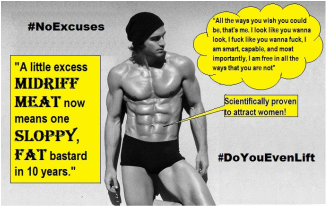 This ad for six-pack-abs exemplifies the new masculine ideal This ad for six-pack-abs exemplifies the new masculine ideal
Tags: bodies, gender, health/medicine, marketing/brands, body dysmorphia, masculinity, michael kimmel, reflexivity, subtitles/CC, 00 to 05 mins
Year: 2015 Length: 4:21 Access: YouTube Summary: This video advertisement directs viewers to a workout program that promises to give men the washboard abs of their dreams, but for sociologists, the ad simply underscores an emergent masculine ideal, which is neither timeless nor inevitable. Contrary to all appearences, the ideal may not be all that healthy either. • In his article "Masculinity as Homophobia: Fear, Shame, and Silence in the Construction of Gender Identity," sociologist Michael Kimmel traces the origins of masculine ideals in the United States to the eighteenth century, where men aspired to the ideal of a Genteel Patriarch, whose standing was based on landownership. The Genteel figure was refined and elegant, while also being sexual and strong. According to Kimmel, by the 1830s the Genteel Patriarch gave way to a new ideal, or what he calls the Marketplace Man. This figure "derived his identity entirely from his success in the capitalist marketplace, as he accumulated wealth, power, status." • Fast forward to 2015 and take stock of the above video advertisement from Six Pack Shortcuts. Johnny, "the Six-Pack-Abs" pitchman, begins by asking men to guess which muscle is "scientifically proven" to attract women. Johnny assures viewers with a knowing smirk that he isn't talking about the penis (After all, it would be unacceptably shallow and misguided to objectify and fetishize a particular part of a man's body!). No, he's referring to men's abs, and he claims to know because, well, science, and because he's the six-pack-abs-guy. He also quotes from Men's Health, which states that women know "a little excess midriff meat now means one sloppy, fat bastard in 10 years." • In the view of many sociologists who study masculinity, the Marketplace Man has given way to a new Supermale masculinity, which is an aspirational ideal that involves manipulating one's body, purging it of fat stores, and accentuating muscle striation. In a relational context, the Supermale affirms his status by high-fiving the bros, broadcasting short clips of his lifts, posting carefully lit selfies of his abs on social media, and by frequently using the hashtag #DoYouEvenLift. • Masculine ideals change over time, and the generation of men who strive to ascend the ranks of any given ideal simultanously avail themselves to new possibilities and vulnerabilities. To understand the masculinity of an era is to understand the sacrifices men are being enticed to make, as well as the widely-shared conseqences for making those sacrifices. Those who pursued the ideal of the Marketplace Man were vulnerable insofar as they directly pinned their masculinity to the viscissitudes of market capitalism, but what are the distinct vulnerabilities of men pursuing the ideal of the Supermale? The fact is that the Supermale is a largely unattainable ideal that may lead boys and men to develop body image concerns, or even body dysmorphia. Johnny, the six-pack-abs-guy, and the entire industry Johnny represents, excel at branding their products as healthy, but if those products promise to deliver an unattainable ideal, they may be doing more harm than good. Submitted By: Lester Andrist 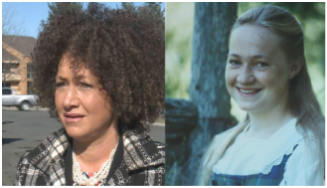 Rachel Dolezal now, and as a teenager. Rachel Dolezal now, and as a teenager.
Tags: bodies, culture, race/ethnicity, social construction, african-american, black, essentialism, privilege, racial identity, transracial, white, 06 to mins
Year: 2015 Length: 10:47 Access: YouTube Summary: Rachel Dolezal sparked a national conversation on racial identity in June 2015 when her black identity was discredited by her white parents. This video is an NBC news interview, in which Dolezal claims "I identify as black" and goes on to defend herself against various criticisms about her racial identity and experiences (including a lawsuit against Howard University, claiming they discriminated against her as a white woman). On the one hand, Rachel Dolezal can be seen as a successful activist that "breathed new life" into her local NAACP chapter as its president (she has since resigned). And some people (both inside and outside the black community) have defended her support for African-American culture, and view criticisms of Dolezal as fracturing the movement for racial justice. However, most commentaries on Dolezal have been highly critical. Jessie Daniels summarized the criticisms in her excellent post, "Rachel Dolezal and the Trouble with White Womanhood." Specifically, Dolezal's attempt to pass as a black woman has taken away resources (i.e. a full scholarship to Howard University) reserved for African-Americans, she has allegedly stolen the stories of African-American (and Native American) oppression and experience and presented them as her own, her white skin has helped her benefit from colorism and white privilege (i.e. a visibly black person would not be permitted to pass as white), and that such claims reflect bell hooks' notion of "eating the other." Her case has also sparked a controversy about her claim of a transracial identity, which has long been applied to adoptees whose race did not match that of their parents. First, this claim of a transracial identity has been criticized by transracial adoptees, who argue that “We find the misuse of ‘transracial,’ describing the phenomenon of a white woman assuming perceived markers of ‘blackness’ in order to pass as ‘black,’ to be erroneous, ahistorical, and dangerous.” Second, numerous conservative pundits jumped on the notion of "transracial" as being the same as transgender, in order to critique and discount both identities. But as Daniels and other scholars and activists have pointed out, the two identities are uniquely different. Carla Kaplan shed light on another dimension of black identity that, upon first glance, seems to be shared with Dolezal. Kaplan noted that, in the 1920s, the term "Voluntary Negro" was used to describe light-skinned blacks who looked white and chose to identify as black. The key point here is that the term was not intended for whites and was meant to honor African-Americans whose ancestry was shaped by racism (unlike that experienced by Dolezal), and that while they could "pass" as white, they chose to embrace their black identity out of racial solidarity. Kaplan went on to acknowledge that a "fervent social constructionist" view might logically enable such a fluid racial identity, but that she would still be culturally wrong in doing so. Submitted By: Paul Dean  Would you choose the beautiful or average door? Would you choose the beautiful or average door?
Tags: bodies, gender, marketing/brands, theory, beauty, looking-glass self, 00 to 05 mins
Year: 2015 Length: 3:40 Access: YouTube Summary: In this ad, Dove’s encouragement of women to "choose beautiful" appears to empower women, but it actually serves to reinforce western standards of beauty and one's sense of self-worth in terms of physical appearance. The ad functions as a social experiment that forces women to choose walking through an “average” or “beautiful” door in a public space. Many women shown are directly influenced by their friends or family when choosing a door, and some are physically steered toward beautiful. Others naturally select the average door, apparently feeling like they did not fit the standards of prescribed beauty. Those who "choose beautiful" report feeling better about themselves, and in this way, Dove is suggesting that being beautiful is about the choices we make as individuals. However, the message of the ad is more complicated. First, in contrast to "average," the idea that beauty is for a minority is reinforced. By positioning “beautiful” in binary opposition to “average” not all women can be beautiful. Second, all of the women interviewed, despite having different cultural backgrounds, fit conventional definitions of beauty. They are all thin, long-haired, have clear skin, and are relatively young. Even the women of color featured have light skin. This sample suggests a specific image of beauty (this skewed sample, which Dove presents as a diverse group, is further explored in our previous post). Third, it reinforces the sense of self-worth on beauty by making women choose between these specific doors, and encouraging women to choose beautiful. Fourth, parts of the video take place in countries like China and India, where the white ideal of beauty (fitting the characteristics described above) has been imposed through colonization. The implications that beauty is for the elite is inescapable. Women in the advertisement are forced to either identify with the majority or to place themselves in positions of prestige. Finally, the video is a great illustration of the looking-glass self, a theoretical concept that explains how perceptions of one’s self are influenced by interactions with others and the imagination of how these others perceive us. Through the lens of the looking-glass self, women approach the door and develop a sense of themselves as beautiful or average, which is largely shaped by their perceptions of how others see them, then experience pride or shame for associating themselves with one or the other door. Submitted By: Miranda Ames  When it comes to infidelity, does gender and biology matter? When it comes to infidelity, does gender and biology matter?
Tags: abortion/reproduction, biology, bodies, culture, emotion/desire, gender, sex/sexuality, biological determinism, infidelity, sociobiology, 06 to 10 mins
Year: 2008 Length: 6:21 Access: today.com Summary: This segment from the Today Show explores whether humans are “wired”—or, biologically predisposed—to cheat on their mates. The clip can be used to teach biological determinist perspectives of gender, and specifically those rooted in sociobiology. In short, biological determinism argues that the social world is predetermined by biological factors. Sociobiology stems from this tradition of thought, but focuses more specifically on genetic reproduction and evolutionary processes. Often relying on observations of animal behaviors to make claims about human behaviors, sociobiology argues that a fundamental human drive is to ensure genetic reproduction, and many human activities can be reduced to this drive. Using the case of infidelity, this video clip is helpful for shedding light on sociobiological explanations of gender difference. The segment opens with a sociobiological perspective, using Barash and Lipton's (2001) book The Myth of Monogamy as a point of reference. Here, the authors argue that monogamy is not natural; from an evolutionary standpoint, humans have a stake in having multiple sexual partners. Sexual promiscuity is prevalent throughout the animal kingdom, they argue, and humans are not exempt from the same biological urges that drive other animals to be promiscuous. After the opening segment (minute mark 2:17), host Meredith Vieira speaks with Jeffrey Kluger, TIME magazine’s science editor, and psychologist David Buss; the conversation quickly turns to a discussion of gender difference. Kluger represents a fairly classical sociobiological argument when he states: “Nature wants one thing, and what it wants are babies. It also wants lots of them. And it wants variety, because the greater the genetic variety, the greater the likelihood that the babies are going to survive into adulthood and do well.” Kruger goes on to assert that men will look for women who are young and fertile, and women look for men who are good providers, such as those who are rich and powerful. Buss introduces more socio-cultural elements into the discussion, such as strong social norms against cheating, and argues that both men and women feel attraction to others outside of their relationships. He also points to psychological pathologies, namely narcissism, as an explanation for infidelity, and draws attention to infidelity in a cross-cultural context where polygamy is common (that is, cultures where men are legally entitled to have multiple wives). Although Buss mostly draws upon socio-cultural explanations, he also suggests that biological impulses to be non-monogamous are a part of our “human nature.” Asked why men cheat more, Kruger draws upon biological and sociological arguments, arguing that: (1) biologically, men have the ability to breed more, and could conceivably breed offspring everyday; from this he argues that men are “tripwired" for infidelity; and (2) in a patriarchal society such as ours, men are more likely to be in positions of power and feeling entitled to be unfaithful. After screening the video, viewers can be encouraged to identify messages in the clip that cohere with, and deviate from, the sociobiological perspective. Viewers can also be encouraged to explore feminist and/or sociological critiques of biological determinism, such as those outlined in Carmen Schifellite’s (1987) essay, "Beyond Tarzan and Jane Genes: Towards a Critique of Biological Determinism.” Submitted By: Valerie Chepp 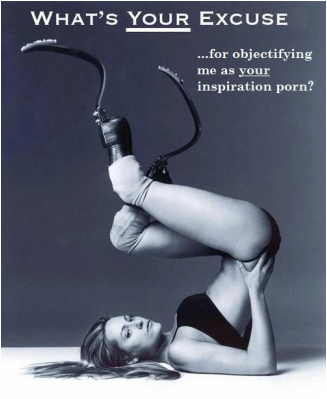 "What's your excuse...for objectifying me as your inspiration porn?" Amy Purdy poses while wearing her running blades "What's your excuse...for objectifying me as your inspiration porn?" Amy Purdy poses while wearing her running blades Tags: bodies, culture, disability, emotion/desire, inequality, knowledge, marketing/brands, media, sports, inspiration porn, super bowl, 00 to 05 mins Year: 2015 Length: 1:15 Access: YouTube Summary: Every year the Super Bowl proves to be a rich site for sociological investigation, and we have analyzed many different aspects of this American spectacle, including the commercials. All media, but the commercials of the Super Bowl in particular, can be seen as cultural artifacts. Ads are saturated with resonant images and meanings, and with a little work, one can deduce information about the society that created the ads, how they see themselves and what they believe about the world. The commercials of Super Bowl XLIX featured a surprising number of people with disabilities. Among them, Reebok and Toyota showcased athletes with prosthetic legs engaged in rather punishing exercise regiments. Our video of the week is the Toyota ad, which tracks world-class snowboarder and double amputee, Amy Purdy, on the slopes, in a dance hall, and as the subject of a photo shoot. Microsoft's ad, by contrast, centered on Braylon O'Neil, a toddler learning how to walk and play T-Ball with his prosthetic legs. All of the ads were accompanied by narration that attempted to inspire and somehow leave audiences with the impression that Microsoft, Toyota, or Reebok are central players in helping humanity realize its full potential. • The problem is that the ads reek of what is sometimes referred to as inspiration porn. That is, to the extent that people with disabilities feature in media at all, they are typically portrayed in a very one-dimensional way; as a narrative device that has been fashioned with the sole intent of inspiring the able-bodied majority. For those who think inspiration porn isn't a big deal, consider the awkward similarities it shares with the old practice of featuring people with disabilities as freaks in circus sideshows. Toyota is using Amy Purdy to inspire the able-bodied majority, whereas P. T. Barnum used double amputees to amuse. In both cases, people with disabilities are being objectified to give the majority a big emotional experience. Find more information and resources about disability and media representation on our Pinterest board. Submitted By: Lester Andrist 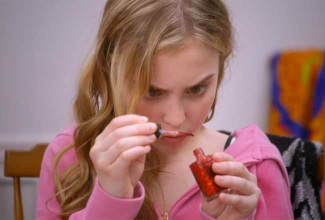 Katie fakes her period and receives a "first moon" party. Katie fakes her period and receives a "first moon" party. Tags: bodies, children/youth, commodification, consumption/consumerism, gender, health/medicine, marketing/brands, sex/sexuality, commercial, humor, menstruation, 00 to 05 mins Year: 2014 Length: 2:20 Access: YouTube Summary: The company HelloFlo has distinguished itself with its innovative marketing of feminine hygiene products, as well as a lively blog and the informative “Ask Dr. Flo” column. This advertisement portrays an adolescent girl who is impatient for the arrival of her first period. At the start, we see her decorating a clean pad with red nail polish. Her mother discovers the pad and pretends that she has been duped. The mother then concocts an extravagant revenge plot in the form of a “First Moon Party,” even though she knows the daughter has yet to have a period. While the advertisement enlists humor to defuse discomfort and embarrassment, the resulting comedy treats male and female characters inequitably and relies upon familiar tropes of conniving girls and devious women. For example, the mother deceives her daughter and exposes her to unwanted attention from men and boys. Grown men do imbecilic things and inspire eye-rolling, while the girl, the supposed protagonist, does something adolescent—after all, she is an adolescent—and suffers punishment. While in the past, a girl might have been daunted by the secrecy and shame surrounding menstruation, here she is discomfited by a denial of privacy, as others take over her rite of passage (one she herself has yet to undergo). The narrative closure comes when the girl admits to her lie and asks whether she will be grounded. Her mother reveals that she has already punished her with the party and then gives her a “period starter kit” as a gift. The advertisement concludes by giving the punchline to a male partygoer who awaits the flow from a sluggish ketchup bottle; he advises another young girl, “Sometimes you just gotta wait.” The ad is framed as a parody, but given the delicate and gendered subject matter, questions arise. How and when can humor dismantle convention? Who is the protagonist? Toward whom is this spot directed? Who is relieved of embarrassment? And to what end? Note that The Sociological Cinema has previously explored how the topic of how menstruation gets handled by the media here and here. Submitted By: Rose Marie McSweeney  In Both, Rebeca learns the truth about a childhood surgery. In Both, Rebeca learns the truth about a childhood surgery. Tags: biology, bodies, gender, lgbtq, science/technology, sex/sexuality, bisexuality, intersex, sexual expression, sexual identity, sexual orientation, 61+ mins Year: 2005 Length: 86:20 Access: Vimeo Summary: [Trigger warning for those who might be traumatized by depictions of the sex reassignment surgery many intersex people experience as children] People often want to know how many people are born intersex? Unless one is specific about the many physical features that often get named "intersex," the question is difficult to answer. For instance, based on research from Blackless et. al. (and reported here), in the medicalizing language of late onset adrenal hyperplasia, 1 in 66 people are intersex; however, only 1 in about 150,000 are intersex if you restrict the label to include only those who have what medical doctors refer to as complete gonadal dysgenesis. The frequency of people receiving surgery to "normalize" the appearance of their genitals is about 1 or 2 people in 1,000. Frequencies are perhaps an interesting place to start a discussion on intersex, but in themselves, numbers do little to give voice to those who are born intersex within a culture and society that upholds a strictly dimorphic understanding of sex. The above film, Both, is a compelling drama, based on the experiences of many intersex adults, and the film tells a story of an issue that has been widely silenced through shame and secrecy. In the film, Rebeca Duarte, played by Jackie Parker, works as a stunt double for indie action films in San Francisco. From rolling out of cars to setting herself on fire, she puts her life at risk on a daily basis. Work, lovers and friends take up most of her time, but deep inside, she feels something is missing. Rebeca feels strangely disconnected from her own body and can’t figure out why. One day she mysteriously receives a photo album from someone in Peru, where she had spent her childhood. The album contains pictures of her parents and her brother who had supposedly died, but no images of herself. Feeling unsettled, Rebeca sets out to discover the mystery and unravel the web of lies that both the doctors and her parents have spun her whole life. Through her fight to uncover the truth, Rebeca discovers her own identity and a renewed passion for life. Both works by posing compelling questions about gender and sexuality through the experiences of its intersex protagonist. For those considering showing the film in class, note that nudity, masturbation, and sexual intercourse are depicted at 17:50 mins, 21:30 mins, and 53:20 mins. Submitted By: Leslie Jaye 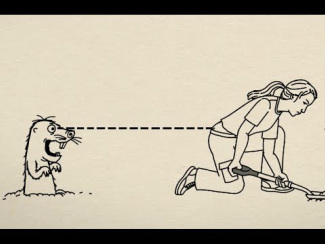 Women are often held responsible when others objectify them. Women are often held responsible when others objectify them. Tags: biology, bodies, gender, marketing/brands, sex/sexuality, biological determinism, dress negotiation, gender blame, sexism, sexual objectification, 00 to 05 mins Year: 2013 Length: 0:30 Access: YouTube Summary: This commercial from Duluth Trading Company is an accurate example of the ways in which women are subtlety encouraged to participate in forms of security from men’s seemingly-natural demeanor. Indeed, through the purchase and use of a Duluth Trading Company "Longtail" t-shirt, women are promised the security from the "gawking gopher," a character that stares as the fictional female character bends to perform a task. The blame, in this case, is placed on women for not covering up, perhaps framed as a feminine task to help men sooth their "inherent" tendencies to be hypersexual. From this born-this-way perspective, men avoid responsibility for their objectification of women. This means that, among other things, men are also excluded as solutions to such an issue. Instead of discouraging men to “gawk” through a deconstruction of the relationship between masculinity and objectification, this commercial delicately—yet notably—places the male response to a women’s body as a natural reaction that can only be solved through the further policing of women’s bodies. Submitted By: Peter Rydzewski |
Tags
All
.
Got any videos?
Are you finding useful videos for your classes? Do you have good videos you use in your own classes? Please consider submitting your videos here and helping us build our database!
 |
 RSS Feed