 Tags: bodies, commodification, consumption/consumerism, gender, health/medicine, marketing/brands, human diversity, medical sociology, medicalization, 00 to 05 mins
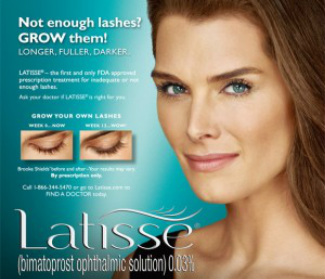
Year: 2009 Length: 1:02 Access: YouTube Summary: This commercial featuring actress/model Brooke Shields is for Latisse, a prescription drug approved by the FDA for “inadequate or not enough lashes.” The ad claims that Latisse can be used to treat symptoms of hypotrichosis, a condition characterized by a "less than normal" amount of hair; advertisements for Latisse have appeared in beauty magazines such as Allure. This clip is excellent for teaching students the concept of medicalization, the process by which normal life conditions (such as menopause, childbirth, aging, or death) or issues not traditionally seen as medical come to be framed as medical problems (e.g. alcoholism, eating disorders, compulsive gambling) (Conrad 1992). The Latisse commercial is particularly powerful when shown alongside a typical mascara commercial (e.g., here); while the latter claims to be a cosmetic product and the former claims to treat a “medical problem,” both are clearly targeted toward women and share many similarities -- e.g., promises of “better” (i.e., longer, darker, and/or fuller) lashes, before/after shots, celebrity actress/model spokeswomen, and scenes of attractive women having "fun," suggesting that longer, darker, and fuller lashes can result in happier social lives for women. Moreover, both commercials imply that women, and not men, should be concerned about their eyelashes, even though men can also have sparse, short, and/or light-colored lashes. While the producers of the commercial never say Latisse is developed for use by people with hypotrichosis (this message is only written in a caption at the bottom of the screen), a classroom discussion can underscore the blurring of the medical and the cosmetic in this advertisement. Instructors can point out that the active ingredient in Latisse is used to treat glaucoma. When some glaucoma patients began to notice more prominent eyelashes, they perceived this as a desirable side effect of their glaucoma medication since longer, thicker, and darker eyelashes on women are symbolic of beauty in our culture (Law 2010). Class discussion can then lead to a conversation about human diversity, in which the diversity of eye color and eye shape, as well as the length and thickness of eyelashes, among the world’s population can be examined. The Latisse commercial can prompt students to question whether eyelash hypotrichosis and other medical problems (e.g., andropause, erectile dysfunction, short stature, ADHD) (Conrad 2007) are medical problems or natural human conditions and/or characteristics that create human diversity. Advertisements such as this point to the commodification of such naturally occurring human conditions. Submitted By: Amy Irby
4 Comments
5/17/2013 05:43:37 am
Wish I'd known, heard about and/or been taught about all this when I was headed into puberty. All I knew was what I saw on TV, learned from family/friends. Sad affairs I must say.
Megan
5/18/2013 12:02:49 am
I, too, wish I'd learned media literacy in my early teens. Maybe then, I wouldn't have spent the past 25 years obsessing over my appearance, trying to "fix" myself (even though nothing was actually wrong or broken), and then, finally, learning to let go of the obsession. I have let it go now, thankfully, but grieved for the health, happiness, time and money I lost in the quest for physical "perfection". I think media literacy should be taught in middle and high school so that fewer kids will grow up to become sick, neurotic adults that waste their precious time trying to achieve an impossible beauty standard.
Wilson Fox
6/9/2022 04:23:16 pm
I suffered from what they called peripheral artery disease (PAD). I have been suffering for years, Me and my wife searched for a medical cure, and then we came across a testimony of a man who suffered the same and was cured by Dr Chief Lucky. So my wife and I contacted Dr Chief Lucky via an email and thank God he replied. I explained what was wrong and he sent me herbal medicines that helped heal me completely. I am happy to say that herbal medicine is the ultimate and Dr Chief Lucky I am grateful. You can contact him on his email: chiefdrlucky@gmail.com or whatsapp: +2348132777335, Facebook page: http://facebook.com/chiefdrlucky or website: https://chiefdrlucky.com/. Dr Chief Lucky said that he also specializes in the following diseases: LUPUS, ALS, CANCER, HPV, HERPES, DIABETES, COPD, HEPATITIS B, HIV AIDS, And more.
Manuel Franco
7/30/2023 04:00:32 pm
I just want to say Thank You to everyone who supported me through the years. My name is Manuel Franco, New Berlin, Wisconsin. My story of how I won the Powerball lottery of $768.4M is a bit of a tale. I have been playing Powerball tickets for 6 years now since I turned 18. I bought my first ticket on my 18 birthday. I was feeling very lucky that day because I had contacted Dr. Odunga Michael to help me with the winning Powerball numbers. I really had that great great feeling that I looked at the camera wanting to wink at it. I only did a tiny part of it and trusted him. He gave me the numbers after I played a couple other tickets along with it for $10. I checked my ticket after the winnings came online and saw the numbers were correct including the Power play. I screamed for about 10 minutes because it felt like a dream. I had won $768.4M. You can check my winning testimony with the lottery officials just with my name search. Thank you Dr Odunga. Well, his email is odungaspelltemple@gmail.com and you can also call or Whats-app him at +2348167159012 so you guys can contact him Leave a Reply. |
Tags
All
.
Got any videos?
Are you finding useful videos for your classes? Do you have good videos you use in your own classes? Please consider submitting your videos here and helping us build our database!
 |
 RSS Feed