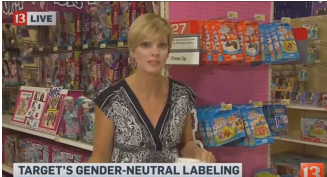
 Target removes gendered signs and colors. Target removes gendered signs and colors.
Tags: children/youth, consumption/consumerism, gender, social construction, gender binary, 00 to 05 mins
Year: 2015 Length: 2:39 Access: YouTube Summary: This local newscast covers a recent Target store's removal of the "boys" and "girls" sections to go gender-neutral. They note the store is changing the symbolic pink and blue background colors to neutral colors. While in the past, girls played with Barbies and boys played with action figures, Target is transcending these distinctions to enable different toys, electronics, and bedding goods to appeal across gender boundaries. They note their decision to go gender-neutral is based on "customer feedback" and that separate girls and boys sections are "not necessary." Some customers reacted negatively to the switch, stating "Can you say publicity stunt?", "RIDICULOUS!!!", and "No longer a fan or shopper of Target." In effect, these customers are policing the gender binary. One of the news shows' interns praises Target for the move toward "gender equality" and enabling children to "create their own person and not have to choose one thing because that's what they're supposed to choose." For related videos, viewers may want to check out similar debates about a J. Crew advertisement, a 5-year old boy who loves to wear dresses, efforts to make gender-neutral Legos, Fox news analysts that mock gender-neutral bathrooms, and a peer sex educator that breaks down the gender binary. Submitted By: Sanah Jivani
1 Comment
 An early example of culture jamming using new media strategies. An early example of culture jamming using new media strategies.
Tags: art/music, consumption/consumerism, gender, marketing/brands, media, science/technology, social mvmts/social change/resistance, activism, culture jamming, new media art, gender socialization, 21 to 60 mins
Year: 1993 Length: 28:29 Access: YouTube Summary: How does social change happen? For more than a century, this question has inspired much sociological research. Within the study of social change, sociologists have often focused their attention on social movement activism and various forms of contentious politics. More recently, some sociologists have sought to move beyond these parameters to ask what other things might “count” as activism. For example, Notre Dame’s Center for the Study of Social Movements Mobilizing Ideas blog recently featured a two-part series entitled “New Ways to Define Activism” (Part I and Part II). Often, sociologists cite new digital media environments and technologies as timely reasons for why we must revisit “old” definitions of activism. While this question might be relevant in the contemporary context, this video illustrates how activists began to strategically draw upon digital media technologies more than twenty years ago. In 1993, a group of artist-activists launched a multi-faceted media campaign call the Barbie Liberation Organization (BLO) in reaction to Mattel’s new talking Barbie, which contained an electronic voice box that played stereotypical phrases such as “Math class is tough” (listen to talking Barbie). The campaign mixed traditional and electronic media, hardware hacking, and “boots on the ground” activism, resulting in this video, which sought to raise awareness of gender stereotypes in a normally difficult-to-reach population of Americans. This video would become one of the earliest and most influential demonstrations of electronic media culture jamming. Instructors can use this video to elicit discussion of successful culture jamming in several ways. First, the video is presented as a legitimate news report, which begs larger questions about the trust we place in news media or the authority of corporations in general. Second, the purported newscast is peppered with clips from actual investigative news reports, such as A Current Affair, to further enhance the legitimacy of BLO’s report. However, many of the clips are taken out of context and edited to subvert the original message, such as when one toy expert’s words are used to accuse Mattel of "terrorism against children” when she was instead accusing BLO of such tactics. Here, we see the artist-activists employing the very medium they challenge to contradict the intended message, which is the crux of culture jamming practice. Finally, the video serves as a DIY tutorial—no different than the myriad of how-to videos populating the web today—which instructs viewers how to perform the voice box swap at home, thus giving consumers and activists alike agency to subvert the toy’s intended message. For a culture jamming video assignment, also posted on The Sociological Cinema, click here. Submitted By: Josh Gumiela and Valerie Chepp  The intersection of teen identity, consumption, and social media. The intersection of teen identity, consumption, and social media.
Tags: children/youth, consumption/consumerism, corporations, marketing/brands, media, science/technology, identity, internet, social media, teenagers, youth culture, subtitles/CC, 21 to 60 mins
Year: 2014 Length: 53:41 Access: PBS Summary: This 2014 PBS Frontline documentary, Generation Like, serves as a nice updated follow-up to the popular 2001 documentary, The Merchants of Cool. As in the 2001 episode, Generation Like explores how large corporations and marketing firms seek to tap into young consumer markets. However, unlike the teens that came of age during the making of The Merchants of Cool, today’s young adults are navigating a radically different media and advertising environment, namely, one dominated by social media. As explained in this plot summary, “Thanks to social media, today's teens are able to directly interact with their culture - artists, celebrities, movies, brands, and even one another - in ways never before possible. But is that real empowerment? Or do marketers still hold the upper hand? In Generation Like, author and FRONTLINE correspondent Douglas Rushkoff (The Merchants of Cool, The Persuaders) explores how the perennial teen quest for identity and connection has migrated to social media - and exposes the game of cat-and-mouse that corporations are playing with these young consumers. Do kids think they're being used? Do they care? Or does the perceived chance to be the next big star make it all worth it? The film is a powerful examination of the evolving and complicated relationship between teens and the companies that are increasingly working to target them.” While this documentary would be useful for teaching ideas related to teen consumption and corporate advertising, it could also serve as a useful way to examine characteristics of the generational cohort following the Millennials, who have been dubbed "Generation Z." Submitted By: Valerie Chepp  John Oliver examines what's behind stylish cheap clothes. John Oliver examines what's behind stylish cheap clothes.
Tags: capitalism, consumption/consumerism, corporations, economic sociology, globalization, apparel, fashion, supply chains, sweatshops, 11 to 20 mins
Year: 2015 Length: 17:09 Access: YouTube Summary: In this clip from Last Week Tonight, John Oliver analyzes the rise of fast fashion and its tremendous profits. Fast fashion includes short times from design to rack, with fashion styles changing constantly at companies such as H&M, Zara, and Forever 21. But news commentators are shown marveling at the very low costs of the trendy, fashionable clothes. Given these low costs, Oliver asks “How does any clothing company make money?” After all, the industry has many billionaire founders and executives, whose companies excel with high-volume sales. The reality is that 2% of clothing worn by Americans is made in the US, while the rest is produced overseas and often in sweatshop conditions. Oliver frames this in terms of the outrage over sweatshop clothing producers in the 1990s, by companies such as Nike, Gap, and most famously, Kathie Lee Gifford. In response to protests, many of these large companies agreed to monitoring programs in their supply chains. So how have their production conditions changed? In more recent years, undercover journalists investigating Gap and Wal-Mart found child slaves; non-compliance with workplace safety standards; and repeated denial of responsibility for any wrong-doing. One particular issue is that contractors producing clothes for Wal-Mart must follow certain standards, but contractors frequently send this work to sub-contractors; when the sub-contractors violate labor standards, Wal-Mart denies any knowledge that their clothes were being produced in these factories. However, this issue is far from an isolated event, and Wal-Mart repeatedly denies awareness of these issues. This dynamic is not unique to any manufacturer, but it reflects supply chain issues that are fundamental to the global economy, and are an important part of understanding global inequality and our own participation (as consumers) within it. Submitted By: Paul Dean  This ad celebrates materialism and the American Dream. This ad celebrates materialism and the American Dream.
Tags: class, consumption/consumerism, culture, marketing/brands, marx/marxism, nationalism, theory, american dream, commercial, ideology, 00 to 05 mins
Year: 2014 Length: 1:02 Access: YouTube Summary: This Cadillac commercial starts with actor Neal McDoungh looking over his private, in-ground pool as he poses the question “Why do we work so hard? For this? For stuff?” He talks about why Americans don’t slack off like other countries, which take a whole month of vacation. He spouts a list of famous innovators, and asks if we think they took an entire month off? Nope, because they were busy being innovators, and living the American dream. The ad is exemplary of the hegemonic ideology of the American Dream. Ideology is a collection of shared beliefs and ideas for understanding the social world that explain and justify power or challenge social relations. In this commercial we see that the actor has achieved economic success. As he walks around his expensive house and material possessions, he discusses why it’s great to be a hard working, no vacation-taking American. McDoungh directly calls out our desire for all the “stuff” which aligns with the value our culture places on material things as a value of success. Then at the end of the commercial he directly ties together the concept that taking only two weeks off means we can have more stuff, enforcing the ideology that hard work will get you the things you want: “It’s pretty simple, you work hard, you create your own luck, and you gotta believe anything is possible.” Similar to a second Cadillac ad, the emphasis on "American" suggests that this idea is a uniquely American characteristic, even though upward mobility is more common in other developed countries. It is like other dominant ideologies that are reproduced throughout institutions (i.e. the media), and this particular ideology is hegemonic because for many Americans, this way of understanding our culture is taken-for-granted. It reproduces existing class relations because it suggests that material success is based upon our degree of effort, passion, and hard work (rather than our class background or other environmental factors), and that if we are not successful, then we accept that we only have ourselves to blame. After watching this ad, it is interesting to see this Ford commercial. It emphasizes local efforts, and parallels the format and style of the Cadillac ad (it really makes fun of the smugness of their competitor, Cadillac). Submitted By: Alexis Blaylock  Affluenza is a combination of "affluence" and "influenza" to critique the disease of consumerism. Affluenza is a combination of "affluence" and "influenza" to critique the disease of consumerism. Tags: capitalism, class, consumption/consumerism, culture, economic sociology, health/medicine, inequality, marketing/brands, affluenza, american dream, keeping up with the joneses, status treadmill, 06 to 10 mins, 21 to 60 mins Year: 1997 Length: 10:13 (entire documentary is 56:00) Access: YouTube Summary: This clip (start 2:12; end 12:35) from the documentary Affluenza (based on the book), defines the concept and consequences of affluenza. Using the metaphor of disease, affluenza can be defined as a bloated, sluggish and unfulfilled feeling that results from efforts to keep up with the Joneses; an epidemic of stress, overwork, waste and indebtedness caused by dogged pursuit of the American Dream; and an unsustainable addiction to economic growth. This clip notes that "never before has so much meant so little to so many." It can cause headaches and depression amongst other symptoms, and the narrator notes that if it goes untreated, the disease can cause "permanent discontent." In addition to discussions of consumer culture, the clip works particularly well with the book, The Spirit Level. Using a variety of quantitative data, authors Wilkinson and Pickett argue that more unequal societies suffer a variety of social problems. The reason, they propose, is that more unequal societies place more emphasis on material success to prove one's worth in society. This constant drive to display one's material success can never be satisfied and leaves individuals throughout the social hierarchy being unfulfilled. In other words, unequal societies are more likely to suffer from affluenza, and the negative social and health outcomes (e.g. lower life expectancy, higher infant mortality, higher mental illness, higher drug use, etc). The narrators in the video clip further note that while the disease is very contagious (due to extensive marketing and the rise of consumer culture), it is treatable. Viewers might peruse the videos in our social movements category and other web resources for ideas of how to cure affluenza. The documentary website from PBS also offers a teaching guide. Submitted By: Paul Dean  The Lorax warns that industrial activity will destroy our natural environment. The Lorax warns that industrial activity will destroy our natural environment. Tags: capitalism, consumption/consumerism, economic sociology, environment, theory, ethical consumption, externalities, industrial production, ipat formula, markets, 21 to 60 mins Year: 1972 Length: 25:13 Access: YouTube Summary: Written by Dr. Seuss, The Lorax is a children's book that tells the story of a stereotypical industrialist who clear-cuts a forest of trees to produce "Thneeds" for growing consumer markets. The Lorax, who "speaks for the trees," continuously but unsuccessfully explains that the industrial activity is destroying the forest and the homes of its many animals. The industrialist, Mr. Onceler, explains he is only "meeting consumer demand" and that "if I didn't, someone else would." But eventually, the trees are gone and the landscape is destroyed, thus making Mr. Onceler's business go bankrupt. Seeing the errors he made, Mr. Onceler encourages a boy passing by to plant new Truffula trees and regrow the forest. The original cartoon based on the book offers a familiar and entertaining way to discuss the relationship between industrial production, consumption, and environmental problems (note the cartoon was more recently made into a computer-animated film with 70+ controversial product-placements, offering additional points of discussion). The cartoon illustrates many key concepts, including the externalization of environmental costs, the consumer demand that partially drives the treadmill of production, and the popular IPAT forumla (Impact = Population X Affluence X Technology) for conceptualizing factors that explain environmental degradation. However, as Maniates (2001) argues in "Individualization: Plant a Tree, Buy a Bike, Save the World?," the story narrowly suggests individualistic solutions. He argues the proposed "response half-consciously understands environmental degradation as the product of individual shortcomings (the Once-ler's greed, for example), best countered by action that is staunchly individual and typically consumer-based (buy a tree and plant it)" (pp. 32-33). As such, the video can be used to distinguish the individualist explanations of production and consumption, from the more sociological explanations that link Mr. Onceler and the Lorax's activities to broader structural and institutional forces (and the limits of consumer-driven prospects for change). Maniates further notes that the popular IPAT formula excludes several important factors related to power and governance that impact environmental degradation. Another interesting theme, noted by Maniates (p. 32), is the "seeming inability of science (represented by the fact-spouting Lorax himself) and objective fact to slow the damage." Submitted By: Paul Dean  Katie fakes her period and receives a "first moon" party. Katie fakes her period and receives a "first moon" party. Tags: bodies, children/youth, commodification, consumption/consumerism, gender, health/medicine, marketing/brands, sex/sexuality, commercial, humor, menstruation, 00 to 05 mins Year: 2014 Length: 2:20 Access: YouTube Summary: The company HelloFlo has distinguished itself with its innovative marketing of feminine hygiene products, as well as a lively blog and the informative “Ask Dr. Flo” column. This advertisement portrays an adolescent girl who is impatient for the arrival of her first period. At the start, we see her decorating a clean pad with red nail polish. Her mother discovers the pad and pretends that she has been duped. The mother then concocts an extravagant revenge plot in the form of a “First Moon Party,” even though she knows the daughter has yet to have a period. While the advertisement enlists humor to defuse discomfort and embarrassment, the resulting comedy treats male and female characters inequitably and relies upon familiar tropes of conniving girls and devious women. For example, the mother deceives her daughter and exposes her to unwanted attention from men and boys. Grown men do imbecilic things and inspire eye-rolling, while the girl, the supposed protagonist, does something adolescent—after all, she is an adolescent—and suffers punishment. While in the past, a girl might have been daunted by the secrecy and shame surrounding menstruation, here she is discomfited by a denial of privacy, as others take over her rite of passage (one she herself has yet to undergo). The narrative closure comes when the girl admits to her lie and asks whether she will be grounded. Her mother reveals that she has already punished her with the party and then gives her a “period starter kit” as a gift. The advertisement concludes by giving the punchline to a male partygoer who awaits the flow from a sluggish ketchup bottle; he advises another young girl, “Sometimes you just gotta wait.” The ad is framed as a parody, but given the delicate and gendered subject matter, questions arise. How and when can humor dismantle convention? Who is the protagonist? Toward whom is this spot directed? Who is relieved of embarrassment? And to what end? Note that The Sociological Cinema has previously explored how the topic of how menstruation gets handled by the media here and here. Submitted By: Rose Marie McSweeney 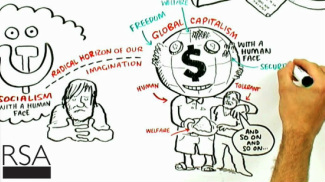 Žižek argues charitable consumption prolongs capitalism's ills. Žižek argues charitable consumption prolongs capitalism's ills. Tags: capitalism, consumption/consumerism, corporations, culture, economic sociology, marketing/brands, marx/marxism, political economy, theory, charity, corporate social responsibility, cultural capitalism, morality, starbucks, žižek, 06 to 10 mins Year: 2010 Length: 10:56 Access: YouTube Summary: In this animated segment of a longer lecture, Slavoj Žižek critiques the cultural dimensions of contemporary capitalism. Žižek begins by stating how capitalism has changed from a dichotomy between production and traditional charity (e.g. Soros earns money by exploiting workers then gives it back to humanist causes), to a form of capitalism that brings the dimensions of morality and consumption together. He offers several examples of this "cultural capitalism," including Starbucks and Tom's Shoes. In each of these instances, the act of consumption and doing good are part of the same process, which has now been universalized throughout capitalism. It is meant to make people (i.e. consumers) feel good about themselves in that they are helping poor people or a degraded environment. However, Žižek argues that by participating in this system, consumers are actually "prolonging the disease ... rather than curing it." He promotes changing the structure rather than this sort of charitable act: "The proper aim is to try and reconstruct society on such a basis that poverty would be impossible and the altruistic virtues have really prevented the carrying out of this aim." He compares this system to slave owners who were kind to their slaves because they prevented oppressed slaves from realizing the core injustice of slavery; in other words, it suggests that we are doing enough to address the system's ills and prevents more significant change. While there is an implicit argument to do away with capitalism here, Žižek explicitly states that 20th century socialism was a "mega catastrophe" and does not promote a return to that system. The clip also works well to initiate critical discussions of corporate social responsibility, Fair Trade, and other social certifications, and begin to imagine what more radical alternatives might look like. Submitted By: Paul Dean  Segmenting the market by gender, companies increase profits. Segmenting the market by gender, companies increase profits. Tags: capitalism, children/youth, consumption/consumerism, gender, inequality, marketing/brands, gender roles, gender socialization, market economy, market segmentation, toys, 06 to 10 mins Year: 2014 Length: 7:24 Access: YouTube Summary: In this episode from the Australian television series The Checkout, gendered marketing is analyzed and, specifically, the theory of market segmentation is explored. This theory posits that dividing consumers up into smaller groups is good for business; as the video demonstrates, gender is a common criteria upon which companies segment the market and increase the sales of their products. Product elements such as "shape, texture, packaging, logos, verbiage, graphics, sounds, and names [are all used] to define the gender of a brand." For example, Lego company tripled the sales of the same product and boosted their annual global revenue by as much as 25% when they created Lego Friends for girls and building sets and action figures for boys. Similar to children’s toys, companies segment the market by gender when advertising products for adults as well. Among the many examples cited in the video, Dove Company created “For Men” soaps, which have more squared edges than its regular, ellipse-shaped soap bars, packed in grey boxes in order to give a more “macho mystique” to the product. This video can be used in classrooms for explaining the connections between capitalist market economy and gender socialization, and its implications for gender inequalities. The video highlights how gender inequality manifests in the different prices of these products, with "women's products" often costing much more than those marketed toward men. However, viewers can also consider other ways that gendered marketing contributes to gender inequality. For other examples and critiques of gendered marketing on The Sociological Cinema, click here, here, and here. For a collection of pics on gendered marketing, click here. Submitted By: Nihal Çelik |
Tags
All
.
Got any videos?
Are you finding useful videos for your classes? Do you have good videos you use in your own classes? Please consider submitting your videos here and helping us build our database!
 |
 RSS Feed