 Katie fakes her period and receives a "first moon" party. Katie fakes her period and receives a "first moon" party. Tags: bodies, children/youth, commodification, consumption/consumerism, gender, health/medicine, marketing/brands, sex/sexuality, commercial, humor, menstruation, 00 to 05 mins Year: 2014 Length: 2:20 Access: YouTube Summary: The company HelloFlo has distinguished itself with its innovative marketing of feminine hygiene products, as well as a lively blog and the informative “Ask Dr. Flo” column. This advertisement portrays an adolescent girl who is impatient for the arrival of her first period. At the start, we see her decorating a clean pad with red nail polish. Her mother discovers the pad and pretends that she has been duped. The mother then concocts an extravagant revenge plot in the form of a “First Moon Party,” even though she knows the daughter has yet to have a period. While the advertisement enlists humor to defuse discomfort and embarrassment, the resulting comedy treats male and female characters inequitably and relies upon familiar tropes of conniving girls and devious women. For example, the mother deceives her daughter and exposes her to unwanted attention from men and boys. Grown men do imbecilic things and inspire eye-rolling, while the girl, the supposed protagonist, does something adolescent—after all, she is an adolescent—and suffers punishment. While in the past, a girl might have been daunted by the secrecy and shame surrounding menstruation, here she is discomfited by a denial of privacy, as others take over her rite of passage (one she herself has yet to undergo). The narrative closure comes when the girl admits to her lie and asks whether she will be grounded. Her mother reveals that she has already punished her with the party and then gives her a “period starter kit” as a gift. The advertisement concludes by giving the punchline to a male partygoer who awaits the flow from a sluggish ketchup bottle; he advises another young girl, “Sometimes you just gotta wait.” The ad is framed as a parody, but given the delicate and gendered subject matter, questions arise. How and when can humor dismantle convention? Who is the protagonist? Toward whom is this spot directed? Who is relieved of embarrassment? And to what end? Note that The Sociological Cinema has previously explored how the topic of how menstruation gets handled by the media here and here. Submitted By: Rose Marie McSweeney
5 Comments
 What are the conditions where their food was produced? What are the conditions where their food was produced? Tags: commodification, consumption/consumerism, economic sociology, food/agriculture, marx/marxism, theory, commodity fetishm, de-fetishism, local food, 00 to 05 mins, 06 to 10 mins Year: 2011 Length: 2:27; 7:46 Access: YouTube (short version) YouTube (full version) Summary: In Marxist theory, commodity fetishism is the process by which people come to see commodities in terms of their physical properties and market value, rather than being derived from the labor and labor conditions that produced it. This is important because it obscures the social relationships between people and reduces commodities to the economic exchange between buyer and seller. Value then falsely appears to be the natural part of that commodity, rather than in the labor that produced it. For example, consider the production and consumption of chicken. In a conventional exchange at the supermarket, consumers know nothing about the labor and conditions that went into producing the chicken. The purely market-based exchange obscures and hides the exploitation and typical industrial farming methods, which are shown in this Food Inc clip or this Samsara clip, making it appear that the value of the chicken comes from the product itself. Local economies, including the local food movement, are often attempts to reverse this process by re-situating economic activity within the social relations that produced it. Through local economies, such as farmers' markets and local handicrafts, consumers can interact directly with local producers and understand the labor process and labor conditions of how goods are produced. In short, it seeks to de-fetishize the commodity. This hilarious clip from Portlandia illustrates these concepts through satire. It shows the main characters ordering a chicken dish in a restaurant, where they inquire about the conditions in which it was raised. For example, they ask about the size of its roaming area, its diet, if it is local and organic, about who is raising the chicken, and if the farmer lives locally. They learn the chicken's name is Colin and are given his "papers." In the full clip, they also travel to the farm where Colin was raised, get a tour, and meet the workers who raised Colin and the other chickens. They end up staying at the farm for 5 years, but then realize the farm is run by a cult, and ultimately return to the restaurant and inquire about the salmon. For related videos, see commodity fetishism illustrated in this Macklemore music video, and de-fetishism through a promotional fair trade video or Chipotle ad. Submitted By: Paul Dean  West discusses his notion of the "habitual vision of greatness." West discusses his notion of the "habitual vision of greatness."
Tags: capitalism, commodification, consumption/consumerism, marx/marxism, social mvmts/social change/resistance, theory, alienation, commodity fetishism, conspicuous consumption, false consciousness, thorstein veblen, 00 to 05 mins
Year: 2004 Length: 5:32 Access: YouTube Summary: In this conversation between Dr. Cornel West and Tavis Smiley, West summarizes his thoughts on the “habitual vision of greatness,” or basing one’s life goals in altruistic motivations and behaviors. After discussing this vision from both religious and non-religious viewpoints, West goes on to distinguish between “success" and "greatness.” In contrast to greatness, he defines success as “pecuniary gain and financial prosperity” evidenced by “a big crib in a vanilla suburb.” Commodities become tools of division and alienation, and are fetishized by both the rich and the poor. This commodity fetishism leads people to believe that they are made human, and have a better chance of their personhood being noticed by others as they accumulate commodities. West emphasizes that this warped vision of success is directly tied to our market-driven, capitalist society. He concludes by citing the hope of Dr. Martin Luther King, Jr. and others as the foundation for leading a compassionate life, rather than a life driven by financial attainment. This video can be used in at least two classroom settings. First, in an Introduction to Sociology or Sociological Theory course, instructors can use the clip when discussing Karl Marx’s concepts of alienation, false consciousness, and commodity fetishism. This video can also be used to stimulate conversation around Thorstein Veblen’s conspicuous consumption, reflected in West’s dissection of monetary affluence flaunted with “a big crib in a vanilla suburb.” To incite discussion, instructors can ask students: What are media representations (i.e., Hollywood actors, reality TV, magazines, and advertisements) of commodity fetishism (and/or conspicuous consumption) that you see on a regular basis? Second, the clip can be used in a Contemporary Social Problems class when discussing remedies to social problems, specifically relying on West’s “habitual vision of greatness” as a potential starting point to think about social justice motivations and behaviors. Instructors can ask students: Why and how are feelings such as "hope," "compassion," and "love" important to theorize and research (and actually feel) when thinking about how to solve social problems? Submitted By: Beverly M. Pratt  Film exposes big drug companies' dangerous marketing tactics. Film exposes big drug companies' dangerous marketing tactics.
Tags: capitalism, commodification, consumption/consumerism, corporations, health/medicine, marketing/brands, pharmaceutical industry, prescription drugs, 21 to 60 mins
Year: 2007 Length: 49:23 Access: YouTube (trailer) Summary: The filmmakers of this documentary argue that "missing in the health care debate is how drug companies are putting your and your family's safety at risk in order to make more money." Money Talks: Profits Before Patient Safety exposes the questionable tactics that big drug companies use to make record profits by playing with the safety of our health care. Using misleading advertising, attractive "drug reps" who wine and dine doctors, and other unethical practices, the drug industry makes billions of dollars every year selling us unsafe, unnecessary, and overpriced drugs. The film gives an in-depth, academic perspective on the questionable marketing tactics of the pharmaceutical industry, and features the commentary of investigative journalists, former pharmaceutical sales representatives, and medical professionals including Dr. John Abramson, author of Overdo$ed America, and Alex Sugerman-Brozan, director of the Prescription Access Litigation Project. Other notable interviewees include Dr. Bob Goodman of Columbia University, founder of the "No Free Lunch" program, and Dr. Jerome Hoffman of UCLA Medical School. Money Talks: Profits Before Patient Safety was chosen by the American Library Association as one of the most notable films for adults in 2008. Submitted By: Holly Mosher  Rapper Macklemore surrounded by Nike products and symbols Rapper Macklemore surrounded by Nike products and symbols
Tags: art/music, capitalism, commodification, consumption/consumerism, marketing/brands, marx/marxism, theory, baudrillard, commodity fetishism, exchange-value, labor, lacan, surplus value, signified, signifier, symbols, use-value, 00 to 05 mins
Year: 2011 Length: 5:33 Access: YouTube Summary: Seattle rapper Macklemore's music video for his thought-provoking song “Wings” is an excellent way to introduce students to Marx’s theory of commodity fetishism. Commodity fetishism is the process of ascribing magic “phantom-like” qualities to an object, whereby the human labour required to make that object is lost once the object is associated with a monetary value for exchange. Under capitalism, once the object emerges as a commodity that has been assigned a monetary value for equivalent universal exchange, it is fetishized, meaning that consumers come to believe that the object has intrinsic value in and of itself. The object’s value appears to come from the commodity, rather than the human labor that produced it. In “Wings,” Macklemore associates this process of commodity fetishism with Nike Air Max athletic shoes, explaining his belief as a child that the shoes would make him into a superstar athlete like Michael Jordan. The value of Nike shoes is displaced from the labour time that went into creating them, and instead is infused with an intrinsic value that comes into being through celebrity endorsement or symbols such as the iconic Nike “Swoosh.” “Wings” becomes a statement on how market capitalism seduces us into purchasing products that promise to make our lives better. Macklemore comes to this realization through the song’s narrative, exclaiming, “Nike tricked us all,” before finally realizing as the song comes to an end that “it’s just another pair of shoes.” Through tracks like “Wings,” Macklemore explores the darker side of consumption, urging listeners to critically rethink the messages imposed on us in capitalist societies that make us feel the need to constantly consume. This video can also be used to teach and distinguish among Marx's notions of use-value and exchange-value, as well as his concept of surplus-value, which is the surplus or profit earned by the capitalist, above and beyond the use-value (labour power) required to produce the object. Viewers may be urged to identify the use-, exchange-, and surplus-values of the Nike shoe in the video. How is value made? Why do we pay $180 for a pair of Nike shoes, but only $20 for a pair of Sketcher shoes? In addition, this video bolsters discussion about the power of symbols and signification (and Baudrillard’s notion of sign-value) in creating cultural meaning embodied in a commodity sign (e.g., the Swoosh on the Nike shoe, or the Apple symbol on an iPhone). Instructors can ask students to name other symbols in popular culture and what they mean to them. Drawing upon Jacques Lacan’s idea of the signifier and signified, instructors can expand the discussion of symbols by asking students to discuss the role of brand symbols in their life. Have they become a part of their identity? Their culture? Their daily lives? In the end, Macklemore speaks to this point: his Nikes are “so much more than just a pair of shoes.” They are “what I am… the source of my youth… the dream that they sold to you.” For another post on The Sociological Cinema that uses Macklemore's music videos to teach sociological concepts, click here. Submitted By: Patricia Louie  Kyle and Stan attempt to destroy the heart of Wall-Mart Kyle and Stan attempt to destroy the heart of Wall-Mart
Tags: capitalism, commodification, consumption/consumerism, corporations, economic sociology, marketing/brands, marx/marxism, political economy, theory, culture industry, false needs, max horkheimer, theodor adorno, wal-mart, 00 to 05 mins
Year: 2004 Length: 3:48 Access: South Park Studios Summary: In this South Park clip, Kyle and Stan enter the local Wall-Mart in an attempt to ruin the business because the people of South Park have been negatively affected by its recent opening in their town. Having been led to believe that destroying the “heart” will destroy the business, the boys search the store for the “heart” of Wal-Mart . While Randy (Stan's father) is walking through the store with the boys, he is distracted by the fact that Wal-Mart continues to lower their prices. Everywhere he looks there are items that he does not need, but he continues to buy them because of the low prices. In this way, Wal-Mart is creating “false-needs,” which are created and fulfilled by capitalism, and exert power over Randy. When the boys meet the man that calls himself “Wal-Mart,” he claims that he can take any “form” that he chooses. He then switches clothes, thereby acquiring different forms through consumer goods, and asks the boys which “form” they prefer. When the boys find the “heart,” they are surprised to see that it is a mirror; i.e. the “heart” of Wal-Mart is the consumer. The man adds that his “forms” can be Wal-Mart, K-Mart, and Target, but that he represents one single entity, “desire.” This desire is the power that is exerted over people by major corporations. While the clip seems to suggest that Wal-Mart is simply fulfilling the desires of the consumer, viewers may consider how such desire and the low prices of Wal-Mart are produced more broadly. Through advertising and Wal-Mart's artificially low prices (e.g. by exploiting cheap labor), these desires are produced like a commodity in a factory and are a fundamental mechanism for capitalist control over people. By suggesting that the "heart of Wal-Mart" is the consumer, does it offer hope in us being able to change the corporate giant or does it unfairly place blame on individuals for a bigger structural issue? Submitted By: Sean Kelley and Ian Hammer  Dancers in the De Wallen red-light district, Amsterdam Dancers in the De Wallen red-light district, Amsterdam Tags: capitalism, children/youth, commodification, consumption/consumerism, crime/law/deviance, gender, globalization, sex/sexuality, human trafficking, prostitution, sex trafficking, slavery, subtitles/CC, 00 to 05 mins
Year: 2012 Length: 1:40 Access: YouTube Summary: This short clip is a PSA from Stop The Traffik (STT), an international charity focused on ending human trafficking. The clip was shot in the famous De Wallen red-light district in Amsterdam and features six women dancing in a typical brothel. Their performance captivates, and a crowd of men soon gathers in the street to watch. The performance abruptly ends and an electronic billboard overhead reads, "Every year, thousands of women are promised a dance career in Western Europe. Sadly, they end up here." Many people are aware of the connection between human trafficking and sexual exploitation, and indeed the Netherlands is listed by the United Nations Office on Drugs and Crime as a primary country of destination for victims of human trafficking. The reality is people are trafficked for a number of reasons, not all having to do with sexual slavery. STT defines human trafficking as the act of deceiving or taking people against their will, to be bought, sold and transported into slavery for sexual exploitation, to be used in sweat shops, circuses, in sacrificial worship, forced begging, or to be used as child brides, farm laborers, unwilling human organ donors, and as domestic servants. Human trafficking appears to be growing, and according to STT, 2 to 4 million men, women and children are trafficked across borders and within their own country every year. More than one person is trafficked across borders every minute, which is equivalent to ten jumbo jets every day. The clip does well to capture viewers' attention and might be an effective foray into what must be a much deeper discussion about trafficking. One can approach the issue in terms of globalization by considering the global flows of trafficked humans from less developed countries to more developed countries. To what extent is human trafficking explained by the conditions of the global economy, where a steady supply of children are sold by people in the global south, who face extreme poverty, in order to meet the demands of those in the global north, who have more than enough? This video would work well in tandem with another clip on The Sociological Cinema, which explores the biography of a young woman who was forced into prostitution in the United States. Submitted By: Lester Andrist  Tags: capitalism, commodification, consumption/consumerism, food/agriculture, economic sociology, marketing/brands, theory, weber, alienation, assembly line, farming, fordism, mass production, McDonalidzation, rationalization, simulacra, slow food, 00 to 05 mins
Year: 2011 Length: 2:20 Access: YouTube Summary: Using Pixar-esque animation and Willie Nelson’s twang, this Chipotle commercial examines the development of our food production system. The commercial-story begins with images of pigs in an open pasture, which are then subjected to larger and more mechanized farming practices that lead to a highly industrialized food production system. It then shows a farmer (who evokes images of Middle America) as he slowly realizes the toxic effects, both on body and planet, of rationally commodifying agriculture and livestock. Set to Coldplay’s “The Scientist” (heartbreakingly sung by Willie Nelson), the main lyrics reference going “back to the start” and a return to earlier farming practices. Within the linear segment, we learn that the said farmer’s consciousness-raising leads to cage-free farming, thereby allowing him, his family, and their farm animals to lead a more socially conscious–and seemingly happy–existence. This clip can bring to life theories of consumption, aiding sociologists-in-training in conceptualizing concepts including Weber’s theories on rationalization, George Ritzer’s theories on McDonaldization, and Jean Baudrillard’s musings on simulacra. It can be useful to spark conversations on the social and environmental impacts of consumption behaviors and the potential impacts of industrial farming practices for human health. Finally, Chipotle’s commercial provides an opportunity to examine the complexities–and sometimes contradictions–of advertising. After a discussion on whether they are prompted (as educated consumers) to frequent Chipotle now that they’ve seen the commercial, the viewer might consider some little known facts and inconsistencies of the fast-food chain. For example, the McDonald’s Corporation was at one time a major investor in Chipotle, though now divested from the Mexican grill. In January 2011, the fast-food chain was in the Minnesota headlines when several locations were hiring undocumented workers, therefore coming to the attention of U.S. Immigration and Customs Enforcement (ICE). Once discovered, Chipotle fired the employees, ranging from 350 to 700 people. This begs the question, while ethical treatment is being maintained for farm animals, is ethical treatment being maintained for actual human employees? Submitted By: Beverly M. Pratt  Tags: commodification, consumption/consumerism, bodies, emotion/desire, food/agriculture, gender, health/medicine, marketing/brands, media, eating disorders, subtitles/CC, 00 to 05 mins
Year: 2011 Length: 0:33 Access: YouTube Summary: This commercial for LAY'S® potato chips can be used to illustrate the common practice among advertisers to represent women's consumption of junk food as a (commodified) act of romantic love, intimacy, or sexual pleasure. In this particular spot, shot entirely in slow motion with Al Green crooning his classic "I'm So In Love With You" in the background, anticipation builds as the woman prepares to encounter her salty prince, err...snack. As she opens the bag, a flirtatious smile spreads wide across her face. She performs all the ritualistic feminine acts of falling in love (bites at her lip, bats her lashes, averts her eyes), adhering to a familiar cultural narrative of a school girl falling in love: she's playful, coy, and unmistakably giddy. Across the bottom of the screen the following words appear: "one taste and you're in love." Feminists have well-documented the ways in which women are persistently depicted as being tormented by an obsessive relationship with food (e.g., Bordo 1998). Recently, scholars have pointed to the ways in which chocolate has been marketed to women, equating chocolate to delightful yet sinful indulgence, sex, and a pseudo form of female empowerment. In the article "Women and Food Chains: The Gendered Politics of Food," Allen and Sachs (2007) place this marketing strategy in a socio-health context, stating that "dieting, anorexia nervosa, bulimia, and obesity—all on the rise—mark the confused messages that women should have perfect (thin) bodies at the same time that they are encouraged to over consume and indulge in junk food. Advertising and media play an enormous role in perpetuating women's obsession with thinness" (2). As these commercials about junk food suggest, advertising and the media also play a role in perpetuating the message that, for women, the junk food eating experience is similar to that of sex, love, and intimacy, all of which perpetuate a complex and often unhealthy relationship with food. In another version of this commercial, Queen's "Crazy Little Thing Called Love" plays in the background. Submitted By: Valerie Chepp 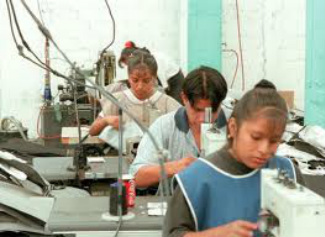 Tags: capitalism, commodification, corporations, economic sociology, globalization, inequality, marx/marxism, organizations/occupations/work, capital flight, feminization of poverty, maquiladoras, world-systems theory, 00 to 05 mins
Year: 2006; 2012 Length: 4:04; 2:58 Access: clip 1 on YouTube; clip 2 at the New York Times Summary: These two clips examine the role of low wage work in the global economy. The first clip looks at maquiladoras (multinationally-owned factories operating in tax-free zones in low wage countries) from the documentary Maquilapolis (city of factories). It presents the stories of two female maquiladora workers. Carmen works the graveyard shift at a factory that produces television parts. She was attracted to the maquiladoras because it paid better wages than the rest of Mexico. However, she ultimately suffers from kidney damage and lead poisoning from her years of exposure to toxic chemicals and her employers that do not allow workers to drink water or go to the bathroom during their shift. In a global economy, corporations are attracted to places like Mexico because of their tax-free zones that offer tax breaks and cheap labor that is easily exploitable. Employers expect labor, which is mostly female, to have "agile hands and would be cheap and docile". Ultimately, Carmen's employer moved from Mexico to Indonesia to find cheaper labor and earn higher profits. The clip discusses female labor as a "cheap commodity" that is easily discarded if they become less productive or defend their labor rights. The second clip documents workers at a Chinese Foxconn factory that employs 120,000 workers with low pay and dangerous working conditions. The clips offer a good illustration of world-systems theory, and viewers can be encouraged to think about the role of maquiladoras in the global economy. How does value flow through the global economy? How is work, gender, and inequality linked to maquiladoras and the mobility of transnational corporations around the world? Do maquiladoras reproduce poverty or can they help nations rise in global value chains? Submitted By: Paul Dean |
Tags
All
.
Got any videos?
Are you finding useful videos for your classes? Do you have good videos you use in your own classes? Please consider submitting your videos here and helping us build our database!
 |
 RSS Feed