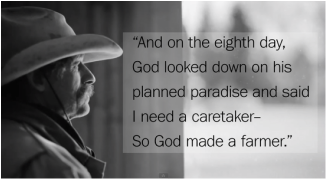
 Notions of good, hard-working people are attached to white male farmers in this ad. Notions of good, hard-working people are attached to white male farmers in this ad.
Tags: culture, gender, marketing/brands, media, nationalism, organizations/occupations/work, race/ethnicity, religion, american dream, commercial, farming, hegemony, ideology, 00 to 05 mins
Year: 2013 Length: 2:02 Access: YouTube Summary: This commercial, which aired during the 2013 Superbowl, is a montage of pictures of farmers, their families, and their lifestyle. Throughout the whole ad there is a Paul Harvey speech, known as his “So God Made a Farmer” speech, that was delivered at a 1978 farmer’s convention. The ad connects the speech with the montage of the people in a way that shows how farming is part of American culture, very hard work, and is of great moral and religious value. The ad promotes the new Dodge Ram truck, although the truck only appears a limited number of times. It illustrates the hegemonic ideology of the American Dream in a gendered and racialized manner. In short, the American Dream is the belief that obtaining success and upward social mobility for your family comes through hard work. In the ad, the farmer is working hard because it is their duty to be a hard working American. As a political conservative, Harvey was a big believer in the American Dream and promoted rugged individualism throughout his radio shows, and reflect the meanings that Dodge is attributing to its brand of trucks. This ideology is hegemonic because people take this cultural attitude, and its uniquely American expression, for granted, thereby reinforcing societal power relations. It ilso illustrates gender ideology, which can be referred to as the attitude regarding the roles, rights, and responsibilities of men and women in society. In the traditional sense, the men work blue-collar jobs while the women take care of the household and children. The ad both reflects and reinforces this traditional gender ideology, with 6 females shown in the ad compared to 21 men. None of the women were shown doing the “dirty work” while many of the men showed were actually involved in acting on their farm duties. The second to last picture in the montage is of a young child staring off into the farm with a cowboy hat while Harvey narrates, “When his son says that he wants to spend his life doing what dad does, so God made a farmer,” which reinforces the notion of farming as a masculine activity. Finally, the vast majority of farmers in the clip are white. There is a single image of an African American male farmer, and a Hispanic woman and her son, but for the most part, the video links the notions of good, hard working moral people with white male farmers, and of course, people who drive Dodge trucks. Submitted By: Omar Mendez
4 Comments
 Eri Hayward discusses her life as a trans woman Eri Hayward discusses her life as a trans woman Tags: inequality, intersectionality, lgbtq, prejudice/discrimination, religion, cisgender, mormon, trans*, transgender, subtitles/CC, 11 to 20 mins Year: 2014 Length: 14:52 Access: YouTube; Vimeo Summary: This short documentary entitled Transmormon, tracks the life of Eri Hayward, who was born and raised in Utah as a Mormon. Eri discusses how she had to come to terms with the fact that the gender she was assigned at birth was not the gender she knows herself to be. As she prepares for sex reassignment surgery, she and her parents recount her journey and how she has worked to reconcile her transgender identity with her religious beliefs as a member of the Church of Jesus Christ of Latter-day Saints. People are often hesitant to talk about what has been clearly stigmatized, so Transmormon provides an an excellent means of beginning a discussion about transgender experiences and identities. The film centers on Eri's intensely personal experiences growing up, but students can be encouraged to think about the implications of widespread stigmatization against transgender people, including the role it plays in creating high levels of violence and discrimination, higher rates of suicide, and inferior access to health care. To learn more about the public issues many transgender people face, explore our Pinterest board on the topic. Submitted By: Samuel H. Allen 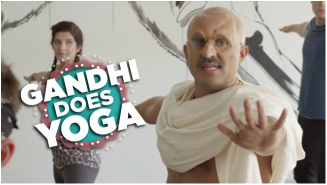 A sarcastic look at the cultural appropriation of yoga A sarcastic look at the cultural appropriation of yoga Tags: culture, religion, cultural appropriation, hinduism, status, yoga, 00 to 05 mins Year: 2015 Length: 2:48 Access: YouTube Summary: This College Humor sketch features a fictitious Mahatma Gandhi taking a yoga class at a trendy studio. Cultural appropriation, or the adoption of specific elements of one culture by another, is its central theme and issues of race, class and privilege run throughout the video. With the exception of Gandhi's character, all of the other students and the instructor in the class are white, and dressed in what is considered appropriate workout attire by dominant western culture. The instructor critiques Gandhi's technique and use of the Hindi names for poses, asserting that the pose he’s working on is actually called “up dog” and, not to worry that “you’ll learn the terminology.” The video draws attention to the impacts of appropriation on the practices adopted. Those in the class are highly concerned with the social prestige that comes with participating in a cultural trend and with “burning carbs” rather than understanding the customs and spiritualism that has informed the practice of yoga. Calling attention to the décor of the studio, which features statues of Hindu gods no one but Gandhi can identify, further illustrates the subjugation of Hindu tradition to a trendy aspect of western culture. When Gandhi finally leaves the class in indignant rage, the class sends him off with Namaste, to which he responds “You don’t know what that means!” The instructor in the video defends herself against Gandhi’s criticisms by stating that she is a certified instructor under the guidance of Carl Smith. The power dynamic present in the video, which leads to Gandhi’s departure is what allows for appropriation to take place. This power dynamic allows the economically elite practitioners of yoga in the United States to not only change and adopt yoga, but also to monopolize, formalize, commercialize, and institutionalize it. Submitted By: Miranda Ames 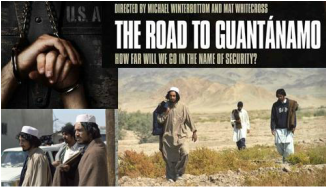 This docu-drama illustrates human rights abuses in the war on terror This docu-drama illustrates human rights abuses in the war on terror Tags: crime/law/deviance, government/the state, prejudice/discrimination, race/ethnicity, religion, war/military, human rights, muslim, racism, rendition, war on terror, 61+ mins Year: 2006 Length: 1:29:43 Access: YouTube Summary: The Road to Guantánamo is an "award-winning, intense, political, docu-drama about the Tipton Three, a trio of British Muslims who were held in Guantanamo Bay for two years until they were released without charge." Just days after 9/11, the three men traveled to Pakistan to attend a wedding. They crossed the border into Afghanistan at the same time that the US began military operations there, and after a series of missteps, they were left stranded. They were captured and transferred to the US military, who had mistaken them for Taliban fighters, and sent them to Guantanamo Bay Naval Base. The Tipton Three were exposed to harsh interrogation techniques but never charged, and eventually were released in 2004. A compelling feature in the film is the combination of first person narratives by the three you men, Ruhal Ahmed, Asif Iqbal and Shafiq Rasul, who appear as themselves in a talking head format alongside dramatic reconstructions of their actual experiences. For example, the film conveys a sense of what it feels like to experience noise bombardment and the 'futility torture' techniques where music is played (e.g. Metallica, James Taylor) to prisoners at deafening volumes in dark rooms. The video can be usefully paired with an article by Suzanne Cusick (2008), “'You are in a Place that is out of this World ...": Music in the Detention Camps of the 'Global War on Terror.'" For a similar account of torture techniques used in the US war on terror at Guantanamo Bay, see this news clip featuring an interview with Muhammad Saad Iqbal Madni. Submitted By: Les Back 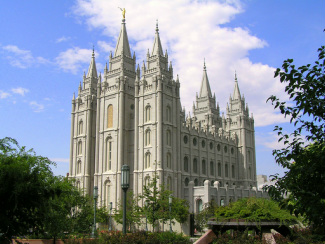 Mormons are questioning if their religion was created by society. Mormons are questioning if their religion was created by society. Tags: culture, durkheim, religion, social construction, theory, integration, mormonism, 00 to 05 mins
Year: 2013 Length: 4:41 Access: New York Times Summary: In The Elementary Forms of Religious Life, Émile Durkheim (1912) explains the social significance of religious life. He argues—“the universal and eternal objective cause of … religious experience … is society”; and—“that which makes a man is the totality of the intellectual property which constitutes civilization, and civilization, is the work of society.” In other words, religion is created by society, and that its beliefs and what it constitutes as "sacred" are a product of human meaning and culture. In this video, we see Hans Mattsson, a former high-ranking leader within the Mormon Church in Europe, coming to terms with the notion that his religion may have been constructed by society (Mattsson is one of a growing group of disbelievers in the Mormon church). It notes that the Church of Jesus Christ of Latter-day Saints (i.e. the Mormon Church) has always taught that The Book of Mormon is factually and historically true, but its claims have recently been contradicted by a variety of evidence. Evidence also shows the Church's founder (Joseph Smith) had intimate relationships with many wives, some of whom were very young, casting further doubt within its adherents. As noted in the accompanying NYT article. "The church was born in America only 183 years ago, and its founder and prophet, Joseph Smith, and his disciples left behind reams of papers that still exist, documenting their work, exposing their warts and sometimes contradicting one another." But the Roman Catholic Church, on the other hand, has had over 2,000 years to work through doubts raised by insiders and outsiders. This more recent example, therefore, might serve as a metaphor to think about how all religions (as argued by Durkheim) are constructed by society. Viewers are encouraged to consider how religions are constructed by people, and following Durkheim, what social conditions are necessary for the development of any religion? (Durkheim argues the necessary conditions are the separation of sacred from profane, beliefs, rites, and a church or single overarching moral community.) In addition, the video illustrates Durkheim's concept of integration, or the degree to which collective sentiments are shared and have social relations which bind individuals to a group. Durkheim argued that too much integration or too little integration is damaging to the individual and we see this when Mattsson's integration is lost. In the accompanying article, Mattsson is quoted as saying "Everything I’d been taught, everything I’d been proud to preach about and witness about just crumbled under my feet. It was such a terrible psychological and nearly physical disturbance.” When Mormons expressed such doubts, they were often cut off from friends, family, and leadership within the church—thereby illustrating a social cause for their individual psychological predicament. Submitted By: Paul Dean  The NiqaBitch video protests France's burqa ban The NiqaBitch video protests France's burqa ban Tags: art/music, bodies, crime/law/deviance, gender, immigration/citizenship, inequality, prejudice/discrimination, race/ethnicity, religion, sex/sexuality, burqa, burqa ban, chandra talpade mohanty, femininity, feminism, male gaze, niqa, postcolonialism, racism, 00 to 05 mins
Year: 2010 Length: 2:17 Access: YouTube Summary: This clip features a protest against France's recent Burqa ban, which went into force in 2011. The new law stipulates that anyone caught wearing the niqab or burqa in public could face a fine of €150, or be forced to take lessons in French citizenship. The performance of the two women in the video challenges the resistance/subordination binary, which typically frames discussions about what it means when non-Western women don the veil. By sexualizing their veiled bodies, the women challenge ideas about whether wearing a veil is necessarily an expression of women's oppression, just as it challenges whether wearing hot pants and high heels is necessarily an expression of women's ability to resist oppression (Note that the ban went into force after the video was made). Moreover, by performing a sexualized femininity they are apparently able to navigate the streets of Paris without being disciplined, and their short walk raises a number of provocative questions. First, to what extent are the two women able to “break” the law because they have garnered the approval of the heterosexual male gaze? How might people react to these women if they did not fit the archetype of attractive females? This clip provides an excellent window into Chandra Mohanty's acclaimed paper “Under Western Eyes.” Mohanty takes issue with the way that Western feminists assume that wearing the veil is a symbol of oppression and fail to give a voice to the women who wear these clothes. It is unfair for Westerners to assume that the way they themselves dress is a symbol of empowerment without unpacking the systems of patriarchy that inform Western modes of dress. Viewers can also consider whether Westerners have the authority to make judgments about the way non-Westerners dress. Does the government have the right to create laws that ban certain styles of dress? If so, why aren't the religious symbol laws enforced for nuns who wear veils? Submitted By: Pat Louie  Sean Dorrance Kelly explains why the Super Bowl is sacred Sean Dorrance Kelly explains why the Super Bowl is sacred Tags: durkheim, religion, theory, profane, sacred, 06 to 10 mins
Year: 2011 Length: 6:48 Access: colbertnation.com Summary: While Émile Durkheim is known as a founding father of sociology, much of his work has anthropological elements. Many of his theories are based on the assumption modern societies have more evolved and complex versions of the same social attributes that are also found, and more easily visible, in “primitive” or pre-modern societies. One of his most well-known examples comes from the ways many pre-modern societies used religion to differentiate the sacred and the profane. The profane is the routine and seemingly unimportant elements of everyday life whereas sacred things are both idealized or beyond reproach, and bond people together through a collective morality. But since religion plays a less central role in modern life, helping students identify what sacred things bond us together in our own modern society is difficult. However, in this clip from The Colbert Report, philosopher Sean Dorrance Kelly explains how sacred aspects of modern societies still exist in places that often seem profane—like The Super Bowl. Submitted By: Jason T. Eastman 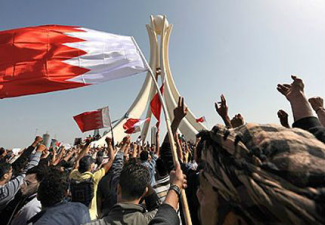 Shi'a and Sunni Muslims lead a protest for democracy in Bahrain Shi'a and Sunni Muslims lead a protest for democracy in Bahrain Tags: globalization, media, nationalism, religion, social mvmts/social change/resistance, violence, war/military, arab spring, bahraini uprising, moral resources, organizational resources, pearls revolution, propaganda, social revolution, 21 to 60 mins
Year: 2011 Length: 50:56 Access: YouTube Summary: [Trigger warning: there are graphic scenes of violence throughout this clip. Two scenes are especially noteworthy. At the 7:38 mark, there is footage of protesters being shot by the Bahraini Army, and at the 8:30 mark a man is shown bleeding in a hospital bed after he was reportedly shot in the head.] This documentary from Al Jazeera English recounts the fight for democracy among Shi'a and Sunni Muslims in Bahrain. An island kingdom on the western shore of the Persian Gulf, Bahrain is formally ruled by the Al Khalifa family as a constitutional monarchy. The film chronicles the early moments of the spread of the Arab Spring to Bahrain where protestors converged on Pearl Roundabout, which lies in the financial district at the heart of Manama. Chief among their demands was for the emergence of a secular democratic government, and more pointedly, protesters called for the majority Shi'a Muslims to be included in the formal political system, which was dominated by a Sunni family. The documentary begins on February 16, 2011, the first day protesters occupied the roundabout. It documents the collaboration between the nations of the Arabian Peninsula under the auspices of the Gulf Cooperation Council (GCC) to stop the spread of these revolutionary protests, and Al Jazeera offers exclusive footage from inside both the opposition encampment at Pearl Roundabout and Salmaniyya Hospital, which was not only a place to treat the injured but also initially a place of refuge from state violence. The documentary works well as a means of introducing students to the study of social movements. Among other concepts, the film is useful for exploring the evolution and consequences of state tactics aimed at quelling the protests—both violent and non-violent. Analysts of social movements often point to the significance of a nascent movement's moral and organizational resources, and this film illustrates the importance of both. For example, one can easily use the film to engage students in a discussion about the significance of Pearl Roundabout and Salmaniyya Hospital as practical locations for organizing protests and disseminating information (i.e., organizational resources). At the same time, one could also lead a discussion about how these were effective sites for protesters to imbue their struggle with meaning and legitimacy (i.e., moral resources). Submitted By: Lester Andrist 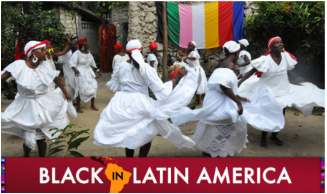 Henry Louis Gates, Jr. explores issues of race and identity in Haiti Henry Louis Gates, Jr. explores issues of race and identity in Haiti Tags: government/the state, historical sociology, inequality, knowledge, nationalism, political economy, race/ethnicity, religion, social construction, social mvmts/social change/resistance, theory, war/military, benedict anderson, edward said, 21 to 60 mins
Year: 2011 Length: 51:25 Access: PBS Video Summary: Part of the PBS series "Black in Latin America," this short film featuring Professor Henry Louis Gates, Jr. explores issues of race and identity in Haiti and the Dominican Republic, two countries that share the same island of Hispaniola, yet share little else in terms of language, economic opportunities, relations with colonial nations, and identification with African ancestry and heritage. This clip is excellent for illustrating how racial classifications are a social construction, as meanings of blackness shift across the two countries. The island's history of race relations also demonstrate how, as Edward Said shows, race is constructed in reference to a racial (and national) "other," as Dominicans have historically understood themselves as "not Haitian" and therefore "not black." Students can see how knowledge about national racial identity has been deliberately cultivated by national elites in the Dominican Republic through selectively told histories, national memorials, holidays, and monuments. This racially motivated nation-building effort articulates well with Benedict Anderson's work on imagined communities. Finally, the video chronicles how Haiti became the first-ever black republic, and the pivotal role that religion played in the slaves' fight for liberation. However, ever since winning independence, outside nations, including the United States, have imposed policies that have made it near impossible for Haitians to develop a robust economy and political infrastructure, evidenced today by the poverty and political corruption that plague the country, but which is always challenged by Haitians' rich and complex belief system and artistic culture. The video is divided into six chapters, allowing instructors to easily screen shorter segments of the film if they wish. I would like to thank Jean François Edouard for suggesting this clip. Submitted By: Valerie Chepp  Tags: discourse/language, religion, theory, bourdieu, culture, habitus, subculture, subtitles/CC, 00 to 05 mins
Year: 2008 Length: 2:49 Access: YouTube Summary: Pierre Bourdieu popularized the sociological concept of habitus, but unfortunately Bourdieu is not the most accessible social theorist. One can use this humorous video and the examples it depicts to explain the concept to students. The clip satirizes an evangelical habitus and begins with the narrator asking rhetorically, "Ever been a part of a conversation with other Christians and you have no clue what they are saying?" To learn how to converse with Christians, all one needs to do, we are told, is buy the instructional tape series, "How to Speak Christianese." As habitus is a set or system of dispositions, including those pertaining to speech and language, the clip's depiction of Christians as sharing common idioms that must be learned works well as a means of illustrating how people occupy fairly distinct habitus. The clip can further serve as a means of illustrating how, depending on one's habitus, one might be predisposed to articulate the world in a particular way. Students can be encouraged to come up with their own examples of habitus. They can be asked to reflect on the advantages someone might have who is able to operate with ease within a particular habitus. Finally, students can even be asked to consider how likely it is for a person to truly inhabit a habitus after merely listening to a book on tape. Submitted By: Kendra Barber |
Tags
All
.
Got any videos?
Are you finding useful videos for your classes? Do you have good videos you use in your own classes? Please consider submitting your videos here and helping us build our database!
 |
 RSS Feed