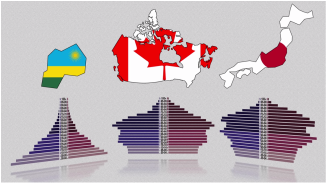
 Rwanda, Canada, and Japan have very different age distributions. Rwanda, Canada, and Japan have very different age distributions.
Tags: aging/life course, demography/population, methodology/statistics, demographic transition, fertility, mortality, subtitles/CC, 00 to 05 mins
Year: 2014 Length: 5:01 Access: YouTube Summary: In an earlier video post from The Economist I introduced the population pyramid, which is a type of graph used by demographers to interpret population characteristics and project how those characteristics will change in the future. Using these pyramid graphs, it's possible to discern whether a given population is growing rapidly, growing slowly, or in decline, and whether the country has undergone a demographic transition. Few graphs are more useful than population pyramids, for they allow policymakers to establish tax structures, based on projections of the number of working-age people who will be able to pay taxes and the number of people who will be dependent on social services. Knowing characteristics of a population is also essential if one hopes to prevent food shortages, avoid ecological threats, and lesson the blow of chronic poverty. This video lesson prepared by Kim Preshoff is a nice primer on reading the graphs, as it compares the population distributions of a number of different countries, including Russia, Nigeria, Rwanda, Canada, Japan, China, and the United States. After watching the video and discussing the potential challenges each country faces, it's useful to ask students to find or create population pyramids for other countries and report on the challenges their chosen country faces based on its population characteristics. Submitted By: Lester Andrist
32 Comments
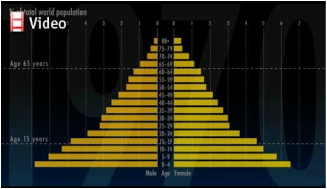 The age structure of the world's population in 1970 The age structure of the world's population in 1970
Tags: aging/life course, demography/population, health/medicine, methodology/statistics, demographic transition, fertility, mortality, total fertility rate, subtitles/CC, 00 to 05 mins
Year: 2015 Length: 4:15 Access: YouTube Summary: The population pyramid is a visualization of a society's age structure and is so named because of its shape. A thick base at the bottom indicates that the largest share of the population is young, and the pyramid's steep slope, which vanishes to a point, represents the cold fact that the mortality rate increases as people age. In countries around the world, the shape of this pyramid age distribution has been observed to change, a process demographers call a demographic transition. The traditional pyramid shape is common in less industrialized societies, which is an indication that fertility and mortality rates are high and life spans are short. However, with the diffusion of medical advancements, the reach of health care services, and improvments in drinking water and sanitation mortality rates typically drop and life spans increase. And with more children surviving the first decade of life and contraception becoming more widely available, fertility rates typically plummet. The result is that the pyramid-looking age distribution begins to resemble a column. Since each successive bar represents the size of an age cohort, it follows that in a society with a stable fertility rate and a low mortality rate, the bars resist sloping inward until the older age cohorts where mortaility seems to overcome advancements in health. • As the above video from The Economist explains, demographic transitions have been observed to happen on a country-by-country basis, but if one pools data from countries around the world, it appears that the age structure of the global population is slowly undergoing one big demographic transition. In 1970, the world's population could be represented as a pyramid, but in 2015 the the pyramid more closely resembles the dome of the U.S. Capitol Building. By 2060, demographers project that the dome-like structure will give way to columns, and it may be difficult to remember why demographers ever called it a population pyramid in the first place. • It is important to keep in mind that creating these graphs is more than an exercise in data visualization, and such graphs can be useful tools for policymakers. For instance, whether the age distribution resembles a pyramid or a column has important implications for answering questions about society's tax structure and resource allocations. It is essential to know the number of people who comprise vulnerable populations, such as children and the elderly. Population pyramids and the calculations they represent can also become a catalyst for more philosophical ponderings, such as what it will mean that for the first time in human history the world will have just as many older people as children. Submitted by: Lester Andrist 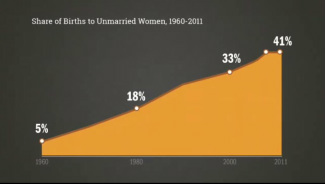 In 2011, 41% of children were born to unwed mothers. In 2011, 41% of children were born to unwed mothers.
Tags: abortion/reproduction, aging/life course, demography/population, marriage/family, cohabitation, divorce, millennials, 00 to 05 mins
Year: 2014 Length: 2:16 Access: YouTube Summary: A report from Pew Research Center confirms a familiar trend known to sociologists of the family: marriage is in decline. While in 1960 about 7 in 10 Americans over the age of 18 were married, by 2010 that rate had slipped to about 5 in 10. To those who see this trend as evidence that families are disappearing, the evidence appears even more grim once one examines the rate of decline among different age groups. In 1960, about 6 out of every 10 Americans between the ages of 18 and 29 tied the knot. Today, people in that age bracket have been dubbed millennials and far fewer of them are married—only about 2 in 10 in 2010. Not surprisingly, the difference in cohort marriage rates seems to be echoed in the difference between what those cohorts say about marriage. For instance, 44% of millenials agree with the sentiment that marriage is becoming obsolete, while only 32% of people over the age of 65 agree with that view. • While the proportion of people aged 18 to 29 who are reluctant to ever get married appears to be growing, it's important to note that many millennials are just waiting longer than ever to to do it. That is, the median age at first marriage in 1960 was 20 for women and 23 for men, but by 2013, the respective ages had increased to 23 for women and 29 for men. Accompanying this delay is the fact that people appear to be much more inclined to have children out of wedlock. • Nevertheless, it is true that the institution of marriage, as Americans once understood it, appears to be changing, and by nearly every measure it is fair to say it is in decline. But to those who see the foregoing discussion as further evidence that the American family is also in decline, or in the grips of a crisis, take a breath and consider the following. Familes existed long before the advent of marriage, so there is no logical reason to assume that they will cease to exist if marriage disappears. To peer into the future of marriage and family, one must analytically uncouple the two concepts: family can exist without marriage, and marriage can exist without family. What seems clear is that families are simply continuing to change, just as they have always changed. Unlike the nuclear family of the 1950s, there is no dominant family type which casts a long shadow on all the others. In a sense, families are persisting in spite of marriage. For even more information about demographic trends related to the family, check out our Pinterest page devoted to the topic. Submitted By: Lester Andrist  Dr. Shiobara uses a comparative methodology to examine how policies of multiculturalism shape different cultures. Dr. Shiobara uses a comparative methodology to examine how policies of multiculturalism shape different cultures.
Tags: culture, demography/population, globalization, immigration/citizenship, methodology/statistics, multiculturalism, race/ethnicity, australia, japan, migration, multiculturalism, subtitles/CC, 00 to 05 mins
Year: 2014 Length: 4:17 Access: YouTube Summary: In this video, Professor Yoshikazu Shiobara of the Keio University Department of Political Science (Faculty of Law) discusses his research on multiculturalism in Japan and Australia. As noted by Dr. Shiobara, "I study various changes in societies associated with globalization, changes in industrial structures, multi-ethnic and multicultural developments in nation-states, migration of people, and growth in immigration. In particular, I specialize in the concept and policies of multiculturalism, and I investigate how they affect people in the host society which accepts ethnic minorities, in the form of immigrants, social minorities, and indigenous peoples. I research these issues in terms of both theory and evidence." His work compares multiculturalism in Australia, which was one of the first to implement a policy of multiculturalism, and Japan, which has yet to systematize policies at the national level. This approach identifies social policies of migrants in these two countries, and their impacts on dominant cultures, migrating cultures, and indigenous populations. This is a useful example of comparative research methods, cross-cultural studies, migration, and global sociology. A full transcript of the short clip is available in the video's description on YouTube. Submitted By: Bhoomi K. Thakore  Wilmore and guests discuss Black fatherhood on The Nightly Show Wilmore and guests discuss Black fatherhood on The Nightly Show Tags: community, demography/population, marriage/family, media, methodology/statistics, prejudice/discrimination, race/ethnicity, fatherhood, larry wilmore, parenting, racism, stereotypes, subtitles/CC, 21 to 60 mins Year: 2014 Length: 21:29 Access: The Nightly Show Summary: When people hear the majority of Black babies are born “out-of-wedlock,” most either feel dismay or distrust at the statistic. However, Larry Wilmore and his panel of artists, authors, and activists confront the accuracy of this statistic and Black fatherhood more generally in a roundtable discussion. In Part 1, New York Times columnist Charles M. Blow explains how context matters, and the rate of births to unmarried Black women reflects the decline in fertility for married Black women, the mass incarceration of Black men, the diminishing importance placed on the traditional nuclear family, and the embracement of more flexible parental roles in our cultural more generally. Part 2 begins with a discussion about how media figures and politicians utilize deeply embedded racial (or racist) stereotypes to explain this statistic (and many others) in prejudicial ways. Part 2 then closes with the panelists offering their own experiences with their fathers and being dads themselves, thus revealing how in the interpreting of statistics many people (perhaps sociologists even more so than others) reify and over-generalize numbers, forgetting every “case” in a sample is actually a unique person, with their own unique experiences that is not readily apparent in macro data. Submitted By: Jason T. Eastman  Kondabolu criticizes the hype of whites as the minority in 2042. Kondabolu criticizes the hype of whites as the minority in 2042. Tags: demography/population, immigration/citizenship, race/ethnicity, hispanic, majority-minority relations, racial identity, white, 00 to 05 mins Year: 2013 Length: 2:55 Access: YouTube Summary: As comedian Hari Kondabolu writes in the description to this stand-up routine, "According to the US census, white people will be the minority in 2042 and Hari Kondabolu doesn't give a shit." On the one hand, the numerical turning point marks an important transition point in American racial demographics: there will be more racial minorities than white people, reflecting a more racially diverse society spurred on by immigration. On the other hand, the political significance of this turning point is very limited. As Kondabolu points out, "49% doesn't make you the minority." Sociologists discuss this in terms of majority-minority relations. The group in the majority is not the numerical majority, but rather is in a superordinate position in wealth, power, and/or prestige. A minority group is in a subordinate position in wealth, power, and/or prestige. In this case, racial minorities in the US will be like black South Africans who are the numerical majority in their country--but they are the minority group in terms of power and wealth. Kondabolu continues "49% white only makes you the minority if you think the other 51% are exactly the same ... that 51% is not a united front." The issue, in part, is about racial identity and consciousness. A "Black guy" and a "Korean guy" do not necessarily see themselves as experiencing the same struggles; they do not possess the same racial identity through which they make sense of the world and engage in collective action. And while white people also do not have a collective identity (they are divided across various ethnic groups), whites are clearly positioned atop the racial hierarchy with a clear set of advantages. The clip concludes by emphasizing race as a social construction. Kondabolu states: "white isn't a thing, race isn't a thing; it's a social construct ... it's a way to separate us." In previous historical periods, the Irish, Jewish people, etc, were not white. They became white as meanings of race were contested and changed throughout history. As 2042 approaches and fades into history, meanings of whiteness, Hispanic, and other racialized groups and boundaries will continue to change. Thanks to Nathan Madonich for suggesting this clip! Submitted By: Paul Dean 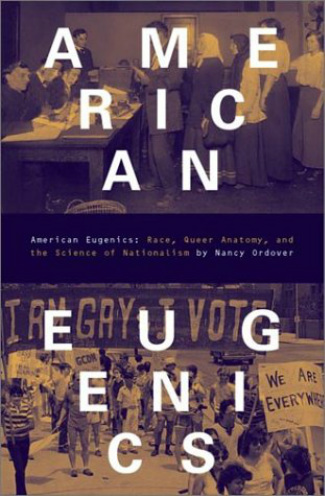 Eugenic thinking is woven into the fabric of American society Eugenic thinking is woven into the fabric of American society Tags: biology, bodies, class, crime/law/deviance, demography/population, disability, discourse/language, gender, health/medicine, immigration/citizenship, intersectionality, lgbtq, nationalism, prejudice/discrimination, race/ethnicity, science/technology, sex/sexuality, institutionalized discrimination, eugenics, subtitles/CC, 11 to 20 mins, 21 to 60 mins Year: 2012; 2013 Length: 15:05; 17:25 Access: YouTube (clip 1; clip 2) Summary: The eugenics movement has a long history in the United States. A popular misconception is that eugenic thinking and the associated practices were uniformly abandoned after the Third Reich's genocidal intentions were laid bare at the end of the Second World War. In point of fact, eugenic ideologies and practices have been recalcitrant features of American social institutions right up until the present day. In her book American Eugenics: Race, Queer Anatomy, and the Science of Nationalism, Nancy Ordover remarks on the resiliency of the ideology, "Eugenics..is a scavenger ideology, exploiting and reinforcing anxieties over race, gender, sexuality, and class and bringing them into the service of nationalism, white supremacy, and heterosexism." In earlier decades eugenicists could openly discuss stemming the "overflow" of immigration, as an effort to "dry up...the streams that feed the torrent of defective and degenerate protoplasm." The language of eugenics would eventually change, but the core ideas have remained; socially deviant groups and socially undesirable conditions are seen by eugenicists as biologically determined. The above clips are news stories, which draw attention to two recent manifestations of eugenics policy. The first clip chronicles the experience of an African American woman who was legally sterilized in the late 1960s in North Carolina after giving birth to her first son. The clip reports that between 1929 and 1974 approximately 7,600 North Carolinians were sterilized for a host of dubious reasons, from "feeble-mindedness" to "promiscuity." But while North Carolina's victims included men, women, and children, Ordover's research points out that the victims were overwhelmingly women and African American (by 1964 African Americans composed 65% of all women sterilized in the state). The first clip, then, is an example of how eugenics became institutionalized with the force of law, but the second news clip examines a case of institutionalized eugenics in California, which existed without the explicit consent of law. In 1909 California became the third state to pass a compulsory sterilization law, allowing prisons and other institutions to sterilize "moral degenerates" and "sexual perverts showing hereditary degeneracy." By 1979, when the law was finally repealed, the state had already sterilized as many as 20,000 people, or about one-third of the total number of such victims throughout the United States. One learns from the news clip that between 2006 and 2010, 148 women were sterilized by doctors who continued to be guided by the precepts of their eugenic ideology. Submitted By: Lester Andrist 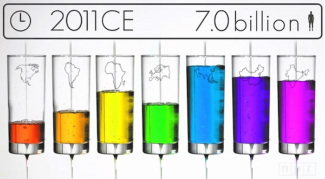 This video explains ebbs and flows in global population. This video explains ebbs and flows in global population. Tags: abortion/reproduction, demography/population, world population, 00 to 05 mins
Year: 2010 Length: 2:58 Access: YouTube Summary: Population growth is a difficult subject to explain to students. This is a great short video that explains some of the subtleties of global population increases simply and with some fun visuals (and even better sound effects). The video explains how the global population increased in size incredibly rapidly in recent history and offers some suggestions for why that increase is likely to slow in the coming years. The video discusses advances in medicine and agriculture as part of what's at work here: accounting for fewer deaths and longer lives. But, the video does not suggest any ways to stave off the number of births. While they do provide the UN project of 10 billion, they don't quite explain how and why population growth will slow. It's a great video to begin a conversation about demographic change and global population. But, it requires a discussion of dual forces at work: (1) social and technological advances that help keep more of us alive longer and (2) social and cultural factors that cause us to have fewer babies, in part—though not entirely—due to various social and technological advances. If births didn't slow down, it's likely we'd already have overfilled the beakers. Discussing the social and cultural forces that work to help people decide to have fewer babies is also part of this conversation and well worth exploring after the video. For other clips on The Sociological Cinema that explore the challenges associated with a world population of 7 billion, click here and here. Submitted By: Tristan Bridges 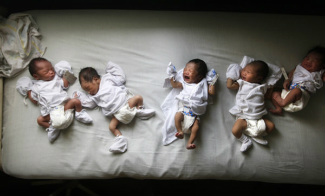 Scene from LA Times video, "The Challenge Ahead" Scene from LA Times video, "The Challenge Ahead"
Tags: abortion/reproduction, consumption/consumerism, demography/population, environment, food/agriculture, globalization, inequality, rural/urban, 06 to 10 mins
Year: 2012 Length: 5:12 Access: Los Angeles Times Summary: This short video, "The Challenge Ahead: Rising Numbers, Shrinking Resources," accompanies a five-part series from the Los Angeles Times and highlights the causes and consequences of the global population explosion. Demographers anticipate continued population growth driven by the reality that there are now 3 billion people on the planet under the age of 25, and about 1.2 billion of them are adolescents who are entering their reproductive years. Projections suggest that by 2050 there will be well over 9 billion people on the earth, and the video highlights many of the resource demands of this many people. For instance, Jonathon Foley of the Institute on the Environment asks, "how are we going to feed 9 billion people without trashing the planet?" and Joel E. Cohen notes that humans are currently consuming resources on planet earth as if the earth were about 50% more productive. The connection between consumption (and production) and population is also explored in Foley's 2011 Ted Talk, where he reports that the total area humans are currently using for agriculture is about the size of South America (16 million square kilometers), while the total area used as pasture and range land is about the size of Africa (30 million square kilometers). Humans are also currently using about 50% of Earth's fresh water, and of this share, about 70% is used for agriculture. But after connecting population growth to agricultural demands, it is only a short distance to discussions exploring the connections between population and environmental degradation, or even climate change. After all, as Foley also points out in his Ted Talk, agricultural activity is by far the largest contributor of greenhouse gases. Thus "The Challenge Ahead" is an excellent teaser for any introduction to the field of demography, and it can be used to spur discussion about the importance of the field for tackling some of the most formidable challenges of the twenty-first century. Note that The Sociological Cinema has previously recommended clips that explore problems associated with population (here, here, and here). Submitted By: Lester Andrist  Race 2012 Tags: demography/population, immigration/citizenship, politics/election/voting, race/ethnicity, bifurcated racial hierarchy, post-racial America, white privilege, subtitles/CC, 21 to 60 mins
Year: 2012 Length: 56:16 Access: YouTube Summary: This PBS documentary uses a political frame to discuss race and politics in America, taking advantage of the political significance of the election of President Barack Obama to set the background for a discussion on the history and politics of race in the United States. Race 2012 uses a nice blend of known academic scholars in political science and sociology, authors, activists, and political figures to provide a narrative on race in America today. The film provides perspectives on questions such as: 1) How do we define a racist or racism? 2) What does a changing minority demographic and a decreasing white demographic mean for America? 3) How do political parties tailor their political platform around an implicit racial narrative? and 4) How are non-Black minorities racialized and positioned within a bifurcated white/black racial hierarchy? Other important themes include contrasting early 20th century discourses around government assistance, which were framed as “nation building” policies and largely benefited whites, with current discourses around government assistance (or “welfare”) which are framed as “handouts” and are believed to largely benefit minorities, despite many whites also receiving these entitlements. The relevance of race in the construction of both a Republican and Democratic party identity is discussed in light of the changing racial demographic in America and persistent explicit and implicit anti-minority sentiments. This documentary would be a nice addition to broad discussions of race in the classroom as it provides both a historical and contemporary perspective on race. It also illustrates the ways that seemingly “race neutral” policies get coded with racialized meanings, and how these racial codes benefit and stigmatize racial groups differently. The documentary can also be useful for more specific discussions on race, demographic shifts, and political narratives, and the implications of these shifting demographics on the future of U.S. electoral politics. Submitted By: Shanna Brewton-Tiayon, Doctoral Student, University of Maryland |
Tags
All
.
Got any videos?
Are you finding useful videos for your classes? Do you have good videos you use in your own classes? Please consider submitting your videos here and helping us build our database!
 |
 RSS Feed